
Greenhouse innovations driving productivity and efficiency
By John Fitzsimmons
When updating an existing production site, or building a new one, an increasingly challenging environment needs to be considered. Greenhouses are therefore usually the option of first choice. But what are the emerging options for this path?
Greenhouses have long offered obvious benefits for commercial plant growers – a more suitable, stable and controllable growing environment for the crops in question. Optimised climate management can reduce energy consumption by up to 30% while increasing propagation success rates by up to 20%.
Apex Greenhouses’ Scott Featherston confirms that increased production and improved quality are major drivers of greenhouse upgrades. ‘Everyone is looking for something special; automation is a big one driven by the high cost and scarcity of labour, and energy efficiency,’ he said.
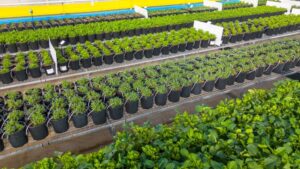
For many growers the first step is the beginning of a sustained learning curve, a path that often leads to adaption/modification of structures and internal systems, and improved management of the system/s to optimise outcomes for the enterprise and its plants. Scott says many Australian greenlife growers are moving from fully manual systems to labour-saving benching systems – manual, semi-automatic, even fully automatic.
Three key common factors currently drive the pace and direction of intensive plant growing environments today. The first two, as observed above, are the availability of labour and the cost of labour. Hort Journal Australia has reported and commented many times now on how progress is changing the number and type of people needed to work in our industry. ‘Green skills’ and semi-skilled manual labour are still needed but not in the same historical way. Thirdly, the cost of inputs, especially energy, are all linked closely to profitability, even viability.
Automation: logistics, systems, control
The most relevant solutions are increasingly found in automation of both internal logistics, and of systems management and control. Automation of manual tasks has long been an option. However the most recent labour and skills shortages, and increased labour costs, in the greenlife industry have accelerated the need and lifted the payback potential of automation, even in smaller enterprises.
The automation of systems management (including decision making) and control has quickly moved to the fore in recent times largely due to advances in computer power, sensors, activation technology, the arrival and accessibility of artificial intelligence (AI), and the development and integration of useful specialist computer programs. This is especially so in terms of management of water/irrigation and nutrient supplies. It is now going the same way with pest and disease control, as we will see below.
Better structural materials
Technical advances in structural materials (plus availability and cost-effectiveness) have also quietly kept pace, meaning the job of climate control via structures and management technologies has also steadily evolved in parallel with the more visible developments.
Of course the overall designs of greenhouses and their ventilation systems have enjoyed a long and continuing evolution. Professional specialist greenhouse companies have always aimed to provide the most suitable solution for the plants being grown. They will consider structural dimensions (especially height), siting and orientation, style (e.g. Venlo, widespan, round-arched), materials (of both the frame structures and cladding) and ventilation systems.
Obviously the internal growing and logistics systems must also be given high consideration – growing in-ground, at floor level or on benches (moveable or fixed), in bulk growing media or pots, hydroponically (many alternative approaches) or otherwise, and so on. Energy sources, management and conservation are also high on the agenda these days as a key part of overall operating costs
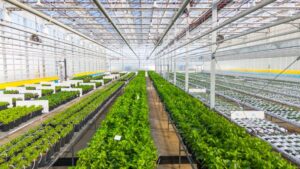
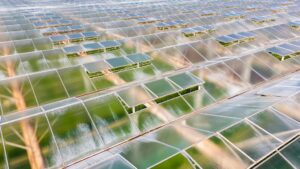
So, to illustrate, let us look at some diverse but relevant innovations and developments. To paraphrase an old motor oil advert ‘glass ain’t glass’. Low iron chemistry results in a clearer product with higher Visible Light Transmission (VLT), up to 96% or more, while the latest anti-reflective coatings also contribute to more uniform light transmission which contribute to greater climate stability in the greenhouse.
Scott says, that while better materials can come at a price premium, superior glass prices have tended to flatten lately as they become more mainstream.
Some films can be specified to block or redirect light at specific wavelengths to benefit different crops. In certain climates anti-condensation coatings inside the greenhouse can also be beneficial. Most of these options are available at new-build stage, some can also be retro-fitted.
‘Self-cooling’ glass reflects heat while maximising light transmission. The working life of films and coatings varies between products. Biodegradable greenhouse plastics can perform a task while also reducing waste.
Various silica aerogel insulated panels can combine high insulation and light transmission values with durability and light weight. Trade names include Lumira and Enova.
If glass is not used, then there is a wide range of alternatives available including various polycarbonates and acrylics. Some materials are even available in double-, triple- and even quad-wall forms, beneficial in situations where energy conservation is a requirement. The life expectation of these materials is usually regarded as decades depending on the quality of the material, local climate, any coatings applied and maintenance.
Poly houses have been utilised for a long time now. While their lifespan is usually shorter than acrylics or glass, there have also been many recent advances including films of varying longitudinal thickness with extra strength along fixing lines, films having different reflectivity and light transmission characteristics, and different use-oriented structural formats.
New materials, new designs
Notable among the latter is the Vento® tunnel which features manufactured ventilation holes longitudinally along the poly house apex. These holes are covered by a reflective strip which allows the venting of hot humid air from the house while preventing the ingress of rain. The concept has now also been extended to similarly structured side curtains to further enhance effective ventilation.
Even in glass-clad houses venting of heat-laden humid air can now go to the extreme of a ‘cabrio’ format – completely open-topped if needed.
Partnering with suppliers
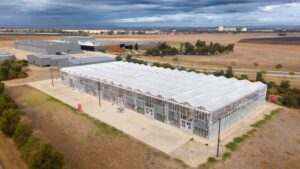
In any situation, discuss your needs with your specialist supplier/s. Compared to the rest of the world, Australia has a small but competitive greenhouse supply sector with some now beating the big international companies. For example, Apex has built for Ball Australia and Boomaroo Nurseries and recently completed a 20-ha house in northern Victoria plus an advanced new facility for Provenance Propagation near Grafton (NSW). ‘Service and support, and value, are probably the biggest factors in choosing a greenhouse partner,’ Scott observed.
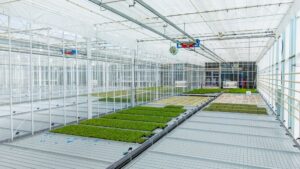
Internationally, the competition is intense with some companies holding patents over critical innovations. For example, KUBO aims for a stable greenhouse climate and efficient use of resources (energy, water, CO2) with its UltraClima® designs. This can see air intake volume, temperature and humidity managed and controlled via a high-volume intake chamber along one side of the greenhouse and vented by engineered conduits and high-capacity fans opposite. An even air crossflow helps maintain a healthy crop. This idea is already at work in Australia.
Energy efficiency – the new focus
Energy efficiency is a major focus for greenhouse designs. Greenhouses utilise radiant heat energy from the sun; it is logical to also harness solar energy to drive the greenhouse’s fertigation pumps and other mechanical systems. While familiar solar panels can be sited around or near the greenhouse, they cannot be placed on the roof, as in houses or factories, because the interruption of light and solar warmth would be self-defeating. But what if solar panels were transparent?
Currently, solar panels use silicon and have a practical efficiency of about 23% in converting light into energy; the theoretical potential is up to perhaps 33%. However, when combined with a mineral called perovskite (calcium titanium oxide) that potential increases to 47%! Recent research developments in the UK suggest that perovskite cells, which are very thin, might even potentially be sprayed on to windows (e.g. greenhouses!?) or vehicle roofs. Even if greater power is needed to power greenhouses or vehicles there is promise in this of supplemental power to maintain battery charge or extend ‘range’. The combined silica-perovskite panels are estimated to have the potential to reduce the cost of electricity production by up to 10%. Of course extending this research into the real world, including consideration of environmental impacts associated with manufacture and the service life of such panels, is still a work in progress.
Perovskite was first discovered nearly 150 years ago and inorganic mineral compounds with the same properties have since been identified. The emerging future possibilities however are remarkable.
At more of a systems level, ‘combined heat & power’ (CHP) or ‘cogeneration’ setups are high-efficiency integrated energy systems that simultaneously generate electricity and capture waste heat for productive use. CO2 as a by-product is, of course, utilised by the plants.
Like many of our contemporary houses, ‘heat pumps’ are also candidates for modern greenhouses. Australian vegetable industry research has considered the physical and financial feasibility of adopting heat pump and associated technologies in greenhouses. Their low operating costs (especially if low-cost solar power is on-site) and low CO2 emissions, plus the higher efficiency of ‘moving’ heat as opposed to ‘creating’ heat, are among the benefits. The details of optimising the benefits of adoption are still being developed. The ability to reduce fuel (energy) costs, reduce the risk of fuel (in)security, and the desire to reduce carbon footprints are also factors. However, capital cost for greenhouse scale units can be high. Detailed specialist analysis of options for individual sites and circumstances is recommended.
LED lighting is also growing in adoption for reasons of both improved productivity and of significant energy savings.
Cameras, sensors, drones
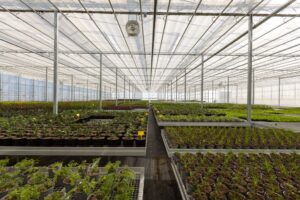
Also in the ‘emerging present’ are an amazing range of cameras, sensors and drones. A Dutch startup is now offering PATS-C with Trap Eye™ – cameras that continuously monitor airspace in the greenhouse for early detection of flying insect pests, replacing weekly inspections of sticky traps. Using AI, the insects’ sizes, speeds and flying patterns are analysed, resulting in number counts and species differentiation.
Having monitored the pests the next step is eliminating them. To this end the Dutch company is now field trialling PATS-X. Small bat-like drones are controlled by the camera system and steered into the insect pests’ flight path where they are destroyed by the propellers. After each flight, the drones return to a charging station to prepare for the next sortie. Daily data and flight reports are sent to a dashboard.
The PATS systems have been shown to work in a Dutch commercial setting with a grower producing more than 100 species of tropical green plants over 6.5 ha. The system has largely worked well because insect presence is detected early in the more vulnerable species/sections, preventing spread to other parts of the house. One grower, with 8 ha of bromeliads, has commented on the effectiveness of the PATS systems, labour savings and the biological non-pesticide approach.
Another bromeliad grower, with a 4.5 ha operation, had experienced problems with banana moth (Opogona sacchari). Pheromone traps had limited success because the moths are mostly active at night and monitoring was difficult. The damage was often severe before being noticed. Their PATS-C system tracks moth activity 24/7. The grower commented: ‘The results are excellent. We can see exactly when (moth) pressure builds and respond more effectively’. This grower mainly uses beneficial nematodes, but timing is critical. Now they know exactly when to dose: ‘Less damage, lower costs, no surprises’.
The PATS system has also been applied to counter diamondback moth (Plutella xylostella) in open fields of cabbage.
Fertigation & sanitation
While still inside the greenhouse, let us finally look at two aspects of irrigation and fertigation.
Firstly, maintaining a clean water supply is critical especially if sourcing it from non-mains supplies or if recycling nutrient solutions. Ultra-violet or ozone treatments and ultra-membrane filtration are generally considered highly cost-effective in preventing disease transmission in recirculated water, safeguarding plant health and reducing the reliance on chemical treatments. There is much information on this expanding field available from industry research and suppliers.
Secondly, consider a recent article, ‘pH vs Nutrient Availability: Rethinking the Classic Charts’, from the website, Science in Hydroponics. That article queries our traditional view of the relationship between pH and nutrient availability. It suggests most of these charts trace back to soil agronomy research from the 1930s and 1940s and are not based on solution chemistry relevant to hydroponics. It has proposed a new ‘heatmap’. Instead of arbitrary bar widths, each nutrient’s relative availability (scaled from 0 = low to 1 = high) is modelled based on actual solubility, speciation and chelation chemistry. The chart covers pH 4.0 to 8.5. The website points out this chart is not an absolute quantitative prediction and that real world systems have variations (depending on concentration, alkalinity, chelate type, etc.). However, it claims to have captured the ‘directional chemistry’ more honestly. If proven, this revelation could change nutrient formulations and costs in the industry.
In summary, climate change and extreme weather events are making greenhouses and protected cropping a better investment. New materials are making new designs possible and improving performance, whilst increasing production input costs and energy efficiency are driving material choices, designs and upgrades of internal systems. At the same time, challenges in attracting and affording suitable labour are driving increased automation within these settings – of internal logistics, crop monitoring, climate control, water and nutrient management, and decision making. Finally, AI is increasingly allied with automation, information gathering and management decision-making within, and of, greenhouses now and most likely into the foreseeable future.
All images supplied by Apex Greenhouses