
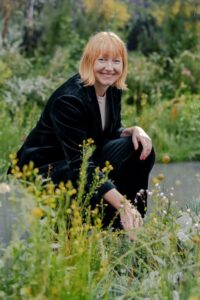
Jac Semmler: Leading a ‘Flower Power’ revolution
By Gabrielle Stannus
Female-owned and operated practices are shaping some of the most thoughtful and plant-driven work emerging in Australia today. One such practice is Super Bloom, a horticultural and planting design studio founded by Jac Semmler. Through large-scale public projects, demonstration gardens and now a new book, Jac is challenging long-held assumptions about what ornamental planting can deliver, aesthetically, ecologically and socially.
Jac Semmler’s life has always centred around plants in one way or another, ‘I was fortunate to grow up on an incredible farm in Central Victoria. I grew up in a family of plant women, and my dad worked for the Department of Primary Industry. I would collect and save indigenous seeds with him on the weekend. It was incredible to have such an idyllic kind of childhood, however, I never realised that you could be a gardener as a career. It really was not spoken of, that you could be a professional gardener or even landscape architect. If you got high grades, you were encouraged to be a doctor or a lawyer.’
So, after completing high school, Jac decided to study outdoor and environmental education in Bendigo. During that time, Jac worked for Marilyn Sprague at Goldfields Revegetation, who she describes as an amazing plant woman, ‘She is such a preeminent expert on Australian plants. To have that kind of foundation was amazing.’ After finishing her studies, Jac worked in outdoor education with young people at risk for several years. She then moved to Alice Springs where she worked for the Centre for Appropriate Technology, an indigenous science and technology company, before moving to South Australia where she worked with the Department of Environment, Water and Natural Resources on a project with farmers.
Having landed in Adelaide, Jac then took up studies in landscape design followed by horticulture, pursuing her ever-present passion for plants. She then started working with the Diggers Club, Australia’s largest gardening club with more than 80,000 members nationwide, at its Adelaide Botanic Gardens site, eventually becoming its Ornamental Category Manager, and leading that enterprise’s ornamental gardening, strategy and selection. Several years ago, Jac took the plunge and started Super Bloom, a plant practice providing specialised horticultural and planting design services and strategy to projects seeking to bring plants to the people.
Plant philosophy
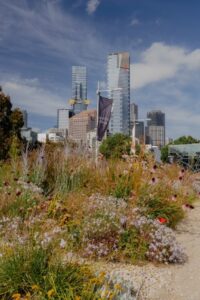
Jac says she and the Super Bloom team are big believers in what she eloquently describes as ‘multidisciplinary teams for planting dreams’. They have brought their plant design, strategy and processes to some exemplary public realm projects bringing beauty to our cities, including ‘Green Our Rooftop’, a demonstration retrofit green roof at 1 Treasury Place in Melbourne, jointly delivered by the City of Melbourne and the Victorian Government. More recently, Super Bloom are part of the Design team led by Hassell for the development of the 18,000-square-metre Laak Boorndap garden that will be built in the Melbourne Arts Precinct, including its proof-of-concept test site at Fed Square.
‘I am a passionate believer in accessibility of plants, and accessibility of the plant world,’ Jac says, ‘A lot of the work that we do at Super Bloom is in the public realm. We are fortunate enough to work on major projects that are plant-driven, are all about plants at a great scale, and for people. We believe that plants are these incredibly nuanced, multidimensional subjects that offer so much to not only the environment, but also to the public experience. We can have beautiful plantings that are climate resilient and support ecology; it is not just one or the other. That is a real core to how we work at Super Bloom, we believe that the seeing is believing. So, being able to demonstrate the possibilities of plants and what diversity and resilient beauty can look like is essential.’
To help create that resilient beauty, especially in response to climate change, Jac would like to see a broader range of plants available on the market, ‘I think too often we are working with very small palettes in the nursery industry and as practitioners as well. We really need to be bold in the palettes that we work with that are climate resilient and offer wonder through all our seasons.’
Dry-climate plants of wonder
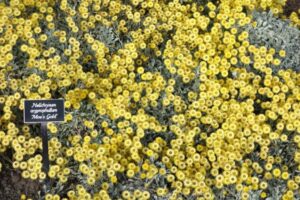
Jac’s message to growers is that there is a diverse range of dry-climate compatible perennials, sub shrubs and succulents that are could be produced for our gardens, including Australian, Californian and South African species, ‘I just feel like there is this incredible array of plants out there. Breeding the same species into multiple cultivars or hybrids has its place, but expanding species diversity is essential if we want to offer the public something genuinely diverse. Boutique growers are producing some of these species, such as Helichrysum argyrophyllum (golden guinea everlasting) and Echinacea tennesseensis ‘Rocky Top’. However, it would be incredible to see them more widely adopted.
‘When it comes to wholesale growers, we are really looking to them for that unique range of climate-compatible, wondrous species. We see a lot of opportunity for dry climate plants. For example, when we think of South African species, it is not just the protea family; there are all these other plants, including perennials, that are not really being considered, yet they offer a lot of wonder in the garden. There is such an opportunity to really lean into our climate. Gardeners are really considering dry tolerant plants, but it does not need to be without beauty. We do not want to see new cultivars and hybrids of gazanias; we want to see other species.
‘For example, there are so many incredible kinds of Ceanothus (Californian lilac), yet we have very few of them regularly available in our marketplace. We have got such an incredible diversity of Australian species. It would be great to see more of them in all their iterations, not just the larger shrubs and trees, but everything else. For example, Podolepis jaceoides is an amazing local species that has big open yellow flowers.’
‘We want to raise the bar and expectations of what planting could and should do. We are really interested in human level planting, so things that people do and see every day. There have been wonderful efforts by our cities to consider the canopy, so naturally that next question is the human level planting. What happens below in our every day that has that direct communion with people that is really of the same scale. And so, we have had a proud focus on that in Flower Power.’
Flower Power
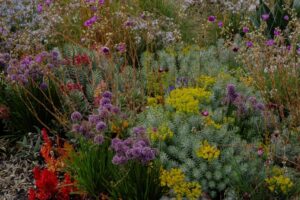
Flower Power: Designing Gardens for Year-Round Wonder, Jac’s third book, had its international release at the start of this month. She says that whilst her previous book Super Bloom provided the ‘ingredients’ to help create a garden, Flower Power shares the ‘recipe’, offering practical guidance to both professional designers and amateurs alike on how to compose a planting design that creates an immersive and floral wonderland, all year round.
‘What has been so incredible about releasing Super Bloom into the world, is that it has spoken of the wonder of plants to all kinds of audiences from practitioners, designers, landscape architects, but also to the public who have a hunger for beauty, a hunger for a garden and plants, and to be connected to nature. And it really posed the question, “If I want to have a plant-driven garden, how do I do it?” We were very purposeful in the way that we structured Flower Power so that it answers that question, so that anyone can create a personal and wondrous plant-driven garden using the approach we lay out in the book.’
In Flower Power, Jac argues that plants are the main event in a garden and should be treated as the central characters in our spaces when designing a garden for year-round interest. She encourages us to follow the lead of plants and consider gardens as ever-changing places that flourish and grow over time, rather than just establish and survive. She says there is a role for both static (permanent) and dynamic (temporal) plants in the garden; for example, a succulent can provide year-round structure, whilst a bulb will come and go. Planting this way provides a garden with year-round, and successional seasonal, wonder, and even more so if it includes a wide variety of plants.
A few of her favourite things
With Flower Power’s companion Super Bloom containing 75 plant profiles from Achillea to Wahlenbergia, it is no wonder it is hard for Jac to narrow down her list of favourite plants for bringing shape, colour and beauty to a garden. However, when pressed she does admit to a soft spot for annuals.
‘Obviously, it is no surprise that I love annuals with a business name like Super Bloom! I really love annuals for their ephemeral quality, that they can come and come again, especially working in public spaces. For example, a lot of the incredible rhodanthe have this textural quality that the public love. People just love their tactility, the sound of their ruffle when you brush your fingers over the petals. I think they are such an amazing Australian annual.’
Perennials, herbs/forbs and succulents also get a big tick of approval from Jac, ‘I think Wahlenbergia stricta is amazing; that blue bell, how it rolls in the landscape, that is really incredible. I like the silver quality of Echeveria ‘Cante’ (white cloud), Themeda triandra ‘True Blue’ (Oh God, this kangaroo grass is so good!). Aloe stricta has got this very interesting form and colour. Calandrinia or Cistanthe grandiflora is an amazing Chilean plant with big purple flowers that float above its foliage. And I think all the new colours of kangaroo paws that are coming through, with coral and tangerine tones, are amazing.’
Edible and ornamental
Given that the theme of our last issue (February 2026) was ‘Edimentals: Beauty with purpose’, I just had to ask Jac for her recommendations for plants that are both ornamental and edible.
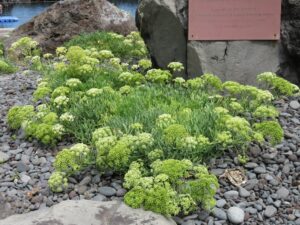
‘That is what I love about ornamentals. I do not think they are exclusive. I love that theme so much. It does not need to be one or the other,’ Jac responds, immediately suggesting rock samphire (Crithmum maritimum). Popular with sailors in the 17th Century, this seaside native is high in Vitamin C and was pickled to preserve it for long voyages. As well as being edible, it is also a striking drought-tolerant ground cover. Jac also suggests other resilient Mediterranean herbs such as Greek mountain tea (Sideritis syriaca), a groundcover with felted silver foliage and yellow-flowering spikes in spring, whose leaves can be made into a tea said to be high in antioxidants.
‘Australian natives like Arthropodium milleflorum (pale vanilla lily) and Arthropodium strictum (chocolate lily) are incredible in what they do in plantings, and they both have edible tubers,’ Jac adds, and a bonus, the chocolate lily has a distinctive perfume of, yes you guessed it, chocolate on a warm day.
See for yourself!
If you are as intrigued by Jac’s planting philosophy and her work as I am, then I encourage you to seek out one of her books for further information and inspiration.
Alternatively, you can see Jac in action at this year’s Melbourne International Flower and Garden Show. Together with Jane Caught from Heliotope Studio and Michael Casey from Evergreen Infrastructure (a regular contributor to these pages), Jac and the Super Bloom team are creating the ‘Plant Futures’ demonstration garden at this iconic horticultural event. This garden will showcase a vision for public planting in Australia’s changing climate, and include low-water plantings, a modular system and biodiverse design, which Jac and her partners hope will delight the public, challenge industry and advocate for what is possible. I say all (flower) power to her!
More information: www.thesuperbloom.com.au
Gabrielle Stannus
Inwardout Studio
M: 0400 431 277
E: gabrielle@inwardoutstudio.com.au
W: www.inwardoutstudio.com.au