
![Old man saltbush (Atriplex nummularia) near Hay, New South Wales (Image: Thomas Mesaglio [thebeachcomber] via iNaturalist, CC BY-SA 4.0)](https://hortjournal.com.au/wp-content/uploads/2026/03/1.-Atriplex_nummularia_Thomas_Mesaglio_iNat_CC-BY-SA-4.0-300x225.jpg)
Atriplex: A story of saltbush
By Clive Larkman
In my last article, ‘Saltbushes of the world’, I wrote about halophytes including mangroves, samphires and saltbush (Hort Journal Australia, February 2026). Like mangroves and samphires, saltbush occurs around the globe in a diverse range of climatic conditions. All three of these plant groups are tolerant of saline ecosystems. The term ‘saltbush’ in general covers plants from five genera across two families including Chenopodium, Enchylaena, Rhagodia and Sarcobatus (all covered last issue), and the largest genus, Atriplex, which I will now explore.
Atriplex is in the Amaranthaceae1 and is thus related to the amaranth (Amaranthoideae) and beet (Betoideae) subgroups of edible plants. As a genus, Atriplex was first described by the father of plant nomenclature, Carl Linnaeus, in the mid-eighteenth century. This genus currently consists of approximately 260 species, including over sixty found in Australia, with many plants commonly referred to as ‘saltbush’ or ‘orache’ (or ‘orach’). Those species known commonly as orache include garden orache (Atriplex hortensis), spear orache (A. patula) and thin-leaved orache (A. prostrata). The saltbushes include coast saltbush (Atriplex isatidea), big saltbush (A. lentiformis), old man saltbush (A. nummularia) and many more.
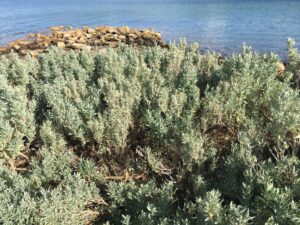
The genus Atriplex is highly variable and is found on all continents except Antarctica. Many are halophytes that come from desert coastal environments, although some inhabit moister and more temperate environments. The name ‘saltbush’ derives from the fact that the plants retain salt in their leaves, which is a result from growing in areas of high soil salination. The leaves are arranged alternately along the branches and are usually a distinctive silver-grey to bluish-green, although some species have produced red or purple-leaved cultivars. The leaves often have a scaly, mealy or hairy surface. Some species of Atriplex have quite fleshy leaves, which range in shape from elliptical to triangular.
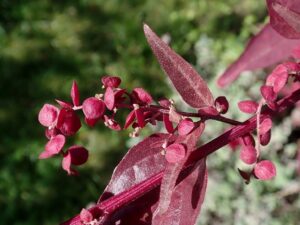
This genus includes annual and perennial herbs, spreading subshrubs and shrubs. Some species are quite large and make excellent hedges, e.g. old man saltbush. Others are used as dryland fodder for grazing of stock, erosion control and coastal rehabilitation. Many have attractive silver foliage and make excellent ornamental plants for houses in drier climates. Atriplex will grow and flower best in full sun but can tolerate a reasonable amount of shade. Well-drained soil is preferrable but not necessary.
Many Atriplex species have also experienced a resurgence in their usage for culinary purposes, with chefs favouring their salty, edible leaves in contemporary cuisine. Three of the most popular culinary varieties are:
Garden orache (Atriplex hortensis): An old culinary plant used as a substitute for spinach in warm, dry climates. It can be steamed as a tangy, leafy green vegetable, tossed into stir-fries or added to soups.
Grey or coast saltbush (A. cinerea): This plant’s leaves add a salty tang to dishes and are used in salads and stuffing, or as a bed for baking or grilling light meat such as seafood and chicken. The leaves can be deep-fried or air-fried, making healthy, salty chips.
Old man saltbush (A. nummularia): Like A. cinerea, the leaves add a salty tang to salads and stuffing and can be used as a bed for baking or grilling light meat like seafood and chicken. Old man saltbush can also be dried and ground, and used as a replacement for salt.
If you are looking to add an Australian touch to your next barbecue, add the following ingredients to dried saltbush leaves: smoked paprika, ground cumin seeds, ground coriander seeds, toasted macadamias and dried pepper berries. Grind these ingredients together and then rub into the meat you would like to barbecue, e.g. lamb, before leaving it to rest overnight. Cook on a hot grill the next day.
Editor’s note: In the article ‘Saltbushes of the world’ (Hort Journal Australia, February 2026), Atriplex, Chenopodium, Enchylaena and Rhagodia were described as belonging to the Chenopodiaceae. Since the Angiosperm Phylogeny Group (APG) IV (2016) reclassification, Chenopodiaceae is no longer recognised by some taxonomists as a separate family, who now treat it as part of the Amaranthaceae (subfamily: Chenopodioideae)2. However, some Australian floras and industry references still retain Chenopodiaceae for continuity and ease of use, meaning both classifications are currently encountered in professional literature.
References
- Zerdoner Calasan, A., Hammen, S., Sukhorukov, A.P., McDonald, J.T., Brignone, N.F., Bohnert, T., & Kadereit, G. (2022). From continental Asia into the world: Global historical biogeography of the saltbush genus Atriplex (Chenopodieae, Chenopodioideae, Amaranthaceae). Perspectives in Plant Ecology, Evolution and Systematics, 54, p.125660.
- Angiosperm Phylogeny Group. (2016). An update of the Angiosperm Phylogeny Group classification for the orders and families of flowering plants: APG IV. Botanical Journal of the Linnean Society, 181(1), pp. 1–20.