Building living infrastructure
Why more women are choosing trade pathways
By Michael Casey
If you have spent any time on a green roof installation, a streetscape retrofit or a living wall maintenance visit, you will have noticed the shift: crews are changing, conversations are changing, and so is what ‘good trade work’ looks like in green infrastructure, which matters because the work ahead is significant.
Cities are getting hotter, rainfall is arriving in sharper bursts, and too many suburbs still behave like heat sinks and hard drains, so greening our cities is not an aesthetic extra anymore. It is performance infrastructure that delivers cooling, shading, stormwater moderation, habitat, human health and comfort, and like any infrastructure it only works if it is built properly and then maintained well over time.
Green infrastructure is not just designed in studios and celebrated in renders; it is assembled, installed, commissioned, tested, repaired and managed in the real world.
It relies on people who can read drawings, understand interfaces and tolerances, work safely at heights, coordinate across trades, and deliver a living system that keeps performing long after project handover. When you frame it that way, it becomes easier to understand why more women are looking at trade-facing roles in this space and seeing something genuinely appealing. The work is skilled and purposeful, outcomes are measurable, and it is increasingly supported by better systems and technology rather than being framed as purely labour-intensive and reactive.
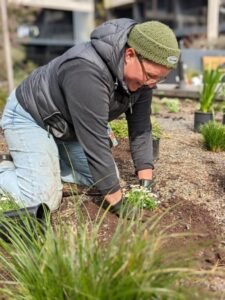
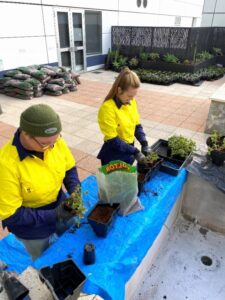
One of the strongest drivers is visible purpose, because there is a particular satisfaction in being able to point to a roof garden, a raingarden, a green wall, or a shaded pedestrian link and say, ‘I helped build that, and it is making the city more liveable’, with outcomes you can actually see in cooler surfaces, healthier plants, improved amenity, and even in how people use a space differently once it has shade, comfort and greenery. In our own team at Evergreen Infrastructure, we have reached a 50–50 gender balance, and most of the women coming through are entering via internships, which tells me the appetite is there when the pathway is visible and the work feels meaningful. One of our team members, Stella Hinrichsen, captured that sense of fit in a way that is hard to ignore because it is grounded in a real place and a real moment: ‘I realised that green infrastructure was the right fit for me during moments spent working on one of our most beautiful green roofs in Kensington – being out there, high up in the early morning among plants, birds and bees as the sun rises above Melbourne. I love the concept of greenery in an urban context as it changes the atmosphere and wellbeing for everyone, for people as well as for animals and other organisms. It is very rewarding to contribute to this through my daily work.’
We are also seeing career changers arriving from environmental science and social science backgrounds, which is telling because it suggests people are looking for roles where values and outcomes line up, and where they can move closer to delivery than policy or theory while still using systems thinking, ecology, human behaviour and community insight as practical tools. Living infrastructure sits right at that intersection. It is technical and measurable, but it also changes how a city feels at street level and how people experience daily life in public space, and that combination can be a powerful draw for those who want their work to be both hands-on and socially useful.
Another reason trade pathways are attracting more women is that green infrastructure offers clearer skills progression than many people realise, because ‘trade’ in this space is not simply manual labour. It is about competencies, compliance tickets, verified capability and responsibility that grows with experience in a way that is visible and motivating. Safe roof access, working at heights, elevated work platforms, irrigation competency, water management, reading and interpreting construction documentation, waterproofing awareness, plant health diagnostics, integrated pest management and system commissioning are all skills that can be learned, assessed and built on. For many people choosing a new direction, that clarity matters because it creates momentum. You can see the pathway from new starter to competent installer, from competent installer to leading hand, from leading hand to supervisor, and then onward into site or contract management, or into specialist streams like irrigation, green roof maintenance, quality assurance auditing, or defect rectification, where deep knowledge and consistency become the value that you bring to the team.
Entry points are diversifying too, and that diversity is one of the most practical reasons why participation is rising, because pre-apprenticeships and targeted short courses let people try the work without needing to commit to a multi-year pathway on day one. Micro-credentials and traineeships can bridge knowledge gaps quickly, particularly for people crossing over from nursery production, horticulture, landscaping, facilities management or environmental roles. This cross-over matters because so much of a project’s success is determined by the interface between construction and horticulture, and when someone understands plants as living systems while also understanding documentation, sequencing and site realities, they lift outcomes for everyone and improve the likelihood that a project will still be performing years after handover.
It also helps that the work itself is evolving away from the brute-force stereotype. While there are still physically demanding days, green infrastructure is increasingly supported by better technology and better planning, with safer gear, improved lifting aids, smarter logistics and more deliberate site planning changing what the day-to-day looks like and how teams manage risk. Digital quality assurance (QA) systems are becoming more common, which lifts professionalism and reduces the ‘it’ll be right’ culture that causes failures later. Irrigation controllers and monitoring tools are improving in ways that push the work toward diagnostics and performance rather than just installation, particularly on green walls where water delivery, plant health and microclimate are closely linked and small changes can have big consequences. As Stella puts it, ‘People are surprised how much consideration goes into monitoring, adjusting and fine tuning our irrigation systems, in particular for green walls. Quite a few different factors can affect the entire system, which can make the whole process both challenging and rewarding when everything comes together.’
And then there is the machinery, which is not a throwaway detail because it speaks to how modern the work can feel. The first time someone operates an elevated work platform, sees a truck-mounted crane lift a pallet of substrate, or watches a tight rooftop delivery land exactly where it needs to be, it can be a genuine wow factor, especially for career changers coming from office-based roles who suddenly find themselves in a world where precision, planning, safety and the right equipment make the work feel skilled rather than rough and improvised.
Participation does not increase just because the work is meaningful or the pathway is clear; it increases when the industry makes practical shifts that remove friction and make good people want to stay. Mixed crews matter, not as tokenism but as the norm, because when women are consistently present across projects the ‘exception’ dynamic disappears and the job becomes what it should be – a team delivering outcomes. Clear site expectations set by project managers and forepersons matter too, because site culture is not a side topic, it is a safety and performance issue, and respectful communication, professional behaviour and clear reporting pathways should be as standard as personal protective equipment (PPE) checks. Training that leads to work immediately is critical as well, because paid placements and structured site rotations solve the experience catch-22 that keeps capable candidates out, and because green infrastructure is broad enough that early exposure often reveals where someone’s strengths really sit.
Mentoring is a big part of that retention story, and it is often the difference between someone ‘trying it out’ and someone deciding they belong here. When new starters can see people like them thriving in the work, women leading crews, running QA, diagnosing irrigation issues, coordinating rooftop logistics, or stepping into supervisor and contract roles, it turns an abstract possibility into something real. Good mentoring also translates the invisible rules of construction sites: how to communicate with other trades, how to manage risk without losing confidence, how to ask the right questions, and how to learn from mistakes without being defined by them. Role models do not need to be perfect; they just need to be visible, capable, and generous with what they know, because that is how confidence becomes competence, and competence becomes leadership.
Another drawcard is making career ladders visible and believable, because the pathway from labourer to leading hand, supervisor, site or contract manager should be described plainly, supported with training, and reinforced by how responsibility is allocated. Specialist streams should be celebrated rather than treated as second tier. A highly competent green roof maintenance lead, irrigation diagnostician, or QA auditor is not ‘just maintenance’; they are protecting an asset and ensuring it performs, and in living infrastructure that role is often the difference between a project becoming a case study or becoming a complaint.
When you pull all of this together, you can see why more women are choosing trade pathways into building greenery into the built environment, and it is not because the work is ‘easier’ than other labour-intensive roles. It is because the work is increasingly smarter, more structured, more purposeful and more connected to long-term outcomes, offering a career that combines hands-on achievement with technical progression while sitting at the intersection of climate response, public health and better cities. And that is exactly the kind of workforce we need if we are serious about making urban greening perform where it matters most – on the ground, on the roof, and through the long life of the asset.
Michael Casey
Director, Evergreen Infrastructure
Company Director, Australasian Green Infrastructure Network
Technical Panel, AIPH World Green Cities Awards
World Ambassador for World Green Roofs Day
E: michael@evergreeninfrastructure.com.au