
Plants that purify
How indoor greenery generates negative air ions
By Dr Peter Irga
Did you know that the air in your home or office might be missing something found in forests and waterfalls – negative air ions (NAIs)? These naturally charged particles can help remove pollutants from the air. New research at the University of Technology Sydney (UTS) explores how common indoor plants could boost NAI production and naturally improving indoor air quality.
What are negative air ions?
Negative air ions (NAIs) are oxygen-based molecules that have gained an extra electron. They occur naturally around waterfalls, forests and after lightning storms; places we often describe as having ‘fresh air’. Research has shown that environments with more than 1,000 ions per cubic centimetre are associated with cleaner air because negatively charged molecules or atoms can electrically charge airborne particles, like dust, and remove it much more efficiently. Unfortunately, indoor and urban spaces typically have far fewer ions than this healthy threshold. Commercial ozone-based NAI generators can artificially increase negative ion levels, but they often produce harmful ozone as a by-product, posing respiratory and environmental risks.
Plants as natural ion generators
The underlying mechanisms of plant NAI generation and its potential, do however remain insufficiently studied. It has been hypothesised that the source of plant-derived NAIs originates from the electron transfer processes involved in photosynthesis and other enzyme-mediated physiological reactions. Current research indicates that the NAI concentration produced by plants is mostly suboptimal for indoor air filtration purposes, generally below 200 ions per cubic centimetre. However, not all plant species have been tested, and it is possible that environmental conditions may enhance plant NAI generation. Factors such as temperature, humidity, light intensity, and other microclimatic variables appear to influence a plant’s ability to produce NAIs. Studies have also shown that NAI levels fluctuate diurnally and seasonally, correlating with temperature and humidity, while specific species modify their NAI output in response to light exposure. Research has further established a negative correlation between NAI, particulate matter and ozone concentrations, reinforcing the role of NAIs in air purification. To date, most studies on plant-based NAI production have focused on outdoor or forest ecosystems1-3 , with limited investigation into these dynamics under controlled indoor conditions.
Exploring plant physiology and microclimates
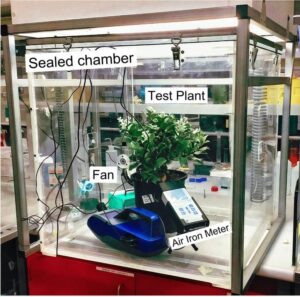
In recent UTS experiments, in collaboration with Green Design Indoor Plant Hire4 , 45 different indoor plant species were tested in a sealed environment to measure their NAI output. Plants tested included monocots, dicot woody and herbaceous species, ferns, and succulents with varying leaf sizes, shapes and surface characteristics (Figure 1). One standout performer was Spathiphyllum wallisii (peace lily). When plant density increased, the peace lilies produced significantly higher levels of negative ions – up to 1.05 × 10³ ions/cm³ per 15 seconds.
The results showed a strong link between leaf area index (LAI), essentially how much leaf surface is present, and ion generation. The more leaves, the greater the output. This was also associated with higher relative humidity, suggesting that moisture and plant transpiration play an important role in the process. Higher humidity conditions saw a peak NAI net change of 0.9 × 10³ ions/cm³, significantly outperforming the lower humidity samples, which saw a NAI net change of 0.3 × 10³ ions/cm³. This effect may be explained by the role of water molecules in facilitating NAI formation, as well as higher humidity levels enhancing plant metabolic activity, thereby increasing NAI production. Additionally, some studies propose that NAIs in humid environments tend to form hydrated ion clusters, improving their stability and longevity.
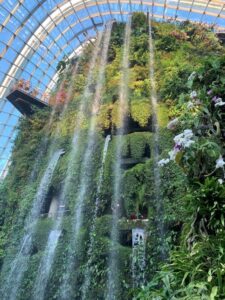
Traditional potted plant setups are limited by available floor space, especially in offices or apartments. However, vertical green walls, where plants and their growing medium are arranged vertically, can dramatically increase planting density. This not only looks spectacular but may also enhance NAI generation and overall air-cleaning efficiency. For the highest NAI production, an integrated waterfall within indoor greening would be ideal. As anyone who has visited Singapore’s Gardens by the Bay Cloud Forest, home to the world’s tallest indoor waterfalls, can attest, the negative air ion levels there are incredibly high.
These findings suggest that fleshy broad-leaved ornamental species commonly cultivated for indoor use exhibit superior negative air ion generation. Their enhanced performance likely reflects physiological adaptations to low light and high humidity environments. Future research aims to explore how plant physiology, species selection and environmental control (such as lighting and humidity) can be combined to create indoor systems that naturally generate ‘fresh air’.
It would come as no surprise to Hort Journal readers that indoor plants already offer significant psychological and aesthetic benefits, but their ability to generate negative air ions opens exciting new possibilities for natural air purification. By selecting high-performing species and optimising growing conditions, we can move closer to self-cleaning indoor environments. Try clustering plants or experimenting with vertical walls to make the air in your home or office a little fresher, naturally.
References
- Li, W., Zhao, W., Bai, B., & Xin, Z. (2024). Spatial distribution of negative air ions (NAIs) in urban green spaces of Nyingchi City, Tibet Plateau. Journal of Computational Methods in Sciences and Engineering, 24(6), 4038–4050.
- Shi, G., Zhang, J., Sang, Y., Du, L., Ni, X., & Hu, Y. (2024). Empirical analysis of the influence of vegetation photosynthetic productivity on negative air ions in forest ecosystems driven by solar radiation. Ecological Indicators, 166, 112377.
- Niu, X., Li, Y., Li, M., Zhang, T., Meng, H., Zhang, Z., Wang, B., & Zhang, W. (2022). Understanding vegetation structures in green spaces to regulate atmospheric particulate matter and negative air ions. Atmospheric Pollution Research, 13(9), 101534.
- Lyu, L., Matheson, S., Surawski, N. C., Irga, P. J., & Torpy, F. R. (2025). Indoor plants produce negative air ions: a comparison across species, temperature and humidity. Science of The Total Environment, 999, 180334.
Dr Peter Irga
University of Technology Sydney
E: Peter.irga@uts.edu.au