Grow yourself, grow the whole
By Patrick Regnault
We invest in tools, materials and vehicles for our work designing and constructing gardens, and in other horticultural businesses. However, are we investing enough time and effort in ourselves; in our health, our knowledge and understanding, our creativity? We are our most valuable asset and yet, looking around, we can see that many of us are running ourselves into the ground, not because of external factors, but because we are not placing the proper value on ourselves. Would we treat a piece of equipment this way?
Health
Good physical and mental wellbeing make us able to act efficiently and effectively, producing quality outcomes in the workplace. Physical health does not require medication or a visit to a health specialist unless necessary. Start by eating a balanced diet and sleeping well. Undertake activities that stimulate the stretching and flexing of body and mind. Participate in activities you find enjoyable, either by yourself or in a group, as well as meditation or other forms of nervous system calming techniques. Avoidance of harmful substances is critical to this too. Mens sana in corpore sano – A healthy mind in a healthy body.
Knowledge and understanding
Let me start with a quote by Mary Catherine Bateson: ‘We are not what we know, but what we are willing to learn’. Knowledge is nothing without understanding. Understanding is what allows us to use our knowledge more deeply and to apply it in a creative, flexible way. There is so much we can learn about plants and their interrelation with other organisms, substrates, air and light. Horticulture is a never-ending subject. We would need many more lifetimes to explore and master its many facets, from garden design to conservation and beyond.
Where to look
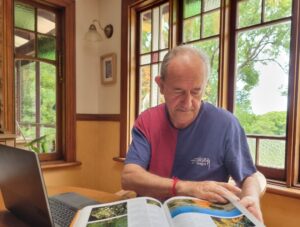
When seeking horticultural knowledge, I recommend that your first port of call be your bookshelves. Leafing through a book has a muse-like quality; one starts with something in mind and ends up learning something unexpected. Perhaps this is an old-fashioned sentiment, however, these days, reading retains its appeal, and not just for the more mature of us either. The internet also has great offerings if you know how to look for it or what to look for.
Here are some classic texts that I highly recommend if you want to increase your horticultural knowledge. Many of these texts describe methods and techniques which when understood and adapted to the present will help develop sustainable agricultural and horticultural practices. We can learn a lot from the past, and we do not need to reinvent the wheel simply to make it more performant.
De Re Rustica by Columella is a comprehensive manual on agriculture written in the first century CE. De Re Rustica is not one book but a series of twelve books or treatises on agriculture. If you are interested in organic farming and traditional practices, Columella’s work is still relevant today. The link below will lead you to a factsheet in English published by the Swedish Agricultural University of Alnarp that will give you a taste of the books’ contents and their pertinence today: https://pub.epsilon.slu.se/5472/1/lundquist_et_al_101025.pdf.
Vrikshayurveda by Surapala, a tenth century classic sharing an ancient Indian science of plant life that has echoes in sustainable practices today. The methods described here are still in use today, especially those related to pest and disease management and soil amendments and can greatly benefit small land holders. Some of the methods outlined in this text can be applied to garden maintenance as well.
Vṛkṣāyurvēda compiled by Parashara is the earliest known text on botany compiled between the first century BCE and the fourth century CE. A must of classical texts that shows us that botanical science was well advanced in other parts of the world years before the European enlightenment.
Yuanye, written by Ji Cheng circa 1630, is the first comprehensive scholarly work written about landscape architecture in the world. This book’s relevance nowadays is even more pronounced; site selection and foundation for ecological adaptation, borrowed landscape, creative use of material for effect, special organisation and the core principle ‘Created by man, yet looking as if made by nature’. You can read the article, ‘A Brief Introduction of Yuanye’, on the Land8 website: www.land8.com.
H. Ouyang and X. Shang’s article, ‘The manuring principles in ancient China from the perspective of the San Cai theory’ can be found in the Humanities and Social Science Communications journal (Issue 12, 2025). The authors present a sustainable model that addresses the ever-increasing contemporary need for more eco-friendly and efficient solutions to tackle issues such as soil degradation, nutrient imbalances and the overuse of chemical fertilisers.
For students of horticulture and landscaping
One thing to remember that will make your studies so much more enjoyable is that we do not have to learn, we simply need to engage with learning. I will keep it to three recommendations:
The Language of Botany by C.N. Debenham, seeks to bring universal clarity to botanical terms that describe plant origins and characteristics, and their relationship with other plants. You can find a digital copy of this extensive glossary on the Australian Native Plants Society (Australia) (ANPSA) website: www.anpsa.org.au
Pests, Diseases, Ailments and Allies of Australian Plants by David L. Jones, W. Rodger Elliot and Sandra R. Jones is a reference for seasoned or student horticulturists, and commercial nurseries. Common and uncommon problems suffered by Australian plants are covered and cross referenced in this book with an emphasis on natural rather than chemical control.
The Waterwise Australian Native Garden by Angus Stewart and A.B. Bishop. A well-illustrated book that contains information on designing and growing a drought-proof native garden.
Keeping our curiosity alive
When it comes to designing gardens, we cannot stick to the same old same old, unless our desire is to live in a bland and homogenous world. Ideas for gardens can come from a wide range of places. Other gardeners from across the globe can help us to see the world with fresh eyes, inspiring new possibilities. The fashion industry and other creative arts can provoke a wave of inspiration with shapes, forms and colours. Nature of course is the most awe-inspiring source; taking daily walks in the great outdoors keeps us grounded and make us see both the whole and the details of life. Perhaps we need to value what gardens bring to us – the connection to a whole integrated system, and a complex web of interconnection. Learning from it is, in a way, an opportunity for us to deepen that connection and, by doing so, be of service to that life web.
Over the Christmas holidays, take some time out to stop and ‘smell the roses’. Buy yourself that horticultural handbook you have always wanted to read but never got around to doing so. Visit a gallery or museum just because you can. Most importantly, spend a little time assessing your physical and mental wellbeing away from the hustle and bustle of your business or workplace. If bad habits are not serving you well, prune them hard now to encourage healthier growth next year.
Here’s to a happier, healthier you in 2026!
Patrick Regnault FAIH RH0062
Interactive Landscapes
E: patrickregnault@hotmail.com