
Not just a pretty flower: The edible hibiscus
By Clive Larkman
Over the years I have often written about edimental plants and how good they are for the urban garden. We all know that prior to the modern supermarket the home garden was a major source of edible plants. Once the family was able to get their basic fruit and vegetables from the local supermarket all year round, they could select plants for the garden that were ornamental. Roses, azaleas, hebe, penstemon and hundreds of other attractive plants became very popular.
Over the last decade, many people have chosen to return their garden to edible plants. Any time they can put in a plant that is both attractive and edible, they win. Some plants are both attractive and edible like citrus, rosemary, salvia and many fruit trees. Others are attractive and while edible, are not palatable. We are now seeing many plants that are truly edimental including the Tasmanian pepper bush and many species in the allium family. Another genus that meets both criteria is Hibiscus.
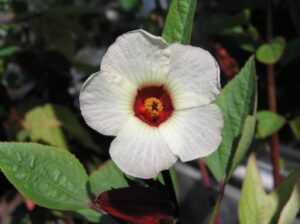
Hibiscus is a genus of flowering plants in the family Malvaceae. This is quite a large genus consisting of several hundred species that grow in warm temperate to subtropical and tropical regions across the world. Some members of this genus are small with large, showy flowers and are commonly known as ‘dinner plate hibiscus’. There are lots of medium to large hibiscus shrubs with less showy but still attractive flowers, of which about 40 species are native to Australia. There are three reasonably common hibiscus varieties that can be classed as edimentals: Hibiscus sabdariffa, Hibiscus heterophyllus and Hibiscus acetosella. All add colour to the garden and flavour to the kitchen.
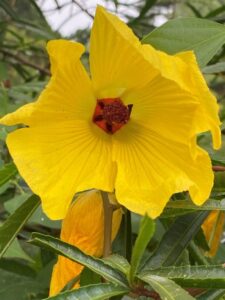
Hibiscus sabdariffa (roselle) flowers are used in tea, desserts, soups, chutneys and eaten fresh in many parts of the world. They are a good source of Vitamin C and used in many herbal remedies. Roselle is thought to have originated in western Africa then making its way to Asia and eventually throughout the world. It is almost naturalised in northern Australia and considered to have been there for ever. With this sort of distribution, variations between countries is becoming significant and they will eventually be classed as subspecies or variants. There is a great cultivar from southern USA called ‘Red Cajun’.
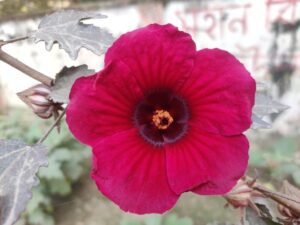
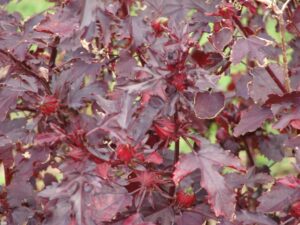
Hibiscus heterophyllus (native rosella) produces many lovely flowers over an extended period. Most parts are edible, and the bark makes useful fibres. It attracts native birds and a variety of insects, so is a useful addition to gardens where natural pest control and pollinators are desired. It is native to the northeastern coast of Australia from the Northern Rivers region in NSW to Cape York in Queensland. It prefers warm, moist environments but has been successfully cultivated in most southern states. It has many similar uses to roselle in that the flower buds and petals can be made into jams, syrups and teas. The young foliage can be used raw in salads or boiled as a vegetable. Petals can also be eaten in salads and for jam. Young shoots and roots are edible, both raw and cooked. The roots are also used as a source of carbohydrates. The bark fibre is known for its strength and was traditionally used to make items such as dilly bags and hunting nets.
The third variety is Hibiscus acetosella (cranberry hibiscus) which has stunning red foliage and flowers. The leaves have a tart taste reminiscent of sorrel which gives the plant its species name. It likes warmer climates but will tolerate the cooler weather in the southern states. Frost may scorch the cranberry hibiscus, but it bounces back quickly when warmer weather returns. It is a fast grower and has been known to put on a metre of growth in one season. It forms a large shrub with red foliage and deep red flowers in spring. It is thought to be a naturally occurring hybrid of Hibiscus asper and Hibiscus surattensis. The foliage is used sparingly in salads and as a leafy vegetable especially for its colour. The leaves are also used to make a tea which is said to have many medicinal properties.