
An ancient tree for contemporary gardens
By Caleb Roberts
Botanical name: Ginkgo biloba
Common names: Ginkgo, maidenhair tree
Family: Ginkgoaceae
Origin or native range: Ginkgo biloba is the sole surviving species within its entire division, class, order and family. This monotypic ‘living fossil’, so called because fossils nearly identical to the modern tree date back to the Jurassic period (around 170 million years ago), is now found virtually unchanged from its earlier iterations in small, woodland populations in temperate China. In the rich sandy soils of the North Zhejiang border, prehistoric trees grow in well-drained, acidic forests between 300- 1,100m altitude. The oldest dated specimen is 1,400 years old in the Gu Guanyin Buddhist Temple, a beauty that truly endures. Ginkgo has been propagated and distributed to gardens, streets and private collections around the world.
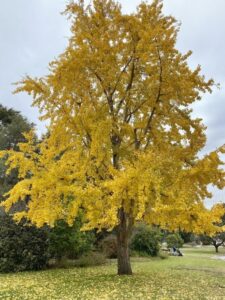
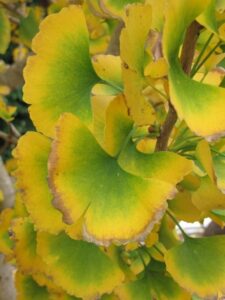
Description: The ancient ginkgo is an upright, deciduous tree up to 40m tall. The average mature spread is 9m. Under cultivation ginkgo can survive ongoing topping to reduce the overall height. The leaves are usually 5-10 cm in length and width, with a narrow petiole splaying out to a fan shape, often notched at the centre and giving rise to their specific epithet biloba (two-lobed). The common name of maidenhair trees comes from the fact that their foliage resembles that of a very large adiantum fern. Leaves are matte to lime green and change to brilliant buttercup yellow and gold in autumn, making it a delightful tree for all seasons, with several named varieties available.
Cultural requirements: A plant does not reach thousands of years old by being too picky, and the ginkgo has shown remarkable tolerance to a range of stressors. Male plants are often used as street trees given their tolerance of the dry, compact, sometimes saline urban soils of variable acidity, and they do not produce the unpleasant odour associated with the fruit from the female. While specimens famously survived the Hiroshima bombing, recovering well with new shoots the following spring, they do not perform well in excessive heat, humidity or waterlogged soils.
Cultivation: Once pollinated, the embryo in a ginkgo seed sometimes continues developing after the fruit has fallen from the tree, and seeds often require cleaning and approximately 40 days of cold stratification to break dormancy for germination to occur. While seed is the most effective way to propagate at scale, cuttings can be taken of semi-mature wood, although they are slow, and grafting can ensure that the desired sex, leaf colour and/or habit can be reproduced.
Landscape and horticultural uses: Ginkgo provides a fascinating texture to a garden and works best as a feature or avenue tree. Deep-rooted and long-lived, it is not especially well suited to long-term container growing, although with its slow growth, it could handle time potted when young. The striking autumn yellows and golds of its foliage make a fantastic focal point, and the unique leaf shape adds interest as a winter carpet below bare branches.
Ecological and cultural notes: Ginkgo biloba as a species does not appear to diverge far from those found in the fossil records. This long history means that the ecology in which it is currently grown is probably quite different from its evolutionary past. With pollen being wind-borne, it does not attract the pollinating insects so prized in modern horticulture, and birds have not shown to be particularly interested in its seeds. There is very little observed damage from herbivores such as deer and rabbits, even in heavily populated areas, and insect pests are very rarely recorded in nurseries or gardens. The fruit and leaves have recorded use in ancient Eastern and modern Western medicine. Seeds, extracts and leaves have been used in pulmonary and circulatory health, antimicrobial applications and prevention of cognitive degeneration. The unique and ancient biology gives access to pharmacological compounds different to those in modern angiosperms.
Maintenance: Like most deciduous trees, pruning of the maidenhair tree is best done in late winter/early spring. The natural pyramidal growth habit requires little intervention, and pruning should be limited to shaping or removing diseased and damaged material. Due to its slow growth, the ginkgo does not heal well from large wounds and often persists with more scarring than one would expect from other trees. It is a very hardy tree once established, but like all plants will need some regular watering and care when first planted.
Caleb Roberts
Daleys Fruit Tree Nursery
W: www.daleysfruit.com.au