

Gardens of lasting beauty
By Patrick Regnault
Designing a garden that lasts more than a few years seems to be more of a challenge these days when compared to previous centuries. The fast pace of change and our desire for constant renewal accompanied by quick results are not conducive to a generational view of landscape design. In this article, I invite you to join me on a cross-cultural journey across several continents to visit gardens of lasting beauty.
In days gone by, it was common to plant for future generations. Food was harder to come by and fuel for everyday use often came from trees, so, our ancestors needed to think, plan and plant with a view to the long-term to ensure their survival. As civilisation has progressed our sense of time has changed, and we are now fixated on immediate returns. Take for example our forests. An old-growth forest requires at least 200 years to establish in a temperate climate. However, contemporary culture tends to favour instant ‘mini forests’, where a tennis-court-sized planting of fast-growing trees is treated as equivalent to a forest, when we know ecologically that it is not. We are building a world that reflects our mind; restless, unfocussed, and addicted to change for change’s sake. Is it not surprising then, in a culture that eats instant noodles, that we build instant gardens? We are treating our gardens, parks and natural environment as fast food, designing them for instant gratification. This attraction to immediate impact has not always been the case as we will find out in the gardens we will now visit.
The classical gardens of Suzhou
Suzhou contains a group of 50 gardens in Jangsu province, just over 100 km from Shanghai, China. Dating from the 11th to the 19th centuries, these gardens have been placed on the UNESCO World Heritage list given their ‘Outstanding Universal Value’. Of the 50 gardens, 9 are the finest embodiment of the ‘Mountain and Water’ style of Chinese gardens. Built in 1044 by Su Shunqin, Canglang Pavillion is the oldest, continuously maintained of these gardens. The name of this garden refers to a verse in a poem regarding an honest official who removes himself from politics rather than act in a corrupt manner. Shunqin chose this name to express his feelings after his own removal from office. Bamboo, ginkgo and plum trees help create this garden’s unique atmosphere and are symbolic in Chinese culture. Garden design is therefore not just beauty; it can reflect art, culture and political statements that are timeless.
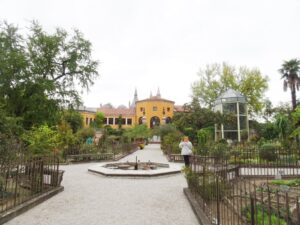
Padua Botanical Garden
Dating back to 1545, the Orto Botanico in Padua, Italy is considered the world’s first botanical garden. This now UNESCO-listed garden was established to enable university students to study medicinal plants in situ and is an example of functional beauty that endures. This garden has contributed greatly to many scientific disciplines including botany, medicine, chemistry, ecology and pharmacology. Today it is still a centre for research. The original, preserved layout centres on a plot representing the world surrounded by a ring of water. The oldest plants in the garden are a Vitex agnus-castus (chaste tree, chasteberry or monk’s pepper) planted in 1550, a Chamaerops humilis (European fan palm) planted in 1585, and a Platanus orientalis (Oriental plane) dating from 1680.
The Agdal Gardens
Moving to Morocco, we now come to another UNESCO World Heritage site encompassing the medina of Marrakech, the Menara Gardens and the Agdal Gardens, the latter of which I will focus on here. Agdal means ‘meadow enclosed by a stone wall’ in Tamazight. Created in the late 12th century by the engineer Ahmad ibn Muhammad ibn Milhan, this garden fell into disrepair until it was successively restored and further developed in the 16th century, when it was opened to the citizens of Marrakesh. It was primarily a production garden, a large orchard with olive trees, vines, pomegranates and, later, citrus trees. A 1916 census recorded 50,795 trees. Crops and trees are planted in different areas according to their water needs. In this garden, beauty meets food security.
Saihoji garden
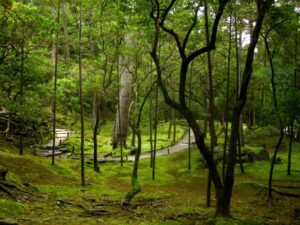
Saihoji is located on the western outskirts of Kyoto in Japan and is registered as a World Heritage site along with multiple other locations in that historic city. This site includes a temple built in 731. Its famed gardens were developed much later during the Muromachi Period (1336-1573), when high priest and master gardener Muso Kokushi created what is said to have been Japan’s first dry landscape garden (karesansui), a style that is nowadays considered the quintessential form of the Japanese garden. Throughout its history, the Saihoji Temple and its gardens have suffered from numerous wars and natural disasters, including major flooding during the Kan’ei (1624-1644) and Genroku (1688-1704) Eras. Moss began to flourish in the garden after these large-scale disturbances, and in true Zen spirit, the garden’s caretakers decided to work with nature rather than against it, allowing the moss to cover the grounds. In this garden, flexibility, adaptability and fearlessness of profound changes have created beauty.
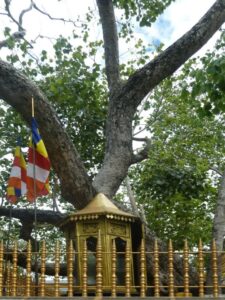
The Bo Tree
The oldest recorded human-planted tree still living is the Jaya Sri Maha Bodhi, a sacred bo tree (Ficus religiosa) planted in 288 BCE in Sri Lanka. This tree was planted from a cutting taken from the original tree under which Siddhartha Gautama (Buddha) achieved enlightenment at Bodh Gaya in India. A Buddhist nun, Sangamitta Maha Theri, daughter of the Indian Emperor Ashoka, brought this cutting to the Mahamewuna Garden in Anuradhapura, 200 km north of Sri Lanka’s current capital, Colombo. Although the tree has had to deal with threats from wild elephants, extreme weather and human vandalism over the course of its long life, it is still alive, protected and venerated to this day, and is a physical symbol of a philosophy.
Urban parks
When it comes to parks, we need to realise that most urban parks were originally set up for the exclusive use of the elite. Most started as hunting grounds reserved for the rulers, or as promenade gardens for the chosen few. Only a handful of these parks were open to the citizens of the city, but even then, the people allowed in were still part of a select group. Many urban parks were set up in religious temples or monasteries with limited public access, if any.
Public parks and gardens as we now conceive them are a relatively new phenomenon. Birkenhead Park, near Liverpool in the United Kingdom, is considered the first publicly-funded park. It was designed by Joseph Paxton and officially opened in 1847. The idea of using public money to fund public parks took off rapidly and gave rise to famous landmarks such as New York’s Central Park. There is little doubt that fast paced industrialisation and demographic explosion in cities created a need for green spaces inside expanding urban areas. Being publicly funded, public parks are subject to budget cuts. However, the public’s need for and love of these places, with their highly valued health and social benefits, has ensured that they are preserved for the benefit of all.
We cannot understand how revolutionary the first public parks were. People from very diverse economic backgrounds could meet on (near) equal terms on neutral ground. Although public parks were first conceived to ‘civilise and educate’ the working class, green spaces became social capital where people started to talk, politics was discussed, and societies started to hear the voice of the voiceless.
Hospital gardens
From the late 1700s, the beneficial effect of gardens and green spaces on the recovery of patients with mental health conditions started to be recognised. Places like Ticehurst House Asylum (1792) and the Northampton General Lunatic Asylum (1838) are famous early examples of this. Of course, those places were reserved for
the wealthy families whilst the poor had to contend with far less salubrious establishments.
From the 1800s, medical reformers, influenced by emerging public health science, began rethinking hospital design, recognising airflow and natural light as essential to health and recovery. Pavilion-style buildings, often integrated with gardens and open space, started to replace the old corridor-based system in some hospitals, reclaiming an idea that had been successfully used from antiquity and ended during the Renaissance. And so, the modern therapeutic garden was born, with gardens being seen as a part of recovery and wellbeing, and therapy for the body and mind.
The Lariboisière Hospital in Paris, France is a notable example of an early pavilion-style hospital. Built between 1839 – 1854, you can still visit this hospital today. Recent refurbishment has included the introduction of seasonal and perennial pollinating plants to its garden, as well as insect hotels and melliferous plants such as Santolina sp., whilst retaining the large lawn and the Buxus sempervirens hedges.
Change over time
Throughout history, gardens have been part of the scientific, cultural and political discourse of societies. Garden designers reflect the political and social landscape of the time and sometimes contribute to its societal transformation. For gardens to survive the test of time they need to resonate with our deepest humanity. The gardens we design today need to be influenced by a reflection on our humanity. Gardens designed not from the ego but from our deepest understanding of our humanity will ensure a long-lasting message that will resonate with people throughout the ages.
Patrick Regnault FAIH RH0062
Interactive Landscapes
E: patrickregnault@hotmail.com