
GROWing First Nations horticulture
By Russell Larke
Public landscapes offer much more than visual beauty; they play a critical role in shaping how people experience and connect with place. They can tell stories, preserve culture, celebrate biodiversity and encourage people to think differently about the country they live on. At Fed Square, a new garden inspired by Victoria’s temperate rainforests now embodies these ideas. However, the most powerful part of this project is not the landscape – it is the First Nations women, Jannali, Lowanna and Shona, who designed, sourced, and planted it. This article shares the journey of the GROW Gardens horticulture team as they built this garden from the ground up, learning, connecting and growing together along the way.
A social enterprise connects people to purpose and place
GROW Gardens (supported by the Killara Foundation) is a First Nations-led social enterprise supporting young First Nations Victorians into meaningful, long-term employment in horticulture, landscaping and environmental care. Co-founded by Damian Walsh and Paul Baker, GROW is built around a clear principle: closing the gap through connection to culture, to Country, and to pathways that lead to real and sustained employment. Each GROW project combines paid work, accredited training, mentoring and hands-on experience.
The Fed Square rainforest garden became a perfect platform for this kind of learning. It asked the team not just to plant a garden, but to think like designers, environmental stewards and cultural storytellers.
The project
Understanding the site: Reading Country before designing
At Fed Square, Jannali, Lowanna and Shona were given the opportunity to rethink and reshape the garden along Birrarung Marr Walk into a rainforest garden.
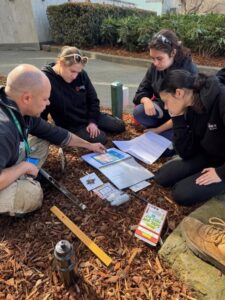
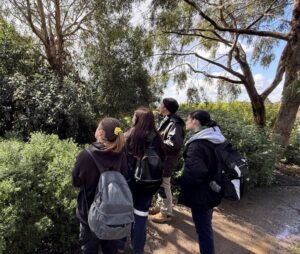
The first stage of the project involved a full site assessment: soil testing, drainage and irrigation checks, studying light levels and shade, and observing how people moved through the space. These early steps taught the team how to read the site and use this to inform planting design. What they discovered was a site with consistently low light and a sheltered microclimate. Therefore, instead of using unsuitable species for the space, the group made a strategic and creative choice: they would design a garden inspired by Victoria’s cool and warm temperate rainforests.
‘It gave me clarity to understand don’t just plant plants without testing the soil first. We need to understand that soil testing is an important first thing before putting any plants in the ground’ – Shona.
In the field: From botanic gardens to the forest
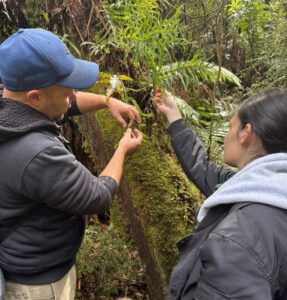
To deepen their knowledge to help with the design, the team visited both the RBGV Cranbourne, a fantastic garden dedicated to the display, cultivation and conservation of Australian flora, and Grants Picnic Ground, one of the best representations of Wet Sclerophyll Forest and Cool Temperate Rainforest in the Dandenong Ranges in Victoria.
Royal Botanic Gardens Victoria – Cranbourne
At Cranbourne, the group studied how native species are used in cultivation. They gained a clearer sense of scale and how these species look next to each other in the landscape. The team looked at things like habit and size (especially the larger the shrubs and tree ferns), different flowering characteristics and the diversity of ferns. They also looked at how different species worked together, examining specifically the different foliage textures and colours.
As Jannali shared: ‘We visited Cranbourne Botanical Gardens to see firsthand how the native plants looked at their full potential and size for reference… We chose which ones we liked based on their visual foliage and flowers, and picked which ones were cohesive.’
The field trip was invaluable, giving the team the opportunity to learn about new species, and to develop a stronger understanding of how to grow and design with these plants while considering their longer‑term growth in the landscape.
Grants Picnic Ground – Experiencing a living rainforest
A trip to Grants Picnic Ground in the Dandenong Ranges was designed so the team could observe how species arranged themselves along slopes and watercourses, how the vegetation layers worked together, and ultimately to view and select their favourite plants along the way. Along the way, we discussed the two different plant communities, identifying which species were characteristic of Wet Sclerophyll Forest and Cool Temperate Rainforest. We also examined how and why certain species occurred in different areas, considering factors such as light availability and moisture.
Shona described the impact of this visit: ‘The range of plants was huge, and we can and should be using them more in our garden projects across Melbourne. I was really surprised how many beautiful and different native plants there are so close to Melbourne CBD.’
For Lowanna, the connection to Country was very personal: ‘My ancestors have probably walked through here before.’ That reflection illustrated the heart of the project and the deep ongoing connection that this team has to these landscapes. It reminded me that horticulture on Country for this team is not just about the technical work; it is rooted in culture and connection.
Designing the garden: Collaboration and creative thinking
Back in the office, the team utilised their research and field experiences to build a conceptual plan. This decision to use predominately rainforest species opened the door to a rich plant palette of tree ferns, understorey shrubs, rainforest herbs, strappy species and canopy trees that naturally thrive in lower light conditions. The team reviewed Ecological Vegetation Classes, the Victorian Rainforest Network’s species lists, and the Yarra Ranges Local Plant Directory to refine their ideas and visual references. Mood boards were created to explore foliage patterns, textures and layering. The early research set a strong foundation and sparked excitement about how this space could celebrate Victorian flora.
This phase was built on collaborative decision‑making between each member of the team. Together, they worked through the core components of landscape design: mapping paths, boundaries and sightlines; determining how the canopy, mid‑storey and understorey layers would interact; choosing species suited to the site’s shade and moisture conditions and arranging plants into distinct rainforest zones. It also included developing materials such as the plant palette selection sheet, both a planting plan and vertical planting section that illustrated the layering and set-out of the plants within the garden.
Through this process, the team learned not just how to design a landscape, but how to think like designers, observing, discussing, refining and imagining how their ideas would grow over time. The group debated plant choices, photo references, textures and colours. Some species they loved from the Dandenong’s would not suit urban conditions; others were perfect but needed careful placement. Lowanna explained the collaborative process: ‘We came back to compare our photos to see if we agreed on which plants to include and why; others may not work.’
By the end of this phase, the team had developed a clear, site‑responsive plan, one that balanced ecological accuracy with aesthetic impact.
Sourcing plants: Learning from experts
A visit to Fern Acres Nursery deepened the group’s knowledge of ferns and rainforest species. They saw spores under a microscope, learned about fern lifecycles, and discussed how certain plants prefer specific soil types, humidity levels and growing conditions. Understanding each fern’s favoured conditions and cultivation requirements helped the team place each species correctly in their final design, and gave them increased confidence in their horticultural decision-making.
Planting day: Bringing the landscape to life
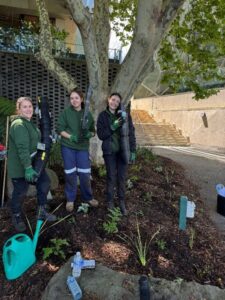
The final stage was planting the garden at Fed Square, a moment where months of work came together. Before digging, the team placed all plants in their intended positions, adjusting the layout repeatedly. They stepped back, re‑grouped species, shifted clusters, and considered how the garden would look in one year, five years, and ten years. Once satisfied, they began planting ensuring each hole was prepared with compost to improve soil structure. The team learned how to tease out roots, position plants at the correct depth, water them in properly, mulch effectively and check irrigation coverage.
This hands-on work strengthened both skills and confidence. It also solidified teamwork: the group communicated constantly, supported one another physically, and problem‑solved as issues arose. It was great for the team to final put their design into practice.
A garden that tells a story
The finished landscape will be lush, green and layered, an authentic interpretation of Victorian rainforest ecosystems. Beyond its beauty, the garden communicates deeper messages including that Country is and can be present in Melbourne’s heart, not just beyond its edges, and that First Nations knowledge and leadership can strengthen public landscapes.
Most of all, the garden celebrates the women who built it, their skills, their cultural connection and their growth. To watch the team grow and learn over the last few months has been amazing. It has been an absolute privilege to be part of their journey.
This project shows that horticulture can be so much more than planting and pruning.
It can be about:
- nurturing confidence
- strengthening identity
- building careers
- celebrating culture
The GROW team did not just build a garden; they created a living expression of their knowledge, resilience, and pride. Their rainforest space at Fed Square will continue to grow, just as they will, offering shade, beauty, biodiversity and story to everyone who walks through it. This is what GROW Gardens stands for: meaningful work, cultural connection, and landscapes that honour Country.
You can learn more about the team and other projects they have been working on at:
- GROW Gardens: www.growgardens.au
- Killara Foundation | Creating sustainable employment opportunities for Aboriginal and Torres Strait Islander peoples in Naarm (Melbourne): www.killarafoundation.org
All images supplied by the author.
Russell Larke
Head Gardener
Melbourne Arts Precinct Corporation
E: russell.larke@mapco.vic.gov.au