Growing ornamentals, growing opportunities
In this issue of Hort Journal, we celebrate ornamentals and the people who grow, trial and champion them. We also turn the spotlight on women in horticulture, recognising their contribution across production, design and leadership.
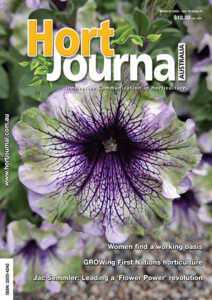
My personal taste in ornamental plants leans heavily towards those that are also edible, so potted colour is usually not the first thing to attract my attention. However, at the Australian Horticultural Trials Week held recently, one petunia caught my eye with its unique colouration. The purple, green and white flowers of Petunia Amazonas® ‘Plum Cockatoo’ recalled for me the colours of the suffragettes, women who actively campaigned in the late 19th and early 20th centuries for womens’ right to vote. The suffragettes adopted these three colours to represent their movement: purple for dignity/loyalty, white for purity, and green for hope/new life, and the plant’s name, ‘Amazonas’, also reminded me of the female warriors and hunters of Greek mythology.
This observation got me thinking about the women working in horticulture, somewhat timely given International Women’s Day is held on 8 March. There are an estimated 1,539 greenlife production businesses nationally, with nursery production businesses employing approximately 22,500 people1. So how are women faring in those businesses?
Employers with 100 or more employees are required to report annually to the Workplace Gender Equality Agency (WGEA) against six priority areas that can have a positive impact for workplace gender equality, including workforce composition2. The WGEA data shines a light on larger nurseries, who by sake of their size, are leading our industry. Whilst half of their employees were female (48%), only one-third of managers were women (34%). Men held more full-time positions than women (56%), whilst women held three-quarters of available part-time positions (72%). Women accounted for half of all promotions of non-managers to managerial positions (50%), yet only 10% of CEOs (or their equivalent) were female.
Behind every statistic lies a human story, so we reached out across Australia to put a human face to the WGEA data and to women in horticulture more generally. Jennifer McQueen shares the stories of five women from across the continent; how they found their way into the industry, and why, despite the challenges, they choose to stay. Russell Larke recounts the experience of a team of First Nations women learning, connecting and growing together as they designed and built a garden at Fed Square. Natalie Vallance from Muchea Tree Farm speaks about her special interest, producing plants for floriculture, an industry she says may play a part in conserving rare and endangered plants. Jac Semmler from Super Bloom challenges long-held assumptions about what ornamental planting can deliver in the public realm.
To conclude, I return to International Women’s Day, whose theme this year is ‘Give To Gain’. There are many ways that you can advance women in our industry. You can give respect, knowledge, mentoring, credit, introductions, opportunities, training, access, time and so much more.
Give what you can!
Until next time,
Gabrielle Stannus and your Hort Journal team
References
- Down to Earth Research, Greenlife Industry Australia & ACIL Allen. (2025, February). Nursery Industry Statistics 2020-21 to 2024-25 (NY21000). 2023-24 Production Nursery Data Capture Report, February 2025.
- Workplace Gender Equality Agency (WGEA). (n.d.). Gender Equality Indicator 1. Gender composition of the workforce. Industry Data Explorer. Retrieved February 13, 2025, from https://www.wgea.gov.au/Data-Explorer/Industry.