
What makes a plant beautiful?
By John Fitzsimmons
If our theme this issue is ‘Ornamentals: Beauty that endures’ then surely, we must start by defining ‘beauty’ and that raises more questions than answers. On such a theme, just where do we start? Beauty is a subjective and multi-faceted quality that evokes pleasure, admiration or deep emotional responses. Beauty can be driven or defined by aesthetics (including colour and form), personal experiences, cultural standards, innate qualities beyond initial or skin-deep attraction, and even utility.
By John Fitzsimmons
Beauty does not have to be perfect. The actor Isabella Rossellini is quoted as observing: ‘If you look at nature there is no perfection … everything is always evolving and adapting … the more diversity there is, the more things are going to survive’.
Beauty can also be situational. If you were stuck in a desert, there would be little more beautiful than a lone, shade tree. In an otherwise monochromatic landscape, a dramatic flash or patch of colour, any differing colour, would probably draw the eye quickly and be received with pleasure.
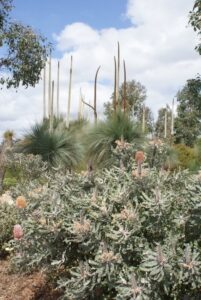
Plants that typify ‘home’ can be elevated to ‘beautiful’ through the emotion they evoke in those who know them. Across Australia, such plants might include wattle, flame trees, jacaranda in flower, London plane trees and desert oak (Allocasuarina decaisneana), a slow-growing, iconic and long-lived tree endemic to the arid regions of this continent. Think too of the cultural appeal of olive trees to people from the eastern Mediterranean, or edelweiss (Leontopodium nivale) to Europe’s alpine dwellers. Whilst the name edelweiss comes from the German language, this plant also has other names in Balkan countries, including Bulgaria and Romania, showing its wider range and appeal.
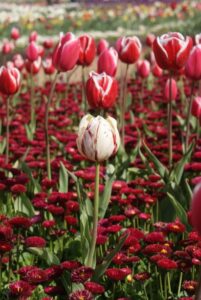
Many of the world’s most popular plants are also associated fondly with the regions they either originate in or are now cultivated. Maybe roses or tulips remind you pleasantly of Europe, azaleas, camellia and cherry blossom of eastern Asia, lantana, hibiscus or clivia of Africa, oleander of the Middle East or Central Asia, or the blue passionflower (Passiflora caerulea) of South America.
All the qualities described above are examples of how ‘beauty’ can be found in natural or constructed landscapes, even the succulents or cacti from arid areas, as presented by Steve Martino of Arizona at the Australian Landscape Conference in 2025.
Universally beautiful plants are frequently characterised by striking flowers, unique foliage and/or engaging forms. Appeal beyond the visual can also elevate desirability; herbs (such as lavender), berries and grasses can delight the senses with their aromatic and tactile features. Freedom from blemish may also add to a plant’s attractiveness, as can uniformity and consistency of foliage and blooms. Form can be highly subjective. Being ‘true to type’ usually scores more beauty points, although human opinion may differ on whether symmetry is an attractive quality or not. Short internodes and denser foliage are often favoured over longer internodes and open canopies, but not always.
More intangible features can also add to a plant’s ‘beauty’. Consider the appeal of a plant’s longevity, environmental benefits (bird and pollinator attraction, water management, erosion control), and utility (food, fibre or construction media).
As with many things in life, the growing environment, and timing and stage of development, are also critical in any snapshot of beauty. Improving growing conditions can resuscitate currently unappealing plants. Others are far more attractive at maturity.
Features out of the ordinary can also elevate appeal. Consider the queues of people who line up around the world when a local botanic garden announces when a corpse flower (Amorphophallus titanum) comes into rare bloom with its notoriously unappealing (to humans) scent. But ‘beautiful’?
‘Night blooming’ plants are probably not so widely appreciated, probably for the simple reason their nocturnal lifestyles rarely coincide with ours. However, they can be highly appealing to certain insects, especially moths, if not us. Their usually pale or white blooms often stay open late in the day and into the night. These plants often feature trumpet-shaped flowers with lots of nectar, and a fragrance best smelt at night. Examples of night-blooming plants include angel’s trumpet (Brugmansia spp.), moonflower (Ipomoea alba), night-scented stock (Matthiola longipetala), tuberose (Agave amica), night phlox (Zaluzianskya capensis), common evening-primrose (Oenothera biennis), soapweed yucca (Yucca glauca), Chilean jasmine (Mandevilla laxa) and calabash or New Guinea bean (Lagenaria siceraria). Whilst attractive to look at, night-blooming jasmine (Cestrum nocturnum), also known as ‘lady-of-the-night’, is a weed that is poisonous to both people and animals – perhaps not so beautiful after all?
So, what greenlife beauty releases your endorphins and gives you a mood-boosting dopamine surge?
The rose, with its almost incalculable variations in floral colour and form, is a universal benchmark of floral beauty. While a rose’s form might not provide appeal in every case, the longevity of its floral display often compensates. This is perhaps in contrast with tulips, daffodils, freesias and hyacinths, but maybe that is why admirers of those plants look forward to their seasonal floral fanfare with such enthusiasm, likewise dahlias and many orchids.
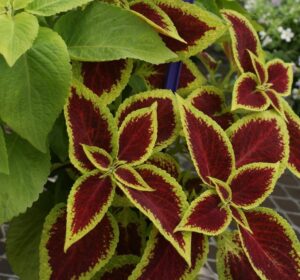
The enjoyment of beauty is extended when the blooms or foliage of a favourite plant can be cut to enhance a living or working environment for days or weeks. Floral displays may be wonderful but then why is foliage variation so universally admired in house plants and outdoor gardens? Ficus, Sansevieria and Monstera species are up there, worldwide, as perennial best sellers.
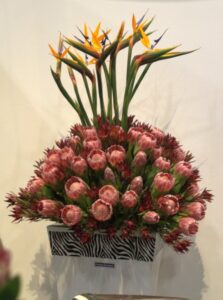
For myself, I am struck almost every day by the presence, majesty and form of trees, individually and collectively. The joy of blossom trees as standalone features, street trees in avenues, or commercial orchards covering hills and dales always holds appeal. That is not to say a striking groundcover or flowers on a nearby shrub, or even grasses will go unappreciated. The understorey of groundcovers, borders and bedding plants covers an almost uncountable number of worthy examples of ‘beautiful’ plants, some of which deliver their appeal through the seasons. The whole tapestry is beautiful – as well as the individual elements that make it up.
As a wise man in the wine trade once observed, some of the enjoyment comes from the wine, but much of the enjoyment comes from the company and occasion. So, it really depends on who you are, where you are, what you are, and WHEN you take in the beauty of a plant.