
Beauty, purpose and the modern garden
By Patrick Regnault
Visiting the Melbourne International Flower and Garden Show in late March helped me to clarify what I am looking for in a garden. It is not only the craftmanship, plant knowledge and overall balance, but something less tangible and probably harder to define, a presence, a purpose. A garden can be well-built, well-planted and magazine-worthy, but essentially remain soulless. Achieving a soulful garden requires intent. Fortunately, most landscapers do bring the intention and care that helps us to connect with their gardens. This was evident in the display gardens at this year’s Show that I describe below.
To me, a garden is a place where we can find refuge; it is a place of peace, harmony and quiet joy that we can appreciate on our own and/or with family and friends. A garden is not necessarily a bustle of constant activity, noise or other artificial stimulation. The only resemblance a garden should have to a busy shopping centre is when pollinators, birds and other wildlife ‘shop’ in it. The noise of these animals is soothing and unobtrusive. When in use by the household, the garden gains an extra burst of energy brought to it by its human users. However, for most of the time, a garden belongs to itself.
Gardens can help us find that deeper connection to ourselves through nature. Through these spaces we can reconnect the link between life and death, and suffering and peace as we observe changes made as part of the natural cycle. Gardens are ever changing; plants grow, some will eventually die or struggle, pests and diseases will make their mark. In brief, life takes its course. Urbanisation has for too long cut people off from seeing that change as a natural process.
Hiding behind technology or looking out of a window is no replacement for contact with nature. Thankfully, some of the display gardens at the Melbourne International Flower and Garden Show responded to this issue with thoughtful design, leaving me hopeful for the future.
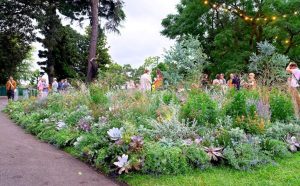
‘Plant Futures: The Future In Bloom’
The ‘Plant Futures: The Future in Bloom’ exhibition garden tackled the double challenge of urbanisation and climate change. This garden was a collaboration between Super Bloom, Heliotope, Evergreen Infrastructure and Mood Construction, with support from Austem Foundation, the Native Plant Project and the Australian Institute of Horticulture. This garden impressed me with its floral display as well as its intent in demonstrating that beauty and climate compatibility are not mutually exclusive. That ethos, together with the multidisciplinary collaboration behind the display and its clear educational purpose, was evident throughout, and gave the garden an added depth. Immersive and richly planted, it drew visitors into a floral landscape that showcased resilient, climate-forward species combining beauty with practicality. In doing so, it offered a compelling vision of how nature can be reintroduced into our cities, whether in home gardens or in larger, diverse and resilient green spaces.
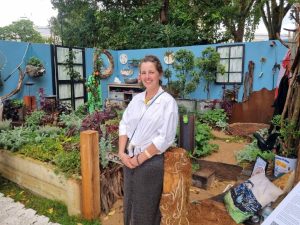
‘Sentio’: ‘I feel, I sense, I understand’
Conceived by Conchi Batson, ‘Sentio’ was a sensory garden that gave me the impression that it was someone’s yard. It had a very restful sensory quality. It was only after feeling the garden that I read its description. Conchi’s words, which I am condensing for the sake of this article, were, ‘The garden is about the personal experience of the world as we feel it. The space is for someone whose mind is always on the move, needs some structure, likes to potter, but knows they need their mind to rest… The plants are the stars, with each one serving multiple purposes… All species are in some way edible and provide sensory stimulation or calmness, from texture, to smell, the colour palette to the sculptural form they provide within the garden…’. This garden had an openness to human sensitivity and vulnerability which was refreshing.
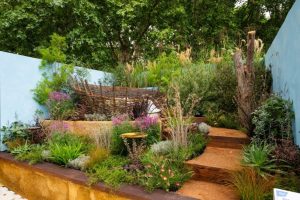
‘Nest’
Designed by Liv Bunting and Lewis McQueen, ‘Nest’ was a contemporary habitat garden designed as a shared space for birds and people. A large, hand‑woven human nest sat at the centre of the garden. The plants were selected to provide habitat and food sources for local birds. The dense planting created a sense of safety for small birds and for humans. ‘Nest’ shows that habitat gardens can be beautiful, creative and fit in all backyard sizes. To me, this display garden led my mind to that quiet, still place that is accessible through peace.
When designing a garden I often ask the clients what their needs are. I do stress their needs, not their wants. Wants are desires, fleeting, temporary, never satisfied; needs are long-lasting, satisfying, purposeful. What those three gardens shows us is that we can, through cooperation and willingness to share, open ourselves up to our limitless creativity to benefit and promote life even in the smallest of spaces and challenging environments.
Patrick Regnault FAIH RH0062
Interactive Landscapes
E: patrickregnault@hotmail.com