

From family roots to recognition: Mitchell Kushturian’s journey
By Gabrielle Stannus
Sydney-based landscape designer Mitchell Kushturian was named Emerging Designer of the Year at last year’s Landscape Design Institute’s annual awards. I spoke with Mitchell recently about family, plants, landscaping and his award-winning design, ‘Grounds of Glossodia’.
Mitchell’s passion for design is contagious and started when he was young, thanks in great part to his family. He says, ‘Our Armenian grandfather, on our father’s side, was born in Jerusalem and migrated to Australia in 1969. He loved building intricate, detailed objects, something that shaped our appreciation for craftsmanship and my brother Joshua’s attention to detail. Our nan, on our mother’s side, shared a deep love of gardening. Her backyard was overflowing with potted plants, and as kids we would often run little ‘plant sales’ out the front of her house selling succulents. Our nan was always so supportive. I remember she would purchase worm castings from my worm farm for a dollar a litre.
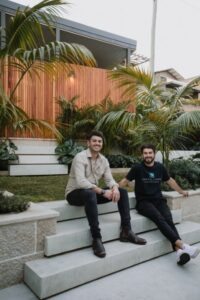
‘From around the age of eight, I spent weekends mowing lawns, weeding and pruning at both grandparents’ homes, not as chores, but as a way of helping them care for something they loved. They both had that old-school, stoic work ethic that shaped how I am today. I think that is why I love landscape design – gardens hold memories. Certain plants can instantly transport you to moments or people in your life. For me, it is the agaves that filled my grandfather’s front yard and the dense purple daisies from my nan’s garden.’
Before becoming a landscape designer, Mitchell began his working life in landscape construction. After a decade spent working for others, Mitchell then decided to start his own business with Joshua, a licensed carpenter. Around the same time, he started learning landscape design, completing a Diploma in Landscape Design through TAFE NSW online.
Despite his decade of practical experience in landscape construction, Mitchell says he is naturally more of a designer than he is a landscaper, ‘I had to work hard to get good at landscaping. Being on the tools probably does not come as naturally to me as designing a garden which I find instinctively easier. However, building gardens was good because it taught me a lot about problem solving. I think even now, how I design gardens comes from problem solving.’
To Mitchell, landscape design is solutions based, ‘You are constantly problem solving. How do you transition from one space to another? How can you make a space feel more enclosed or more private, a bit more intimate? Every space has potential. I could never go somewhere and think “this garden is useless; you cannot do anything with it”. I think you just have to have the right approach to it.’
Mitchell is not afraid to go outside his comfort zone, pushing and testing his skills as a both a designer and landscaper. He and Joshua appeared on ‘The Block’ in 2020 and 2021, putting their landscaping skills to good use for other designers. More recently, they participated in the Balcony Gardens display competition at the 2023 Melbourne International Flower and Garden Show. They only had four or five days in which to build their ‘Mosman Hideaway’ design concept in small scale, ensuring it fit within the 2.4 m x 1.2 m competition requirements. ‘We were working from 7am to 10:30 at night,’ Mitchell says, ‘Coming from Sydney was especially hard because we could not build anything beforehand, but it was a great experience. I love being around like-minded people. I now go every year to look and to work, taking my mum down too.’
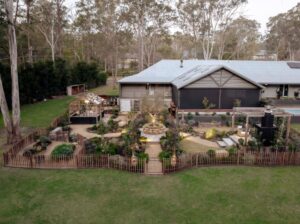
‘Grounds of Glossodia’
With a desire for continual improvement, Mitchell entered his work into the Landscape Design Institute’s 2025 annual awards, seeking the appraisal of his peers. This modest young man was stunned when he received recognition as Emerging Designer of the Year, ‘To know that other designers see our work and think it is alright, it is an unreal feeling. I could not be happier. To win an award like this for a young business like ours, which is only five or six years old, it is a great confidence booster.’
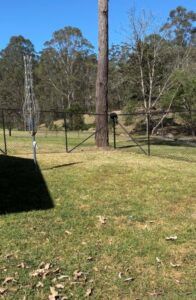
The project for which Mitchell received this recognition is on a semi-rural property in Glossodia around 70 kilometres north-west of the Sydney CBD. A garden area approximately 600 square metres with an otherwise barren turfed area was surrounded by a big black fence, albeit with an outlook to neighbouring bushland that gave Mitchell a beautiful backdrop with which to work. Mitchell says the look and feel of this space did not represent the personalities of his clients. When they came to him for help, they said they were inspired by the aesthete of The Grounds of Alexandria, an iconic inner-Sydney hospitality venue set in a former pie factory and featuring lush gardens.
‘Within that complex there is a small farm and multiple cafes. It is an iconic space in Sydney that people generally go to get Instagram photos,’ explains Mitchell, ‘The designers have used a lot of rustic materials, including sleepers, hardwood and recycled bricks. There are plants everywhere, many in pots. One of the clients had been to that cafe and absolutely loved it. She wanted to take that feeling into her own home.’ And so ‘Grounds of Glossodia’ was conceived.
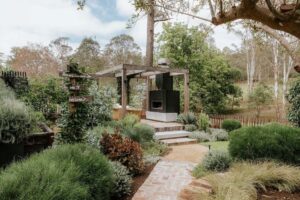
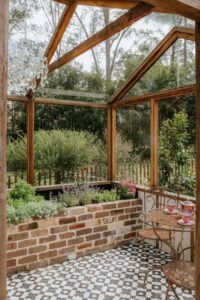
‘Top of the client’s wish list was a glasshouse to enable her to propagate plants, including tomatoes, cucumbers and cauliflowers, as well as wildflowers. We designed and constructed the glasshouse ourselves. It is approximately three by five metres, housing three wicking beds hidden behind a recycled brick wall. Our goal was for the glasshouse to blend seamlessly into the surrounding landscape, using hardwood timbers that will silver off naturally over time to tie in with the hardwood picket fence and pergola. The Shou Sugi Ban (charred timber) cladding gives the structure bold contrast against the deco granite flooring and grey-green foliage palette. We also incorporated personal touches for the clients, reusing patterned tiles from their old family home, and a chandelier as a nostalgic centrepiece in the glasshouse. Even the fixings were intentionally rusted to create a timeless, aged character. The aim was to create something that felt part of the landscape, not placed within it.
‘The client loves native plants, so most of the garden outside the glasshouse consists of Australian native plants. She also likes the informal cottage garden look. So, we sectioned off an area of the garden where she can plant wildflowers. In this space, we installed raised planter boxes, where she can just have a bit more fun with the plants, planting different flowers such as salvias and echiums,’ says Mitchell, adding that the raised beds also give the garden a sense of varying levels, so it does not feel like one flat, uniform space.
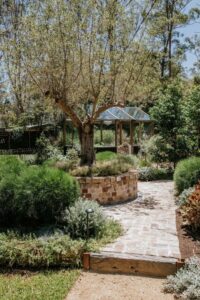
‘Throughout the garden there is a series of gravel pathways,’ Mitchell continues, ‘We have used ground covers such as myoporum to soften the pathway edges. We wanted to make it feel like you are within a garden, so there are no defined lines. We also built a raised pergola with a fireplace and planted white-flowering hardenbergia to grow up the rusted steel frame, creating a green canopy overhead. This hardenbergia looks fantastic when it is in flower and brings a lot of bees to the garden.
‘The focal point though, the real heart of the garden, is a raised olive tree. We built an elevated, recycled brick planter box and then craned in a 50-year-old olive tree. This tree sits around three metres tall to the top. Bringing in such a large, mature plant brings a strong presence and feeling to the garden.’
Not resting on his laurels
Since completing ‘Grounds of Glossodia’ and winning the Emerging Designer of the Year award, Mitchell has not rested on his laurels or become comfortable in his design style: ‘We are currently working on a formal garden, which is probably a little bit different to what I have done previously. I have never done a formal garden before. At first, I was concerned that the formal nature of such a garden might constrain my creativity. How would I bring personality into a very structured and formal space?’
For this project, Mitchell has selected a restrained colour palette, using mostly greens and silvers, whilst choosing different textured foliage to add depth. ‘I wanted to give the garden a lot more personality as opposed to plain Buxus and conifer hedges. We have created different outdoor rooms by using pittosporums as hedges and then layered plantings with gardenias and lamb’s ears (Stachys byzantina) below. Lamb’s ears have got a great texture. I love using them, especially placed against deeper green foliage plants. We have also used living pergola trees to create an overhead canopy. In essence, we have followed the principles of a formal garden but brought a bit of personality to the space.’
Condition the soil
Speaking with Mitchell, it is clear he has learnt a lot during his time as a landscaper which he has brought to his design work, advice which others in the landscape industry could learn from. He would like to see more landscapers conditioning soils before planting to increase garden longevity and speed up plant growth processes: ‘I am a big believer in conditioning the soil before any project. I love using mushroom compost. Once we start building, as soon as we excavate, we bring in mushroom compost early so we can condition the soil with it. It is more gentle on plants than other ameliorants. Mixing mushroom compost into a garden bed, along with the nitrogen found in rainwater, helps make the most of additional fertilisers. You can put fertiliser in rubbish soil, but it will not do anything if it does not have the nutrients to be unlocked’.
Stay true to your palette
Like many designers, Mitchell has his favourite plants although he is not afraid to choose character over botanical craze, ‘Plants come in trends. A couple of years ago, everyone was using ligularias (tractor seat plants) and now that trend has kind of died out. I still love using them, they are probably one of my favourite plants. More recently, I have grown to love Kalanchoe orgyalis (Copper Spoons), a furry, textured plant, which has nice bronze leaves with silver undersides. When you mass plant this kalanchoe, it provides a lot of impact as it contrasts well with greener foliaged plants. It is very easy to care for too. I also really like Rhaphiolepsis indica ‘Oriental Pearl’, with its leathery deep green foliage. It pairs well with succulents, and you can use it cottage gardens too. It is very versatile. In terms of like how important plants are and attitudes towards using them, I have always loved the idea that there are plant combinations, that design is not just about solely using one plant. It is about pairing plants together. A good designer can combine certain plants together so that their foliage, colours and textures elevate the aesthetic.’
Visit nurseries regularly for inspiration
‘I love going to nurseries, picking up plants and putting them next to each other, and moving them around. I am constantly trying to find different combinations or seeing the different combinations that other designers use. That always keeps it fun,’ says Mitchell. He sources many of his plants from Exotic Nurseries, a wholesale nursery in Dural, ‘If you are ever in Sydney, I recommend going out there because their nursery, compared with any nursery I have been to, they have the best displays because they put a real effort into it. Fantastic.’ Indeed, I was struck by the design capabilities of Exotic Nurseries when viewing their display at The Landscape Association’s recent Landscape Expo. To me, it is a no-brainer, if a nursery puts a little effort into visual merchandising to show their customers how they can use their plants in the landscape or garden, the more likely they are to buy plants there.
Draw inspiration from other designers
Mitchell describes himself as a landscaping fanboy who loves following the work of other designers, ‘I think I would get more excited if I ran into a landscape designer in the street than a footy player! As a Sydney-based design and construction company, we really aspire to businesses like Outdoor Establishments, Secret Gardens and Wyer & Co., all for their clean, modern aesthetic paired with an exceptional standard of craftsmanship. From a design perspective, I have always admired Adam Robinson and Steve Taylor for their ability to bring personality and lifestyle into a space; they design gardens that feel genuinely lived in.
‘On the planting side, I draw inspiration from Myles Baldwin, Dangar Barin Smith and Jane Jones, all of whom have an incredible understanding of how to use plants as the hero of a design. Their compositions are both refined and emotive, often creating gardens that feel like art forms in themselves.’
‘I think plants really give a space feeling. I have got friends that build fantastic decks and structures, they look great. However, even with us, once you build the structure and the garden is bare, then the day you bring plants in, it completely changes how the space feels. And I just think that is such is such an underrated thing, even indoors.’
If you are a landscaper seeking to transition into design just like Mitchell did, he shares this final advice, ‘Have a genuine appreciation for plants and the value they bring to a landscape, they are the heart of every garden. Spend time studying planting combinations and textures. Construction skills are important but understanding how plants evolve over time and interact with each other is what transforms a space from functional to truly living.’ Wise words indeed from an up-and-coming landscape designer.
Gabrielle Stannus
Inwardout Studio
M: 0400 431 277
E: gabrielle@inwardoutstudio.com.au
W: www.inwardoutstudio.com.au