
Edimental Australian landscape plants
By Daniel Fuller
Australia is home to many plant species that have fed people for thousands of years. Did you know that the following ornamental species are edible?
(Image supplied by Ozbreed)
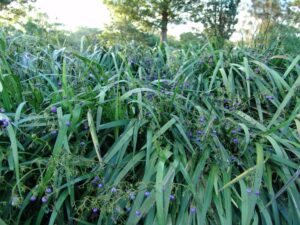
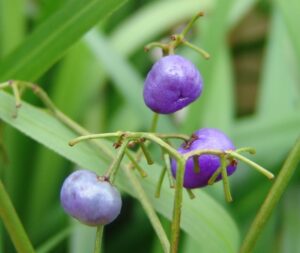
Dianella caerulea berries are almost like little blueberries with pleasantly crunchy seeds. Its close relative, Dianella tasmanica has however been labelled ‘toxic’ in many sources. Some online sources will even place D. caerulea in the same category as D. tasmanica, although there is enough credibility behind this species being a traditional bush food to list it here.
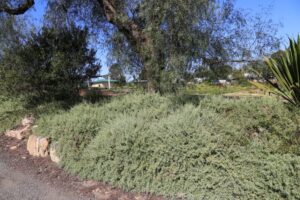
Rhagodia spinescens has small edible berries that can be added to salads or simply popped in your mouth when you are walking through the garden. The foliage is also edible as a salad crop but can be quite salty especially if grown in salt-rich conditions where it thrives. Use sparingly in fresh salads as the flavour can be strong or add to cooked dishes as a green or a seasoning.
Lomandra spp. are highly useful plants in a survival situation. Not only can the new shoots be removed and the bases eaten (especially in L. hystrix), but the stems are rich in starch and whole leaves can be used for fibre. Fertile female plants produce seeds that can be ground into flour.
Syzygium spp. including those formerly classified as Acmena and Waterhousea, are classic, lush hedging and screening plants, but not many people eat their berries. However, for many people such as myself, these berries provide a delicious treat throughout spring and summer (depending on the individual species). They have a moreish tart flavour that I have been told makes an excellent jam.
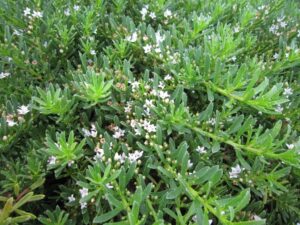
Myoporum spp. have foliage that can be toxic, but their berries can be edible and range in taste from sweet to bitter, depending on the species. Both the fruit of Myoporum parvifolium and M. insulare have traditionally been snacked upon by humans.
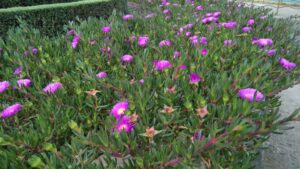
Carpobrotus glaucescens produces fig-shaped fruits that can be very sweet, tart and salty all at the same time when ripe. They can be used in jams and other sweets as you would use an actual fig. The foliage can be pickled, or eaten raw in survival situations as a source of hydration.
Of course, some Australian plants are not edible, but their flowers and/or leaves can be steeped in hot or cool water to provide a tasty treat. The flowers of Callistemon and Melaleuca spp. can be steeped in cool water for a nectar infusion, perfect as a refreshing sweet drink when mixed with ice on a hot day. On the other hand, Correa alba leaves can be used as a tea. Hardenbergia violacea leaves are also documented as being used to make tea, but they come from a family that is sometimes toxic (Fabaceae), and I could not find a reputable source confirming its safety.
I personally enjoy eating all these plants and have found many sources to back the claims of their edibility. However, I am a horticulturist, and not a toxicologist! Take everything that I say about the edibility of these plants with caution and enjoy them in moderation as part of a balanced diet.
Daniel Fuller
Ozbreed Planting Strategist
M: 0426 169 708
E: Horticulture@ozbreed.com.au
W: ozbreed.com.au