
Australian Horticultural Trials Week
By Gabrielle Stannus
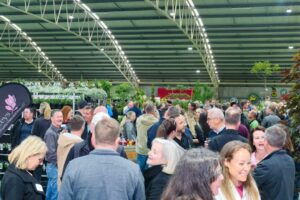
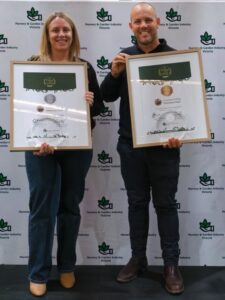
The 2025 Australian Horticultural Trials Week kicked off on Monday 1 December with a Summer Soiree held at KCC Park in Skye. The Nursery and Garden Industry Victoria (NGIV) announced the winners of its 2026 Plant of the Year awards during the evening, with Mansfield’s Propagation Nursery taking out the top gong for Corymbia ficifolia ‘Precious Pearl’. I was fortunate enough to make my first in-person visit to this annual industry event and the subsequent trials which I have previously ‘attended’ only online. It is a pleasure to share with you a selection of the new and upcoming plant releases showcased by exhibitors during the week.
After a night of networking at the Summer Soiree, it was an early start the next day for those of us who had booked tickets for NGIV’s bus tour. This tour is a great initiative making it so much easier for interstate visitors to view the event’s multiple exhibitors across six sites in a stress-free manner over two days.
Ball Australia

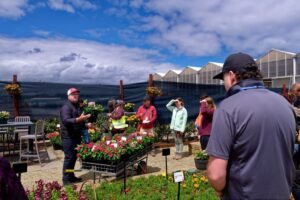
Our first stop on this bus tour was Ball Australia’s Skye production facility where their catchphrase ‘We colour the world’ was clearly on display, and featured Petchoa ‘Caliburst Yellow’ (Petunia x Calibrachoa), the first petchoa produced from seed. This day-length neutral petchoa has a mounded, spreading habit growing to a height of 15-25cm and width of 50-70cm. Like other petchoas, ‘Caliburst Yellow’ features the large flowers and vigour of petunias with the strong roots, vibrant colours, and non-sticky foliage of calibrachoas. Its controlled habit makes it suitable for 13cm, 17cm pots and baskets 23cm+ production programs. Growers can include it in mixed combinations with both seed and vegetative components. Other new petchoas on display included those in the Supercal Premium range, such as ‘Coral Star’ and ‘Pink Mist’. These mounded petchoas grow to a height of 35-60cm, and a width of 35-65cm.
New dahlias on display including recent additions to the Dalina® series. These mounded, double-flowered dahlias (Dahlia pinnata) now include the ‘Cherry Glow’ and ‘Pink Blast’ varieties. Dalina® ‘Cherry Glow’grows to a height of 40-50cm, and a width of 30-40cm, and has a long flowering time from late spring to autumn. Growers can produce this dahlia indoors or outdoors, and even unpinched if seeking an early production.
New releases in the Lake series of salvias (Salvia guaranitica), Salvia ‘Lake Blueberry’ and Salvia ‘Lake Como’ were a highlight. These medium-sized salvias have an upright habit, growing to between 40-55cm in height. These are quick-flowering, vigorous salvias with numerous side shoots and long, flowering stems. They are suitable for 170-210mm pot production. Other salvias of note included the upright Salvia ‘Plum Crazy’ (Salvia guaranitica) with its long, tubular spikes of dark burgundy calyces and plum corolla tubes.
Tissue culture lines on display included new cordyline varieties (Cordyline fruticosa) which gardeners can bring indoors on a seasonal rotation. Cordyline ‘Pink Diamond’ has vibrant pink and green variegated foliage, whilst Cordyline ‘Coffee Compacta’, as its name suggests, has a compact growth habit and glossy, dark coffee-brown foliage with contrasting creamy yellow margins.
Our tour lead, Stuart Abela, said that Ball Australia is now also growing a tissue culture version of oakleaf hydrangea (Hydrangea quercifolia), speeding up the production of this plant which can be slow to grow from cuttings. And a bonus, it also flowers in its first year. Ball also has a coleus produced from seed, which they can produce for about 20 per cent of the cost of a vegetative cutting as they do not need to maintain a mother stock program.
Tony Collins walked us through the Syngenta Flowers display which featured ‘Painted Love’, a mounded bicolour petunia suitable for 120-40mm pot production programs. Tony also highlighted new seed grown vincas (Catharanthus roseus) from PanAmerican Seed’s Vinca Pacifica X.P. range, including Vinca Pacifica XP ‘Red Halo’ and ‘Pink’. ‘Vincas are a hot summer survivor, so a product that really comes into its own now from Christmas into the new year,’ said Tony.
Haars Nursery
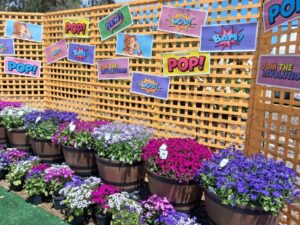
The feel at Haars Nursery in Lyndhurst was very much that of a backyard summer celebration, featuring colour, food, music and conversation. The wood-fired pizza on offer was a standout!
Proven Winners® Australia highlighted their ColorChoice® series of buddleja and lagerstroemia from the Spring Meadow breeding program in Michigan, USA. The Center Stage™ lagerstroemia range (Lagerstroemia indica ‘SMNLIJ’) comes in a range of colourful varieties including ‘Coral’, ‘Pink’ and ‘Red’. These heat tolerant, early-blooming, vigorous crepe myrtles have shown excellent powdery mildew disease resistance. Their Pugster® buddleja (Buddleja davidii) cultivars ‘Pinker’ and ‘Blue’ both possess honey-scented flowers on a compact dwarf butterfly bush. The name ‘Pugster’ comes from these plants’ resemblance to a pug – short, stocky and cute!
Also at the Proven Winners® display was the first-ever series of scaevola with star-shaped rather than fan-shaped flowers. Check out Scaevola StardivaTM ‘Blue’ and StardivaTM ‘Pink’ for yourself. TheSupertunia® Mini Vista ‘Plum Veined’ also caught my attention with its masses of medium, fuchsia-pink, plum veined flowers covering a mounding habit. At maturity, this petunia hybrid grows to a height of 30cm and width of 60cm. Available soon, the new releaseAromagica® ‘Purple Heliotrope’ (Heliotropium arborescens) stays full and vibrant all season with large, fragrant, deep purple blooms amongst dark green textured foliage. Gardeners can plant this heliotrope in patio pots, window boxes and landscapes, attracting pollinators all season long, as well as using it for cut flowers.
While walking around the displays, I got to talking to my fellow tour participants to find out why they attended the trials and their thoughts about the displays so far. Genevieve from Proteaflora said that this was her first time at Trials Week, and that her focus was on gleaning information about how other nurseries produce plants, even if the setups are quite different to the ones she works on. Olivia Ma has a small-scale nursery in Ashburton. Her clientele is mostly Asian in origin. She says that they would love the Argyranthemum ‘Angelic Sweets’ that caught her eye at Haars, with its mixed pink and yellow flowers.
Fleming’s Nurseries
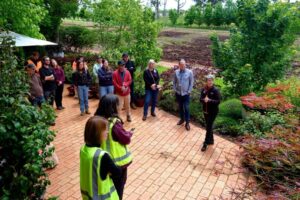
At our next stop at Fleming’s Nurseries in Monbulk in Melbourne’s Dandenong Ranges, Leanne Gillies reminded us about the length of time it takes to get a tree to market (up to 20 years!), whilst Daniel Jansen spoke about trends in trees.
‘Over the years, we are seeing backyards are getting smaller, so the need for big trees is getting less,’ said Daniel, ‘Trees are going from the backyard to the nature strip. In some cases, councils are buying trees and giving them to people to put in their backyard to try and save some canopy. So, there is a need that we are seeing for (smaller, more fastigiate) trees. In the older days, you would buy a house and a fruit tree or two. There is no room for that anymore. That is a smaller market. Now we are talking about fruit trees in pots on balconies. So, it is a change in the type of fruit tree that we look to produce.’ Work is also underway to produce trees more resilient to climate change.
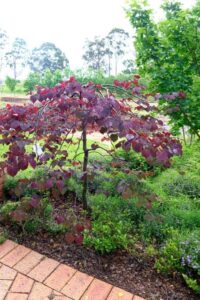
Leanne and Daniel then showed us these compact trees including ornamental crabapples, Malus ‘Raspberry Spear’ PBR and Malus ‘Ivory Spear’ PBR, designed for small or narrow spaces, such as driveways. Cercis canadensis ‘Ruby Falls’ PBR Enchanted Forest®, is a unique, compact weeping redbud with beautiful foliage. Its deciduous leaves turn yellow in autumn, and the flowers cover the bare branches in spring. ‘It does everything that ‘Forest Pansy’ does, but with a pendulous habit,’ said Leanne, adding that it would be available late 2026. Breeders have also selected Parrotia persica ‘JLColumnar’ Persian Spire for its form and compact growth characteristics. Its leaves are smaller and narrower than typical of the species, yet according to Leanne still pack a punch on display, ‘I love it on foggy days up here because it just glows. It has spectacular yellow-orange foliage.’
There were new maples on display, including the second generation out of the Acer truncatum x platanoides hybrid breeding program which initially produced the ‘Pacific Sunset’ and ‘Norwegian Sunset’ cultivars. ‘We have now got ‘Ruby Sunset’, ‘Crimson Sunset’ and ‘Urban Sunset’. These are more refined (and) compact in shape and have much better tolerances than ‘Pacific Sunset’,’ said Leanne, ‘‘Ruby Sunset’, I think is a good home garden tree. It is quite compact, slower growing (and) gets amazing red autumn colour. ‘Crimson Sunset’ is all about the foliage colour. It is still a bigger growing tree. ‘Urban Sunset’ is more upright growing, so it will work better on the nature strip side of council planting, but (it) also gets really good autumn colour.’ A new addition to the Lipstick Tree® range of maples, Acer rubrum ‘Frank Jr’ Redpointe has a handsome habit, improved tolerances and striking vibrant red colour. It is suitable for use as a stand-alone specimen tree or avenue planting.
Other highlights included Betula nigra ‘BNMTF’ Dura Heat™, a selection of river birch that Fleming’s say may be of use in streetscapes where other birch trees have failed to perform, and Avocado ‘JA1A’ PBR Jala™, whoselarge fruit are almost double the size of a ‘Hass’ or ‘Bacon’ avocado. This avocado is showing self-pollinating tendencies and is intended for the home garden market.
Leanne said Fleming’s are working on new compact hydrangeas, not ready for market just yet, which would be suitable for use in both public landscapes and private gardens when available. Americans use hydrangeas in a lot of public settings. We (though) are very fixed (on the idea that) hydrangeas are soft plants and we need to use them in protected spaces, in very safe home gardens. They are actually really tough plants.’

JD Propagation
On Day Two of the NGIV Trials Week bus tour, we started off at the JD Propagation wholesale nursery in Pearcedale, where visitors enjoyed a hearty breakfast. Dan Patience then showed our group around the plants on display.
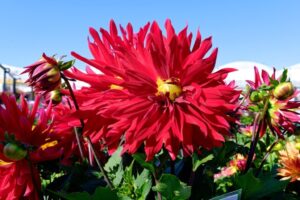
According to Dan, the market for dahlias remains strong, particularly dark-leaved varieties such as the ‘Happy Days’ series. Adding to Sincerity ‘Rose Bicolor’ which won herbaceous perennial at the 2025 Plant of the Year awards, JD Propagation are now producing Sincerity ‘Bronze Orange’ and Sincerity ‘Peach’. ‘We have a series called Summer Bees from Dümmen Orange, which have been bred to produce more pollen for the pollinators,’ said Dan, ‘And then we have a series here called XXL from Dümmen Orange, which are cut flower varieties that have been genetically shrunk to suit pot production.
‘(We also have) a new series of lacecap hydrangeas called ‘Trail Blazers’ … These are completely day-length neutral, repeat flowering and evergreen. They are the only hydrangea in the market that will flower all season long. They are being put through PBR right now.’
Also on display at JD Propagation were two new French lavenders; the first-year flowering ‘La Diva Imperial’ and a ‘micro’ lavender called ‘Shorty’, and a new euphorbia called ‘Miner’s Merlot’ with dark red foliage. New ranges from Dümmen Orange on show included the compact WallArt range of erysimums (wallflowers), the SpinTop range of gaillardias and the Sweet Daisy range of leucanthemums, the latter two both being day-length neutral.
If that does not sound like the JD Propagation team are busy enough, Dan says they are also building a new greenhouse specifically for pelargonium mother stock.
Their pelargoniums include the double-flowered ‘Savannah’ range and a new series called ‘Santana’, both from Dümmen Orange.
Syngenta Flowers also had a display at JD Propagation where Tony Collins was again on hand to talk us through that breeder’s plants: ‘One product I am really proud of is the DekkoTM series (of hybrid petunias). So, DekkoTM is like a (Petunia) milliflora, a little bit bigger than a calibrachoa. It has the petunia attributes coming through. I think DekkoTM ‘Pinwheel Purple’ is the standout in this class, (with its) nice dark foliage, nice self-cleaning, and plenty of colour coming through from there.
Tony says Syngenta also have a ‘ripping bunch’ of mandevillas from the United States. These include the Rio Petite range (Pink, Red, White) suitable for smaller pots. Less vining means lower labour costs to produce it, and Syngenta claims it flowers 7 to 10 days earlier than its main competitors. The Rio Grande range (Scarlet, Pink, Red) has a vigorous vining habit suiting trellised containers which can make an impact in high-end retail sector.
At Syngenta’s display, I spoke with Mike Murgiano, Global Portfolio Manager for Syngenta Flowers in Chicago, about his experience at Trials Week and reflections on the Australian industry more generally: ‘There is a high appetite always for new products. But there are some unique challenges that growers have here. One of the surprises for me was how difficult it is to get vegetative products into the market. There is a high interest in innovative seed products because of the logistic barriers, where(as) in other markets, innovation comes a lot from new cuttings. For me that was an interesting observation that I am going to take back and see what we can do a little bit better to support those products’.
Mansfield’s Propagation Nursery
Next stop was Mansfield’s Propagation Nursery in Skye where we toured the display gardens featuring Austraflora, Ozbreed, Instyle, and Core lines, plus new corymbia varieties and tissue culture introductions.
Symone Brown got us started on our tour, firstly highlighting a new 100 ml air-pruned pot that is making a difference to their production, particularly with their eucalypts and corymbias. She then showed us Corymbia ficifolia ‘Precious Pearl’, the 2026 Plant of the Year in situ in their display gardens. Mansfield’s are growing this corymbia from tissue culture which Symone is excited about: ‘It was difficult to get the protocols working, and now that we have got them working, we are looking at what other small native trees we can put into tissue culture. We are doing Eucalyptus ‘Euki Dwarf’ now and looking at other corymbia to start bringing through the pipeline.’ Another plant that Mansfield’s has cracked the tissue culture protocol for is the compact Wisteria ‘Amethyst Falls’ which should be available later this year.
At the Ozbreed display garden, Symone’s brother Matt Mansfield showed us another Plant of the Year award recipient (Australian Native Plant of the Year), the cutting-grown Chrysocephalum apiculatum ‘Aussie Reflection’. Another plant that caught my eye in the Ozbreed bed was Melaleuca ‘Space Saver’, which Matt says is a great option for hedges and along driveways. In other beds, new michelias (Magnolia spp.) from Paradise Plants, known for the Princess range, are being trialled to ensure their suitability in Victorian conditions.
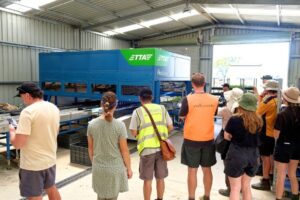
But it was not just the plants that caught our attention at Mansfield’s. This propagation nursery has recently installed additional automation and are using a transplantable plug to increase production. These Grownets, biodegradable and compostable plug liners, mean fewer plastic tubes going to landfill. We saw Mansfield’s new ‘sticking machine’ in action, which they expect to stick cuttings ten hours a day, compared to a human who on average spends six or so hours on this task. Mansfield’s have also installed a vision grading system which uses cameras, artificial intelligence and robotics to automatically inspect, sort and categorise plants based on predefined quality criteria.
Greenhills Propagation Nursery
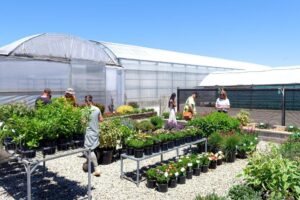
Greenhills Propagation Nursery in Tynong, was the final stop on our two-day bus tour, where Touch of Class Plants were on display. Greenhills had set up their displays to show the results of 12-week, 16-week and 40-week trials so customers can see what they can achieve from their plug or tube ranges in those timelines.
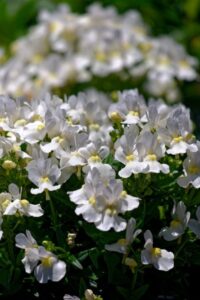
Sales Manager Shane Mott showed me Sweet Treats™ Nemesia (Nemesia fruticans), which have a naturally neat, compact habit suited to pots. They are cold and heat tolerant, and a trim after flowering will encourage rapid reblooming. ‘They are all fragrant in their own way, but ‘Vanilla Slice’ is obviously one of those special ones,’ said Shane of this nemesia cultivar. Shane is growing ‘Vanilla Slice’ in his own garden, finding that its perfume intersperses nicely with the scent of his citrus trees.
Shane also showed me a dwarf Indian hawthorn, Rhaphiolepis indica ‘Minikin’ that grows approximately 50cm tall by 50cm wide. He sees a market for this cultivar with apartment dwellers wanting to beautify their balconies, whilst retaining views beyond. It can also be used as a small border instead of Buxus. ‘Minikin’ provides seasonal interest throughout the year, especially important in a small space where landscapers and gardeners can select only a limited number of plants. White flowers appearing throughout winter and spring accompany its glossy green foliage.
A whole-of-industry showcase
Trials Week offers far more than a preview of new plant releases, and even after two full days, it feels as though I still had so much more to discover. Alongside the exciting genetics on display, allied suppliers such as Garden City Plastics, ICL, Norwood and Powerplants played a vital role in showcasing the tools, inputs and systems that underpin successful plant production. From pots and substrates to nutrition and infrastructure, these products are integral to how plants are grown, presented and perform in the market. A consistent message throughout the trials was clear: plants are becoming more compact and climate-adapted, with breeders, growers and suppliers working together to enable the industry to meet changing consumer and landscape demands.
.………………………………………………………………………………………………..
2026 PLANT OF THE YEAR WINNERS
- (Overall) Plant of the Year and Tree of the Year: Corymbia ficifolia ‘Precious Pearl’
- Shrub of the Year: Nandina domestica ‘LemLime’ – Magical Lemon Lime®
- Australian Native Plant of the Year: Chrysocephalum apiculatum ‘CAP07’ PRB Intended Trade Name – Aussie ReflectionTM.
- Highly Commended Australian Native Plant: Waxflower ‘Pinnacle Pink’
- Highly Commended Herbaceous Plant: Cyclamen persicum ‘Illusia’