Edible landscapes in the public realm
By Chris Williams
In this article I outline reasons for integrating community-based food production into municipal-level open space strategies. I argue that food production in public landscapes should be a fundamental part of a multi-functional urban green space system. Within this framework, thinking of crops and food plants as potentially edimental (both edible and ornamental) offers a powerful way to achieve the following: high-quality aesthetic objectives for general open space users; increased cultural relevance (through so-called culturally appropriate foods); and production of food for use by volunteer growers or for donation to food relief organisations. I present some general principles for designing edible landscapes in the public realm. These principles include spaces run largely by community volunteers as well as those managed by open space teams within local government (and everything in-between). I illustrate this with an overview of a project in south-east Melbourne which used edimental plants from my Novel Crops project.
In Australian cities many people grow veggies and fruit trees in their backyards. Beyond these private spaces there is also limited food production on public land, organised through community gardens. For most of us ‘community gardens’ means the traditional ‘allotment garden’ model: fenced sites, subdivided into individual plots, managed by local community members. While allotment style gardens can be personally and socially valuable, this model has significant limitations and challenges when applied to public land. These include uneven horticultural skill levels, governance challenges, limited oversight, and restricted community access beyond garden members, effectively the problem of privatising public open space.
In badly managed community gardens, elements of private gardens such as ad hoc structures, ‘amateur’ horticultural practices and a strong sense of exclusive ‘ownership’ can undermine the benefits of these spaces. This can occur even where some gardeners are skilful or dedicated, leading to an overall pattern of dysfunction and reduced amenity. In the last 10 years, most councils in Melbourne, where I research and lecture in urban agriculture, have moved away from the traditional ‘privatised’ allotment style model. Rather than individual plots being the default model, councils now promote communal or facilitated spaces that balance food production with broadly aesthetic goals linked to inclusive urban green space objectives.
Why grow food in public landscapes?
There are compelling reasons to integrate food production into the public realm.
Firstly, edible plants significantly expand the planting palette available to designers and horticulture teams. Edible species introduce distinctive seasonal change into planted landscapes, offer diverse and unique distinctive textures and forms and educational opportunities. This diversity can also deliver biodiversity benefits too, particularly when a wider range of herbaceous and perennial species is used.
Secondly, food gardens create opportunities for skills development and space activation. Council staff, contractors and volunteers develop new horticultural skills, while growing, harvesting and distribution of crops create reasons for people to engage with public space beyond passive recreation.
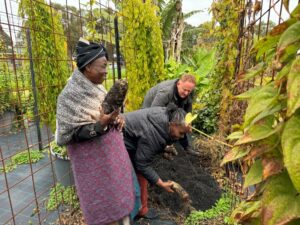
Thirdly, edible landscapes greatly enhance cultural recognition and inclusion, particularly relevant and important in multicultural cities. Many edible species are instantly recognisable to specific communities, creating what I call associative aesthetics. This is when someone, usually a recent migrant or refugee sees a food plant growing in a public space for the first time since they have migrated to Australia. There is a startling recognition of the plant, a sense of nostalgia is generated and the realisation that perhaps this plant could be grown in their private gardens, despite the very different climate in which they now live. More on this below.
Finally, edible species in public landscapes provide food! Produce can be distributed locally, donated to food charities or sold in appropriate contexts. This supports food security, provides culturally appropriate food, and in some cases contributes to local economic development.
Guiding principles for edible public landscapes for designers and managers
Public space function must come first. Food gardens should be accessible, welcoming and enjoyable for a diversity of users. They must look and feel intentional, coherent and well cared for.
Production must be real. Edible landscapes should be planned, designed and maintained to produce a usable harvest. Symbolic or gestural plantings, especially if they look attractive and are well maintained, have their place. However, designing and managing a food garden for a yield adds to the sense of purpose and achievement for the whole project. Digging, mulching, weeding and other crop maintenance tasks provide their own set of unique experiences and benefits which are as important as the crop itself. But the end goal remains a successful harvest, seasonal vagaries, pest and diseases notwithstanding!
Design with management planning is fundamental. Whether an edible landscape is being run by community volunteers or by in-house council horticulture teams, an edible landscape on public land needs a design process. This includes such obvious points as site selection, soil analysis, spatial arrangement, plant selection (crop choice) and planting design. Management and maintenance requirements including labour availability and horticultural skills should also be detailed. Ideally, the public land manager (usually a local council) should have a long term and transparent role in managing and supporting the space.
To reiterate, food gardens in the public realm should be stimulating and enriching at multiple levels, aesthetically pleasing, culturally meaningful and genuinely productive.
Design choices and caution with ‘food forests’
There are diverse design choices for edible landscapes in the public realm, from relatively formal and high turnover kitchen gardens to larger ‘market gardens’ and orchards. At a more complex level there are also mixed and layered plantings of diverse life forms, including fruit trees, vines, perennial herbaceous species and more conventional annual vegetables. In a mixed planting that incorporates diverse life forms (trees, shrubs, herbaceous species) it is important not to forgo basic site assessment and fundamental design processes.
The mixed plantings present the biggest challenges when initiated and run by community groups. I have reviewed various ‘food forest’ projects developed by local community permaculture groups in Melbourne. These projects all arose when local residents requested the use of public land to create a ‘food forest’. I have found that with all these projects the stated aims of the projects were never quite achieved. All these ‘food forests’ were, and are, promoted as self-sustaining, no-maintenance edible landscapes where mixing species together is promoted as creating an abundant food production ‘ecosystem’ mimicking the diverse layers of a tropical rainforest. These projects were not subject to a rigorous design process or site assessment, especially around soil, rainfall and plant selection. I found that these sites were quickly overwhelmed by weeds (usually summer grasses such as kikuyu). Over time they become dominated by the woody species, especially trees, that outcompete the understory plantings. Very little food is produced.
Systems, life forms and order
The failure of community-initiated ‘food forests’ (in Melbourne at least) has driven my interest in the role of local government horticulturists and open space managers in facilitating edible landscape projects. There are indeed several examples in Melbourne where abandoned or semi-derelict food forests have been restored through efforts from local government horticulture teams. In these cases, council officers have facilitated the creation of a new volunteer group to help with revival and on-going maintenance. With council horticulture teams providing free mulch, access to irrigation and help with working bees, a more functional and attractive edible landscape is developed. I am fond of the old saying that ‘the best fertiliser is the footsteps of the gardener.’ There is no getting around management and maintenance of all planted vegetation, and this is especially true of edible landscapes. Council support highlights the importance of engagement and facilitation of community food production by skilled in-house horticulturists.
If the benefits of urban food production outlined above are to be achieved, several principles are critical.
Novel Crops project
Australia’s extraordinary cultural diversity presents a significant opportunity to rethink edible landscapes. In the last ten years, through my Novel Crops project, I have investigated the question of whether a multicultural city like Melbourne could utilise a wider variety of crop species in private and public gardens. The aim is to better reflect our location in the Asia-Pacific, and the food and gardening practices of culturally and linguistically diverse communities.
Through the Novel Crops project, I have identified and trialled crops that are usually not mainstream to Melbourne’s backyard or community food gardens, but which are ‘culturally appropriate’ to a range of migrant communities from all over the world. These crops include taro, yams, sweet potato, cassava, ginger, water chestnut, kang kong (water spinach), choko and more. Clearly, a crop like ginger is used almost universally across the whole community while choko has a long history of use by Anglo-Celtic Australians, at least as a backyard plant from Sydney and north, although certainly not a much-loved vegetable! Through my engagement projects I have discovered that some communities do grow these ‘novel crops’ at home or in community gardens. However, this is usually not at scale and, critically, not with the preferred varieties of these crops. And herein lies a fascinating tale.
Lessons from the City of Greater Dandenong
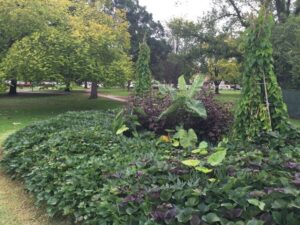
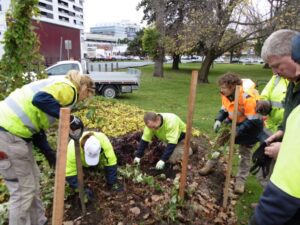
For many years I worked with the horticulture team at the City of Greater Dandenong in south-east Melbourne, the second most ethnically diverse municipality in Australia, after Fairfield in Sydney. Over half of the municipality’s population was born in non-English-speaking countries with residents from more than 160 national backgrounds. We grew sweet potatoes, yams, cassava, cranberry hibiscus, Abyssinian bananas, and taro in Dandenong Park, and then outside the Dandenong Market in planting beds that might once have been used for annual flowers. The horticulture team at Dandenong, led by team leader Stephen Nelson, had already experimented with conventional vegetable plantings in parks, and these had been popular with the public.
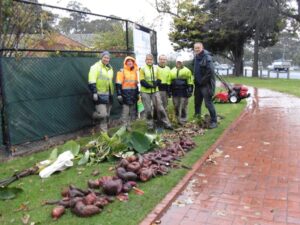
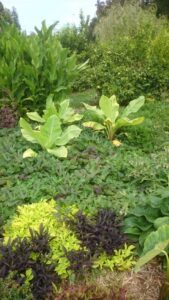
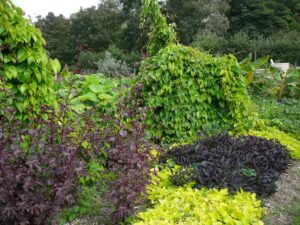
We teamed up to plant what we dubbed the ‘tropical beds’. Through several engagement projects, I had discovered that in most migrant communities, conventional orange sweet potatoes are not highly regarded. I had built up a collection of firmer, ‘breadier’ types of sweet potatoes and these were planted in Dandenong Park and outside the market. In one summer growing season, these sweet potatoes produced excellent yields of tubers all of which was donated to charity. The sweet potato tubers ranged from all purple (inside and out) to white and orange types. From a functional and aesthetic perspective, the sweet potato plants knitted together to create a cohesive weed supressing ground cover with a diversity of leaf shapes and colours. Rising out of this flat plane were the elephant ears of the taro and the gigantic Abyssinian banana. One fascinating outcome was the interest of the local community (people from Ghana, Vietnam and India) in harvesting the leaves of the sweet potatoes to use as a highly nutritious summer spinach.
Several lessons emerged from this experience:
- These species can be grown successfully in public landscapes, with good yields. Even crops that were sub-optimal such as cassava, in terms of root production, still grew well enough during the summer to look not just recognisable but also produced leaves that are a secondary but popular crop for many communities.
- Users enjoy and recognise the plantings, often forming strong connections to them.
- Council gardeners develop new skills and take pride in contributing something distinctive.
- Produce is valued and used: during the period of the project all sweet potatoes were distributed to local food charities.
We could apply the agronomic lessons from this partnership to food production with other projects. In fact, I have now worked with the food relief organisation FareShare since 2016 on supply and production of sweet potato plants at their small farm sites in Melbourne.
Conclusion
I have a ‘non-secret agenda’ to create meaningful employment pathways for horticulture graduates as designers, managers and maintainers of vegetation in urban green space. This includes training graduates to confidently and intelligently use edible species as part of sophisticated planting design, rather than relegating food plants to fenced-off community gardens or marginal spaces.
Melbourne is projected to reach nine million people by 2056, an 85% increase from today. At the same time more people will live without access to private backyards as apartment living becomes more common. In this scenario public open space must work harder to provide meaningful experiences for a wide range of users. Integrating productive planting into urban green space offers one pathway to more resilient, multifunctional landscapes.
Some useful references
- Jacke, D., & Toensmeier, E. (2005). Edible forest gardens, volume I: Ecological vision and theory for temperate climate permaculture. Chelsea Green Publishing.
- Jacke, D., & Toensmeier, E. (2005). Edible forest gardens, volume II: Ecological design and practice for temperate-climate permaculture. Chelsea Green Publishing.
- Glowinski, L. (2008). The complete book of fruit growing in Australia. Hachette Australia.
- Phillips, A. (2013). Designing urban agriculture: A complete guide to the planning, design, construction, maintenance, and management of edible landscapes. John Wiley & Sons.
- Toensmeier, E. (2012). Perennial vegetable gardening. Chelsea Green Publishing.
All images supplied by the author.
Chris Williams
University of Melbourne
E: chriscw@unimelb.edu.au