
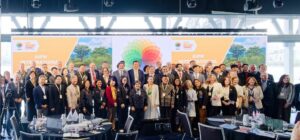
AIPH Meeting Sydney 2026
By Gabrielle Stannus
The International Association of Horticultural Producers (AIPH) 2026 Meeting, which took place from 8-12 March 2026, offered unique insights into the current challenges and opportunities for the global industry and provided in-depth knowledge of Australia’s ornamental horticulture sector. Hosted by AIPH member Greenlife Industry Australia (GIA), the meeting provided an important platform for delegates to gain international insight, strengthen professional networks, share best practice and engage in constructive discussion on the future of ornamental horticulture worldwide. In this article, I share relevant insights from two key events held during this week: 1) International Horticultural Expo Conference, and 2) Horticultural Industry Conference.
INTERNATIONAL HORTICULTURAL EXPO CONFERENCE
AIPH is a membership association of national horticulture industry associations which represent thousands of growers of flowers and ornamental plants around the world. AIPH’s key aim is to stimulate demand for ornamental trees, plants and flowers worldwide. One of the ways this organisation does that is through its role as the global approving body for international horticultural expos held in countries across the world.
On Monday 9 March 2026, we heard progress reports from AIPH members currently organising the following events:
A1 International Horticultural Expos
- Expo 2027 Yokohama (GREENxExpo), Japan
- Expo 2029 Korat, Thailand
- Expo 2031 Minnesota, USA
International Green Expos
- Expo 2026 Udon Thani, Thailand
- 2028 Ulsan International Garden Expo, Rep. Korea
- Expo 2029 Garden Baghdad, Iraq
International Horticultural Shows
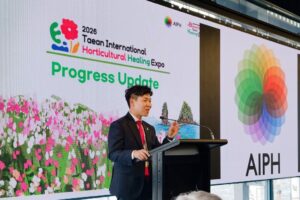
- Taean International Horticultural Healing Expo 2026, Rep. Korea
- Expo İzmir 2027, Turkiye
I really loved the energy and enthusiasm these members brought to the room, especially Jung Wook Choi, the Republic of Korea delegate, whose team are capitalising on the K-pop craze as part of their event planning.
These events create long lasting green legacies in cities across the globe, and there is momentum within our local horticultural industry to secure one here in Australia (Bringing the ‘Horticultural Olympics’ Down Under! Hort Journal Australia, April 2025). No formal announcement was made during this conference as to if and where that might happen. However, I can say there were plenty of local industry members from across the country, including New South Wales, Tasmania, Victoria and Western Australia, all listening attentively. Which city might get the gig? Stay tuned for further news!
HORTICULTURAL INDUSTRY CONFERENCE
On Tuesday 10 March 2026, the AIPH Horticultural Industry Conference brought together leaders from across the global horticultural sector to explore two defining forces reshaping the industry: a rapidly changing climate and an increasingly dynamic marketplace. The conference examined how producers and innovators can adapt and build resilience for the future in the face of mounting pressures on water availability, accelerating climate change, and growing biosecurity risks. Alongside these environmental challenges, delegates also explored shifting consumer expectations, evolving supply chains, and new market opportunities, setting the stage for a discussion on the future of horticulture worldwide.

Session 1: The climate is changing
Matt Kean, Chair of the Climate Change Authority in Australia, opened this conference with a presentation on the challenges of climate change and actions that need to be taken. Matt reminded us that the carbon clock is ticking and that there are real business risks facing us if we do not adapt to change. However, not all is doom and gloom. Horticultural producers could benefit from opportunities to decarbonise the Australian economy. For example, increasing biochar production would divert methane-producing organic material from landfill, and when incorporated into soil, it becomes a durable carbon sink. Regular contributor Erik van Zuilekom will write about the biochar revolution and that product’s use in growing media in our May issue.
Water
Chris Philpot, CEO, The Water Conservancy, then presented insights on water management best practice in Australia and initiatives to support the horticulture industry. Production nurseries and growing media businesses seeking to reduce their water consumption are encouraged to explore GIA’s Nursery Industry Accreditation Scheme of Australia (NIASA) and the associated EcoHort Guidelines, both of which are independently certified through The Water Conservancy’s Smart Drop certification scheme. EcoHort is an environmental management system designed for Australian businesses, with a systematic approach to assess their environmental and natural resource management responsibilities as part of their daily business management.
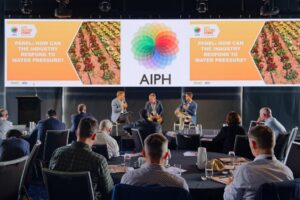
How can the industry respond to water pressure? This was the question Chris then put to Andy Cameron, President, Greenlife Industry NSW & ACT (GINA), and Eduardo Barbosa, R&D Manager, Hort Innovation. Andy reminded us that here in Australia, we can grow plants outside throughout the year, unlike some other conference participants. However, this is changing as we experience climate-change related extreme weather events, including altered rainfall patterns, across this continent. Andy encouraged investment in recycled water. Eduardo said that without water, you cannot grow product and flagged the potential for artificial intelligence (AI) to gather data from multiple sources to improve irrigation outcomes. One salient point made during this panel session was that our parks and gardens, which benefit us all, are often the first users to be placed on water restrictions during times of drought, despite these being the very places that require water to survive. What does this say about how we value green infrastructure? Industry can do more to lobby for water to stay in our gardens during drought and call for other non-essential activities such as car washing to be reduced instead. Furthermore, we must better promote the environmental benefits of a healthy and well-hydrated landscape to make this happen.
Biosecurity
Celeste Cook from GIA explored national plant health schemes and how to protect ornamental horticulture in her presentation, ‘Biosecure HACCP – A High Health Plant Production System’. Celeste’s presentation highlighted the Australian Plant Production Standard (APPS) programs, showcasing Australia’s accreditation systems to the international audience. Celeste has kindly shared additional information about BioSecure HACCP and what that looks like in practice for nurseries in her article, ‘Inside the nursery: Small changes that stop pests spreading’, in this issue.
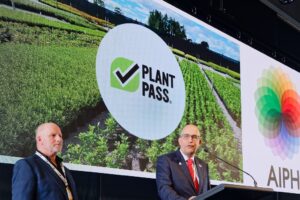
Matt Dolan, CEO, New Zealand Plant Producers Incorporated (NZPPI) continued the biosecurity theme, outlining how he is working with growers to protect the New Zealand industry through the Plant Pass scheme. New Zealand has had its fair share of biosecurity challenges over the last decade or so, notably the incursion of PSA (Pseudomonas syringae pv. actinidiae), a highly destructive bacterial disease that affects kiwifruit vines causing leaf spots, shoot dieback, and cankers that ooze a red-brown substance.
Jack Goossens, AIPH Vice-President and Chair of its Ornamentals Production Committee, and Dr Audrey Timm, AIPH Technical Initiatives Manager ‘launched’ the AIPH Plant Health Framework, a unified voluntary plant health framework to support global biosecurity and trade. This framework has been designed to give existing voluntary standards international validation and support new regions in creating standards to help provide opportunities for ‘frictionless trade’ across borders.
Session 2: The market is changing
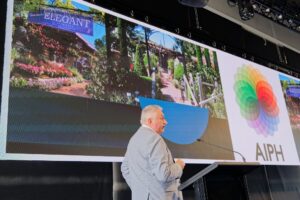
Mike Mehigan, CEO, GINA, spoke about the evolution of plant retailing in Australia. Mike said that traditional garden centres are struggling. The more successful one’s are those centres diversifying by adding allied products, cafes, giftware and garden art to their greenlife range. According to Mike, having a garden centre on a block with solely trees, shrubs and other plants is not sustainable with land values so high. He says another model is coming; one that factors in high traffic areas, such as at supermarkets. John Fitzsimmons picks up on this problem briefly in another article in this issue of Hort Journal Australia, ‘Merchandising for maximum impact, minimum spend’. Mike also said that people want plants, yet they also want quality-trained staff to help them choose and maintain those plants. Consumers do not necessarily receive this type of assistance when visiting a big box store where the standard is a self-service model featuring plant labels and QR codes, with very little human interaction. Independent garden centres can bridge that gap. However, Mike does not rule out the use of technology, saying it does not replace the garden centre, rather, it supercharges it! For example, Bunnings now promotes home delivery of plants through Uber. What could your garden centre do differently if it used technology more effectively?
Elyse Allum, Associate Marketing Manager, Hort Innovation, introduced ‘The plant value report’, a recent initiative undertaken with Domain Insight through the Greener Spaces, Better Places program. This report, published in October 2025, shows how gardens, plants and leafy spaces boost the value of Australian homes. I took a closer look at the report post-conference. Nationally, houses with greenery sell for 17.4% more, commanding an additional $140,000 on the median sale price compared with similar homes without greenery features. Hort Innovation’s approach to industry marketing has changed over the last decade, moving from a focus on the public realm through the 202020 Vision with its aim to increase public green space by 20% by 2020, to speaking more directly to the consumer, firstly through Plant Life Balance and now this report. Ellen highlighted that Hort Innovation’s current nursery marketing plan runs out at the end of June 2027. What changes might we see next?
In his other capacity as Interim Chair, Plants and Flowers Foundation Holland, Jack Goossens shared that industry association’s example of consumer-focused marketing. Their simple yet effective campaign, ‘Something beautiful is growing here’ links the emotional value of flowers with sustainability. Growers receive media training to ensure consistent messaging and are encouraged to manage negative perceptions about the industry’s chemical and energy use by sharing authentic sustainability stories.
Bill Hardy, AIPH Chair of Green City Committee, and Dr Audrey Timm, AIPH Technical Initiatives Manager then introduced AIPH’s Green City Standard, a new initiative that aims to enhance urban greening and plant use through an evidence-based framework. The Standard features eight, city-led processes with 50 measurable outcomes for assessing urban greening progress. Audrey says that AIPH is hoping to roll this out in Australian cities: ‘By having a number of Australian cities involved, they can learn from each other, and they can grow and progress together.’
Session 3: Advocating for the industry
Nick Hutchinson, GIA Chairman and General Manager, Fernland, spoke about the relationship between GIA and Bunnings in a highly concentrated retail market, and what this means for the future of ornamental horticulture. With 300 stores nationally, Bunnings is the largest retailer of plants in the country. ‘It is not a melodrama, it is mathematics’, said Nick about this situation. Working with government, GIA, has brought about better trading terms for Australian growers, including its well-publicised campaign with Bunnings.
Tim Briercliffe, AIPH Secretary General chaired a panel on the topic ‘Getting the best deal for growers’, which featured Nick Hutchinson, Victor Santacruz, CEO of Canadian Nursery Landscape Association (CNLA), Leonardo Capitanio, AIPH President and Former President of the Italian Nurserystock Exporters Association (ANVE), and José Antonio Restrepo Rada, Chairman of the Board of Directors Asocolflores, Colombia. They spoke briefly about the struggle to attract younger people into the industry. This is a challenge that I have put to the International Plant Production Society (IPPS) Australia, whose 54th conference is happening in Hobart soon. At that conference, participants will take part in Design Sprints, working together to solve common industry problems. There will be a large TAFE student cohort attending, so maybe they can bring a fresh perspective to this challenge, if it is accepted.
Wrapping up
There was a lot to digest at both conferences, including some very delicious dinners at Botanic House and Bondi Icebergs Club. Many attendees even found the energy to participate in the post-conference professional visits, touring local nurseries (Andreasens Green, Oasis Horticulture, Tim’s Garden Centre) and scenic sights (Australian Botanic Garden Mount Annan and the Blue Mountains). My one key take-away? If you want to be an industry leader, you must attend the next AIPH meeting the next time it is held in Australia!