
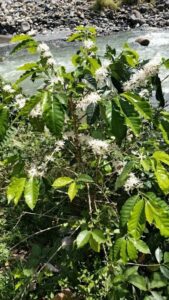
Coffee: A shrub with history!
By Clive Larkman
Living in Melbourne means permanent access to great coffee and a culture of having this staple drink with every meal. However, many people seem to have little knowledge of the plant itself. Plants in the Coffea genus provide the source of the world’s most popular morning drink, as well as some very attractive shrubs.
The Coffea genus belongs to the Rubiaceae (coffee, madder, bedstraw family) and includes over 120 species. This genus originated from equatorial Africa and its plants are now found across the continent including 60 to 65 species in Madagascar, several in Asia and even one in Australia (Coffea brassii). While fossils of the specific Coffea species are scarce, studies point to East African countries such as Ethiopia, Sudan and Kenya as being the origin of the modern Arabica plant (C. arabica). It is thought to be a natural hybrid of Robusta (C. canephora Syn. C. robusta) and C. eugenioides around 500,000 years ago.
The drink we now call coffee has its origins in the kingdom of Kaffa in the Ethiopian Highlands. Legend has it that an Ethiopian goatherder named Kaldi discovered coffee in the early eighth century after noticing his herd dancing with energy after eating the plant’s red berries. Kaldi also tried these berries and he too felt energised. He took his new find to the local monks who initially rejected them and put them in the fire. The roasted berries created a pleasant aroma, prompting the monks to rake them from the fire and make a drink with hot water to help them stay awake during prayers. The modern coffee ceremony you can now partake in at most good Ethiopian restaurants has its origins in this serendipitous event.
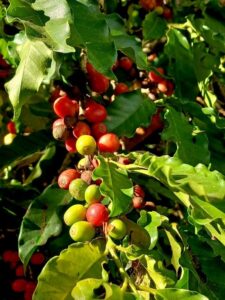
From Ethiopia, the plant crossed the Red Sea into Yemen in the 15th century, where the names ‘Arabica’ and ‘coffee’ (from the Dutch word koffie, via Ottoman Turkish kahve, after the Arabic, qahwah) came into being. It is also where the seeds were first roasted and brewed into a beverage like the one we drink today.
By the 16th century, coffee had spread throughout the Middle East, eventually reaching Europe via Venetian trade routes and forever changing the social fabric of the West through the rise of coffee houses. The first coffee house was in Oxford in England. These establishments quickly became popular in London, one of which took the name ‘Coffee Club’ from a wooden club in the room. This gave rise to the use of the word ‘club’ in modern English society. We now have ‘clubs’ in all walks of life!
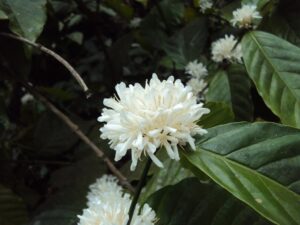
The coffee we now love to drink basically comes from only two species C. arabica and C. canephora (Syn. C. robusta). C. arabica (Arabica) is of a higher quality being smoother and sweeter with a more complex flavour profile. C. canephora (Robusta) is stronger and more bitter as it contains more caffeine. As with many things, neither species is inherently ‘better’, but what tastes best ultimately depends on the drinker’s personal preference, which is why blends are often favoured.
C. arabica makes up approximately 60 to 70% of global coffee production. This species thrives at higher altitudes, requiring quite specific temperature ranges to survive and produce viable yields. C. canephora is much hardier, more pest resistant and able to grow at lower altitudes and higher temperatures. It also has double the caffeine of Arabica, and produces a more robust and broader flavour profile making it the preferred species from which to produce instant coffee. Other species including C. liberica and C. excelsa have some commercial usage but their production accounts for well under 2% of the global market. Many of these varieties are used in their local regions.
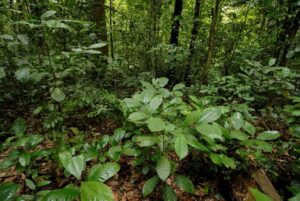
Coffee plants themselves are generally large woody evergreen shrubs or small trees. Left unpruned, some species can reach over 8 m in height. Arabica normally grows to around 3-4 m, whilst Robusta grows to 6-7 m tall. Most farmers will keep them at about 2 m for ease of harvest and management. Arabica has larger more oval-shaped beans and Robusta leaves are smaller and rounder. Whilst these plants are highly ornamental, care must be taken to ensure that they do not become weedy in environmentally sensitive landscapes.