
Underground storage: A tactic for tougher landscape plants
By Daniel Fuller
Plants can be conceptualised as self-sustaining machines that do not eat food; they manufacture their own food using photosynthesis. Every leaf is like a solar panel, capturing energy that can be stored in the plant’s roots and other storage organs. Some plants are better at storing that energy than other plants. There are some extraordinary Australian plants that can store energy underground to help them continue thriving through extremely stressful climatic events or at least bounce back after conditions improve.
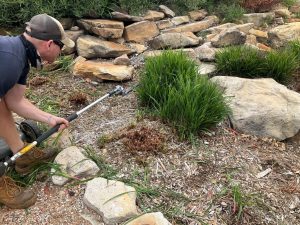
Dianella caerulea ‘DCNC3’ PBR Trade Name Baby Breeze™ is an especially rhizomatous Australian flax. Instead of staying tight as a clump, it should be allowed to spread throughout a bed and create many new tightly-packed clumps. While the general advice is to prune Dianella spp. at least 100 mm from the ground, this variety reliably bounces back from extreme cutbacks just above the ground.
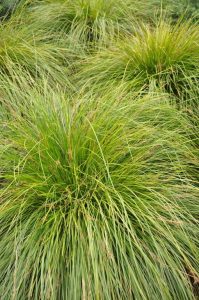
Lomandra longifolia ‘LM360′ PBR Trade Name Lady Tanika® has a true clumping form that does not spread. Whilst lomandras generally store most of their energy reserves in their crowns and basal stem tissue, this cultivar retains enough resources below ground to reliably bounce back after extreme cutbacks just above the ground, much lower than the generally recommended 100 mm.
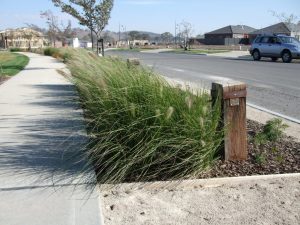
Cenchrus purpurascens ‘PA300’ Trade Name Nafray® is a true grass that establishes remarkably quickly. It is perfect for slope erosion control where you need good growth within the first season. Like most clumping grasses, it appreciates a cutback around 100 mm above the ground before spring each year. Chop ‘n’ drop style mulching is a sustainable practice for low profile sites.
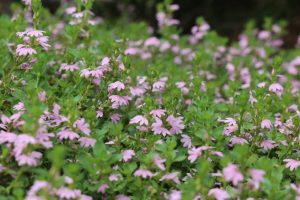
Scaevola humilis ‘PFS200’ PBR Trade Name Pink Fusion™ is extremely stoloniferous, continuously setting down new roots and underground storage points as it rambles. If you plant it near other low-growing plants, the chances are that Pink Fusion™ Scaevola will end up smothering them all. Pruning is optional and can be done with a hedge trimmer or brushcutter, before blowing the trimmings under a shrub or onto mulch.
Chrysocephalum apiculatum ‘CAP07’ PBR Intended Trade Name Aussie Reflection™ is an unusual yellow button plant. While most varieties exhaust their energy reserves within the first couple of seasons, Aussie Reflection™ Chrysocephalum spends some of those energy reserves setting new roots and underground storage along its stems, allowing it to continue to flower prolifically. Its ability to store underground energy allows it to bounce back quickly after experiencing adverse conditions. Every new set of roots provides additional redundancy.
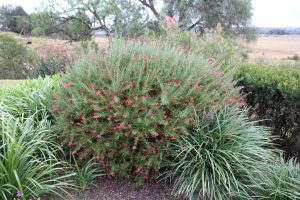
Grevillea rosmarinifolia ‘H16’ PBR Trade Name Crimson Villea™ is a small to medium shrub that is ideal for low hedging, domes and naturalistic shapes. It can tolerate extreme cutbacks just above the ground, which lets us know it is highly capable of storing energy in its roots, and sends up epicormic shoots to replace lost foliage.
Callistemon viminalis ‘CV01’ PBR Trade Name Slim™ is one of Ozbreed’s flagship screening hedges or fastigiate trees. Through testing over the years, it has proven itself a fantastic candidate for coppicing due to its ability to store energy in its roots.
Ultimately, these plants may not ever need to rely on their underground storage if they never face adverse growing conditions. However, it is nice to know that they are keeping some reserves in the tank if they ever need them. Watch these cultivars bounce back where other members of the same species give up and die.
Daniel Fuller
Ozbreed Planting Strategist
M: 0426 169 708
E: Horticulture@ozbreed.com.au
W: ozbreed.com.au