
Women find a working oasis
By Gabrielle Stannus
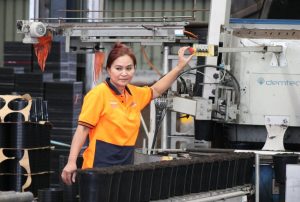
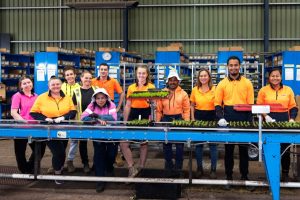
Recent promotions and position changes at Oasis Horticulture’s Springwood production facility have seen women step into key roles across the operation, with almost two-thirds of management and supervisory positions now held by female team members. I spoke with two of those women to find out how Oasis is fostering diverse and inclusive leadership amongst its horticultural workforce.
Anna Yodkiri, Production Manager
Anna Yodkiri has been working with Oasis Horticulture for almost thirteen years. Anna got her start there working part-time as a nursery hand, picking and packing plants. In 2018, she was promoted to the position of Transplanting Supervisor and has more recently become this site’s Production Manager. Anna did not start her working life in horticulture even though she grew up in the Thailand countryside where her father owned a mango farm – her early ambition lay elsewhere. She completed a business degree before moving into the hospitality industry, owning her own restaurant, and she now brings the skills learnt in that environment to production horticulture.
With her business acumen, Anna ensures the production team runs on time and on budget, managing staff availability, meeting daily production deadlines and communicating with senior managers. In her current role, she supervises 20 to 30 people, even more in peak production times, producing hundreds of plant varieties. However, Anna is not one to rest easy and is always on the hunt for opportunities to improve business practices and Oasis’ plant production, ‘How I can make the job flow easier and improve efficiency? How can we do something a bit faster? What technology is coming that we could use in the future? If we get new machinery, that might improve things for the nursery so we can put more product into the market,’ she says, adding that this will ultimately improve the business’ bottom line.
With no formal training, Anna’s horticultural knowledge has been gained on the job, which she describes as very hands-on, ‘I operate machinery. Sometimes I operate the forklift or the frontend loader if needed. If a machine breaks down, I need to get it fixed. I like to raise problems early. I just act straight away as I do not like to wait. If I need the machine fixed, I contact help straight away on my phone.’ During such times, Anna quickly engages her team on alternative tasks such as planting by hand to ensure that workflow continues, thereby enabling production deadlines to be met.
Anna has some words for other women seeking to move up the horticultural career ladder, ‘Women must believe in themselves and need to try new things like learning how to operate machinery; do not be scared to touch the machine, to learn how to drive the forklift. They must believe in themselves and that they can do it. Do not be scared to ask questions, “Did I do this right?” If you do not know and you do not ask, you are not going to learn anything. That is why I am trying to inspire women to learn and speak up for themselves.’
She says that businesses also have a role in supporting women to learn new skills, be that operating machinery or learning how to lead work teams. At Oasis, Anna is appreciative of the training she receives during work hours, including a leadership course she is commencing this month.
A supportive culture helps businesses retain good people like Anna, and she also likes to ensure that the production shed environment is a happy one for workers. ‘You can solve any problem, but you must work together. In the production team, you cannot work alone. It does not matter how good I am in my job. I still need the support of the team and the business to get the job done. If you do not have a good team, you can forget about success.’
Anna has enjoyed her career switch, finding that production horticulture provides very attractive opportunities for women in the workforce including long-term careers, full-time jobs and paid leave, benefits that she did not necessarily receive when working in the restaurant game. The biggest bonus? ‘Because you only work Monday to Friday you have the weekend off. If you work in hospitality, you never have the weekend off!’ says Anna.
Kabita Kurunju, Plug Coordinator
Kabita Kurunju is another woman working her way up the ranks at Oasis Horticulture. From a young age, Kabita developed a connection with plants on her family’s small farm in her home country, Nepal, where they grew vegetables, rice, maize and potatoes for daily consumption. She completed an undergraduate degree in agriculture majoring in plant protection, before working in hybrid tomato seed production. She then moved to Australia for her future study and completed postgraduate studies in agriculture and horticulture, specialising in protected cropping.
A year ago, Kabita started working at Oasis’ Springwood production facility, where she is now employed as its Plug Coordinator. She is responsible for coordinating and growing all plug orders, including sourcing plugs externally if Oasis does not grow them, and monitoring the progress of crops from the seed sowing stage to the transplant table.
Kabita is keen to incorporate the latest horticultural technology in her growing, including automation, precision growing and emerging applications of artificial intelligence to improve production efficiency and crop consistency. She strongly values the role of genetically improved seeds in nursery production noting its contribution to higher and more uniform germination rates, stronger early vigour, and higher tolerance to environmental stress. ‘While I was working in hybrid seed production, different tasks, especially pollination, required high level of accuracy and close monitoring, as even small errors could significantly affect crop and seed quality. That experience has reinforced the importance of precision in growing plants. By adopting advanced growing technologies, I believe we can improve plug uniformity, plant health and production efficiency’, says Kabita.
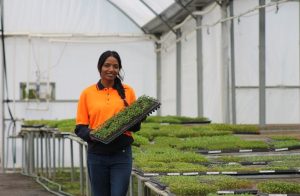
Kabita is also interested in how technology can enable production horticulturists to meet the challenges of a changing climate, a phenomenon which she says is affecting the growing of plugs, ‘The temperature is 40 degrees Celsius one day, and the next day it is only 25 degrees Celsius, and then the day after that, it rains.’ She is drawing on her greenhouse and protected cropping experience to respond to this issue now but acknowledges that this is a growing problem which not only she, but all in the industry, needs to solve.
Kabita says that work conditions in Australia are very different to those in Nepal, ‘Back in my country, the farming system is very different from here. So landing a job in a completely different country with completely different growing structures and climate is challenging. Previously, I have worked directly in the soil rather than in the plug mix or in a pot.’
Australian workplaces are also very different culturally. According to Kabita, most leaders in Nepal are men: ‘It is a male-dominated country where few women are engaged in leadership. If the woman is leading a team, people should not undervalue her or her work. Instead of questioning her, she should be supported, she should be guided properly. Here, working as a female leader of a team, I think we can inspire more women in horticulture by providing clear career pathways, including roles and positions that women can realistically access. Providing flexible working hours and creating supportive conditions, particularly around pregnancy and early motherhood, are essential.’
Kabita also notes that workplaces need greater awareness of women’s health more broadly, including the physical and emotional impacts of menstruation. This may involve providing appropriate amenities, as well as fostering understanding among managers and supervisors so they can respond thoughtfully to temporary changes in wellbeing or energy levels.
For women seeking to extend their skills and move into leadership positions, Kabita also has some very wise words: ‘Find mentors who can guide you properly. When I started working here, I had the previous plug growers, Sarah and Leigh, guiding me throughout my journey. Take opportunities that comes your way even if you are not one hundred percent ready and make as much of it as possible. Most importantly, have confidence. You should be confident, so whatever you are doing, you do your best.’
For Kabita, the most satisfying part of her work is seeing fully germinated plug trays heading out to customers, ‘From a very tiny seed, it is exciting to see them alive and growing so well. I feel very fulfilled when we meet production targets without compromising the quality, and when our customers get their required production with full satisfaction. I think that is the most rewarding aspect of being a plug grower.’
Both Kabita and Anna are enjoying a rewarding horticultural career, success which is due in part to a supportive workplace culture. Matthew Ford, Nursery Manager at Oasis Horticulture’s Springwood facility acknowledges the importance of that site’s management team reflecting the workforce they have in their nurseries, ‘Women play a critical role across our nurseries, whether in production, logistics or leadership, and having that representation at a management level ensures decisions are grounded in the practical realities of nursery production and operations. A diverse management team brings different perspectives, challenges assumptions and leads to better outcomes for our people and our business. Creating space for women to share their stories helps reinforce that leadership in the nursery industry is achievable, valued and strengthened by diversity.’
Gabrielle Stannus
Inwardout Studio
M: 0400 431 277
E: gabrielle@inwardoutstudio.com.au