Working smarter under pressure
How nurseries are rethinking labour, consistency and scale
By Jennifer McQueen
A task that once took two people a full day now takes one person five hours. That is the kind of change many nurseries are chasing, but not through large-scale automation or complex systems. Instead, growers are finding smarter, more practical ways to improve how core jobs get done. Labour constraints, rising production demands and increasing biosecurity risks are pushing nurseries to rethink how their operations run. For many, ‘working smarter’ is not about fully automated operations: it is about targeted upgrades to key processes that improve consistency, reduce risk and create capacity for growth. Two Australian nurseries, Engall’s and Harts Nursery, are doing exactly that. By focusing on core production system elements, spraying and pruning, both have achieved significant efficiency gains while improving plant quality and workplace conditions.
Solving a major bottleneck
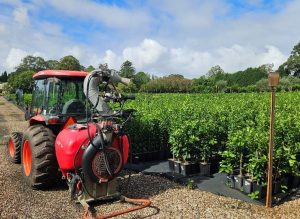
At Engall’s Nursery in New South Wales, spraying used to take two employees a full day. As the business expanded, that approach became increasingly unsustainable. Owner and General Manager Mark Engall recognised the need for a more efficient solution and invested in a compact enclosed-cabin tractor fitted with a turbomiser sprayer. The impact was immediate. Today, the same task takes one person around five hours, a 92% reduction in labour, even as the nursery has grown to four times its previous size.
More importantly, the change improved consistency and control. The turbomiser delivers even chemical coverage across large areas, reduced chemical drift and improved spray accuracy, thus improving safety for staff and supporting more environmentally responsible practices. ‘We now sit in a tractor with the radio going and spraying is a breeze,’ Mark said. The time saved has been reinvested into improving production systems and planning for growth, rather than repetitive manual work.
From manual work to managed systems
A similar shift has taken place at Harts Nursery in the Gold Coast hinterland, where manual trimming once limited efficiency and consistency at scale. Producing hundreds of thousands of plants each year, the nursery relied on staff trimming individual pots and trays by hand, a process that was slow, physically demanding and difficult to standardise. It also required strict hygiene practices to minimise the risk of spreading pests and disease.
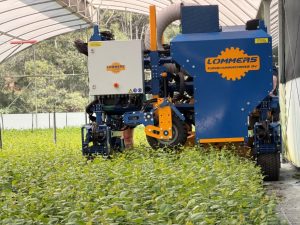
With support from the nursery levy-funded GrowConnex program, the business explored how mechanical pruning could be integrated into existing workflows. After trialling different options, Harts installed its first machine. ‘That first machine was the turning point. Since it arrived, the consistency has been fantastic,’ said owner Chris Hart. Mechanical pruning now delivers uniform size and shape across a wide range of crops, including ornamentals, hedging plants and blueberries. Trimming is faster and easier to schedule, allowing plants to be pruned more regularly and encouraging stronger, bushier growth.
Reducing handling, improving outcomes
Building on early success, Harts worked with international designers to develop a second-generation machine that trims plants in place, eliminating the need for manual handling. ‘Now it’s the machine touching the plants, not people,’ Chris said. Reducing handling has lowered the risk of introducing pests and disease, while also improving workflow efficiency. Staff now operate equipment rather than performing repetitive manual tasks, freeing up time for higher-value work across the nursery.
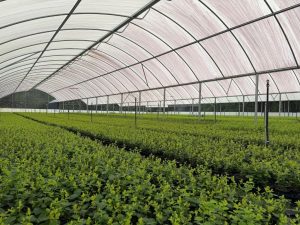
Mechanical pruning is now integrated into both propagation and production. Trays are trimmed before robotic transplanting to ensure uniformity, while established plants are pruned in place within greenhouses. Importantly, the system was adapted to fit existing infrastructure, making adoption practical rather than disruptive.
Consistency at scale
For both nurseries, the real benefit of mechanisation is consistency. At Harts, uniformity is critical for large production runs, particularly for berry crops where plants must look and perform the same. ‘We want the first plant to look exactly the same as the 500,000th,’ Chris said. At Engall’s, consistent spray application has improved plant health outcomes and reduced the need for reactive treatments, which supports more stable production across the season.
Creating capacity for growth
At Engall’s, labour savings have been reinvested into system improvements and data-driven decision-making. At Harts, mechanical pruning has streamlined workflows and improved both product quality and staff wellbeing. These changes are not about replacing people, but about using labour more effectively and shifting time away from repetitive manual tasks and into areas that support business growth.
Targeted change, real impact
What stands out in both examples is how targeted these changes are. Neither business set out to overhaul their entire operation. Instead, they focused on the tasks that were slowing them down most, spraying and pruning, and asked what a better system could look like.
Technology adoption in nurseries is rarely about cutting-edge innovation. Instead, it’s about using practical, well-chosen systems to improve how key jobs get done. In many cases, change starts with a single pressure point rather than a whole-of-business strategy. The result is not just time saved, it is a different way of running the nursery. It is more predictable workflows, better use of skilled staff and greater confidence in output at scale.

Small changes, significant impact
The experience of Engall’s and Harts highlights a broader trend across the nursery industry. Incremental, practical changes to core systems can deliver significant gains in efficiency, consistency and scalability. Rather than chasing large, complex automation projects, these businesses have focused on targeted improvements that fit their operations and solve real problems. In an environment where labour, quality and risk are constant pressures, that approach is proving to be one of the smartest ways forward.
All images supplied by the author.
Jennifer McQueen
Director of Communications
Greenlife Industry Australia