Conserving nature through floriculture
By Gabrielle Stannus
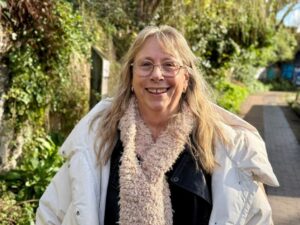
A town planner by trade, Natalie Vallance has grown into the role of a grower with the support of her late husband and horticulturist, Steve. Together the pair transformed an essentially vacant block of land 50 kilometres north of Perth, Western Australia, into the Muchea Tree Farm, a thriving production nursery specialising in Australian natives and Proteaceae. Natalie now has a special interest in producing plants for floriculture, an industry she says may play a part in conserving rare and endangered plants.
Natalie and her team grow thousands of different native and exotic plants including native farm trees, shrubs and ground covers for both conservation and ornamental purposes. Over the years, Natalie and Steve have even cultivated several proteas and leucospermums of their own, naming them after their daughters, Protea ‘Kaziah’, Protea ‘Cherith’, Leucospermum ‘Syan Laura’, Leucospermum ‘Esther’s Gold’, and granddaughters, Leucospermum ‘Ceana May’ and Protea ‘Princess Grace’. ‘I will never be able to retire until I can find that elusive one to name after little Elsie’ says Natalie about her third granddaughter.
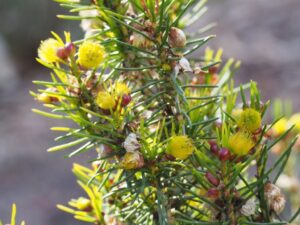
However, one of Natalie’s true passions is the conservation of rare and endangered plants, and she believes that floriculture and landscaping are two avenues through which they can be protected, ‘Landscaping is a great way of doing it because you can get those plants out into the public forum. However, conservation through floriculture is more of a passion for me because a lot of our plants, such as the verticordias, have huge potential and are now being used in floriculture.’
Not being familiar with verticordias (I live in Tasmania, not the southwest!), I did a little research and found out that their genus name means ‘turner of hearts’1, not surprising given their ornamental appeal. ‘Some of the verticordia that we promote as garden specimens for landscaping and floriculture include Verticordia staminosa (Wongan featherflower) and grandis (scarlet featherflower), the latter of which is very difficult to propagate. That is basically the holy grail of verticordias. The monadelpha (pink woolly featherflower) and the nitens (Morrison featherflower); they are the perfect verticordias to have in your arrangement because they have long holding periods,’ says Natalie, referring to those plants’ ability to retain marketable quality over an extended period without deterioration.
‘We even have some acacias that are being used, but only by the brave! For example, Acacia meisneri, which has grey-green leaves, and Acacia aphylla, which does not look anything like an acacia! But it is all timing. It is a matter of getting the plant when it is in bud. If it has already opened, then you are too late!’
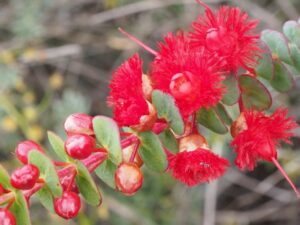
Natalie is encouraging flower growers to look out for variations in species to add to the floricultural palette, ‘We try to encourage growers to plant chamaelaucium and verticordias together when they are putting them out into the field because they do a lot of crossing. It is always good fun when the growers find variations, and it gives them something that is particularly theirs as well. We do not usually encourage hybridising eucalypts, however, you cannot help it if you have only got them on 10 or 20 acres because they do tend to hybridise, which makes it very difficult to retain genetics. We cannot get seed over here from the eastern states’ eucalypts due to biosecurity regulations.’
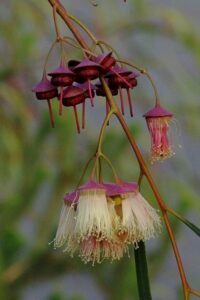
Natalie says that out of the many plants that she and her hard-working team are growing at Muchea there are several other standouts for use in floriculture, including grey-green leaved, mallee-type eucalypts such as Eucalyptus synandra. Native to the Great Victoria Desert in Western Australia, this eucalypt has smooth grey/red sometimes powdery white bark, and pink to red buds which open and mature to a rich cream from early spring to late summer. ‘The flower buds look like little ballerinas with their skirts on. Just before they come out, it looks like the ballerina is ready to do a little dance,’ says Natalie, ‘It is one of those trees that every nanna should have! They are also fantastic in floral arrangements.’
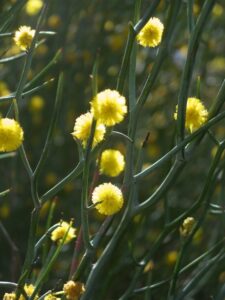
Other eucalypts with grey-green foliage that are used in floriculture include E. pulverulenta (silver-leafed mountain gum) and E. gunnii (cider gum), both from the eastern states, and Western Australian trees such as E. crucis (Southern Cross silver mallee) and E. albida (white-leaved mallee). Their juvenile leaves are highly decorative, given their colour and form, and being opposite and sessile. ‘Even our jarrahs are being used for floriculture as well now, which is quite exciting because sometimes you need that plant variation, not only in flower type, but also in leaf type.’ says Natalie of E. marginata and its several subspecies whose juvenile leaves are alternate and bluish-green.
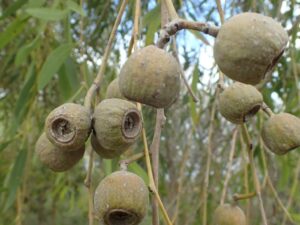
‘Eucalyptus todtiana (prickly bark) is another one of my favourite trees, especially for planting out for revegetation projects. It looks like a granddad; its branches just hang out, looking like it can hold multiple grandchildren. The todtiana has nuts on it that are just beautiful in floriculture, if they are cut at the right time.
‘There are a lot of Western Australian native trees that are used for foliage. Foliage is important in floriculture because it forms the basis of a lot of arrangements. That is quite exciting because some of these species, including Eucalyptus synandra2 are listed as priority species, in danger of extinction, a great concern for those remnant specimens in the wild. However, if we can place monetary value on them, the chances of saving these species increases.’
Natalie is very mindful of the role she can play as a grower in the conservation of these plants, sharing a poignant moment with me, ‘When my grandson Jayden was only five or six, he made a very significant comment to me when we were hand watering in our seed shed. As I was explaining plants to him, he kept asking, “Is this one a rare one, Nanna?”, “No, that is just a normal plant that we grow every day, but we need those as well,” I would reply, and then we finally came across a rare plant and he said, “So, if you do not grow that one Nanna, they will go extinct like dinosaurs. Is that right?” And I said, you nailed that one darl!
‘From the mouth of babes: If we do not save these plants, they are going to go extinct. That is why I give talks to garden groups because they already understand the value of plants. They can see that they are making a difference. I like to point out to people that they can appreciate the aesthetic appeal of landscaping and ornamental plants in general, but to remind them that by growing native plants, they are also allowing bees to survive in suburbia and birds to travel from one place to another. One person can make a difference on this planet and that can be them at this point in time.
‘Ours is a fantastic industry because it is quite holistic, even though we may sometimes think that all we are doing is growing plants. I get a real buzz out of encouraging people to grow natives, especially the rare and endangered species, and know that they are doing their bit for conservation as well.’
Natalie is concerned though that the number of nurseries growing native plants has decreased significantly over the last decade, ‘People are aging and their land is worth more than those people who are wanting to buy it for a nursery. Urban sprawl is sadly taking over land that is quite productive.’
![The colourful buds and soft white flowers of Eucalyptus marginata subsp. marginata near Denmark in Western Australia (Image: Tyler Anthony [sunshiney_tyler] via iNaturalist, CC BY-SA 3.0)](https://hortjournal.com.au/wp-content/uploads/2026/03/6.Eucalyptus_marginata_sunshineytyler_WC_CC-BY-3.0-225x300.jpg)
However, there is some good news on this front. Whilst Natalie will always acknowledge her late husband, Steve, as being her number one mentor, she says she has found it important to continue to surround herself with other like-minded people. She is inspired by the work being undertaken by others in the industry, including Dave Mynott (seed collector), Neroli Forster (Seed Shed), Phil Vaughan (Vaughan’s Australian Plants), Julie Knowles (WA Horticulture) and Amanda Shade (Kings Park and Botanic Garden), as well as fellow nursery people and members of the International Plant Production Society (IPPS), David Hancock, and Tony and Rose Van der Staay.
Natalie is also very happy that local native plant guru George Lulfitz has come out of retirement, at least partially. He is now growing some plants for Muchea, which Natalie says is fantastic because the demand in the retail sector is getting higher especially since COVID-19, ‘For the horticulture industry, I think it (COVID) made us realize how important our industry is in Australia and in the wellbeing of people in general. People realise that the growing of plants is not just for aesthetics, landscaping, revegetation or floriculture; it makes the individual feel better as well. We are not an island, if we are to conserve native species, we must work together so we can help turn Australia into a positive adventure for the future.’
Natalie believes that the industry is also slowly educating the public about the monetary value of plants, and that consumers are learning that they must pay a decent price for their product, ‘It is all very nice to conserve our plants and to make sure that there are decent plants going out into conservation areas, revegetation, landscaping and so forth. However, if we do not make a dollar, we cannot continue doing it. It really is that simple. I do not think Australians really value the impact and necessity of horticulture, particularly when we look at places like India. India has universities that are dedicated to horticulture as well as agriculture.’
Production horticulture is hard work, as is the conserving of rare and endangered plants. Natalie certainly has her hands full on both accounts! However, she brings a level of enthusiasm to the latter task which is contagious, and I feel that, together with her special nursery team, she will be successful in anything she puts her mind to. I look forward to hearing more from Natalie about this subject and her other horticultural activities in the future.
Note: Common names for Western Australian plants written as recorded in the Western Australian Herbarium’s Florabase. Common names for eucalypts written as recorded in EUCLID.
References
- Gregson, M. (2024, October 31). Verticordia—the Turner of Hearts. Western Australian Naturalists’ Club. https://www.wanaturalists.org.au/verticordia-the-turner-of-hearts/
- Eucalyptus synandra is listed as ‘Vulnerable’ under the Western Australian Biodiversity Conservation Act 2016: Biodiversity Conservation (Listing of Native Species) (Flora) Order 2024, Western Australian Government Gazette, No. 49, 30 April 2024
Gabrielle Stannus
Inwardout Studio
M: 0400 431 277
E: gabrielle@inwardoutstudio.com.au