
What grows when women stay
Women, work and belonging in greenlife
By Jennifer McQueen
What keeps women in greenlife? It is not just plants. It is purpose, flexibility, shared knowledge and the quiet strength of community. In this International Women’s Day reflection, women from across Australia share how they found their way into the industry, and why, despite the challenges, they choose to stay.
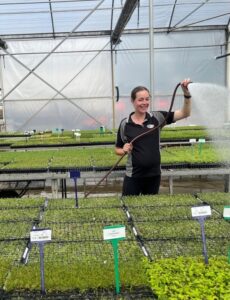
Ellie Krainz found her calling in the middle of the first forest she ever saw. ‘I moved from Alice Springs to Adelaide and went walking with a friend. All the lush greenery, I was mesmerised. My friend had a Cert III in Horticulture and started telling me about the plants. I immediately knew what I wanted to do.’ In 2020, after a year at TAFE, Ellie started work at Jungle in Willunga, South Australia.
Post-COVID, Zoe Johnson volunteered on the Board at APACE in North Fremantle, Western Australia, drawn by the not-for-profit’s focus on environmental sustainability and community. She moved into a paid admin role, then sales, before stepping into the General Manager position. ‘I am not a horticulturist; my background is in news and current affairs. It is an accidental career, and I love it.’
After graduating with an Environmental Science degree, Kaitlin Bingley took a casual job in greenlife dispatch at Plant Growers Australia (PGA) in Wonga Park, Victoria. Kaitlin said, ‘With my botany specialisation, a job in the city with DAFF (Department of Agriculture, Fisheries and Forestry) seemed like the logical step. But I did not really have a career plan and PGA was only 15 minutes from home.
At first, I thought I’d made a mistake. I was the only female on the potting team. I was so terrible at potting that I used to sit in my car and cry. I was going to quit.’
One conversation shifted everything. ‘Our potting manager Emma took me aside and said, “What do we need to do to make this work for you?” Emma is one of the coolest, strongest women I have ever met. I wanted to make her proud. I am stubborn. I thought, “I am going to be good at this, no matter what.” Suddenly I had a drive and direction I had never had before. Nailing potting was just the beginning. Four months later, I reached out to the owner to ask if my degree could be better utilised. Now I am in my dream role as Head Grower at Wonga Park.’
Each woman came to greenlife by a different pathway. What keeps them here is surprisingly consistent.
Kaitlin said, ‘There are thirty women in the propagation department, so I say I have thirty mums. I am pregnant right now and they all check in. They genuinely care, and together we get the job done and produce amazing plants. On the flipside, my growing and tubing team is mainly 18 to 23-year-olds. I am a bit of a mother hen; I look out for them, show them what to do, and notice when they are struggling. There is complete trust.’
In 2019, biology graduate Jacquie Rusha volunteered on the board of LCN Native Plants in Bunbury, Western Australia. Jacquie said, ‘Four months later, the manager quit and I said I would take on the role before starting my career properly. Six and a half years later, I am still here and I absolutely love it.
‘I come from a family of social workers, and while I was never going to go that route, it is hard not to take on a nurturing role. We have a tight-knit group of long-term staff. I mentor trainees and try to give volunteers a sense of stewardship and appreciation. It is not easy to get people to do this work for nothing. Working alongside them is humbling.’
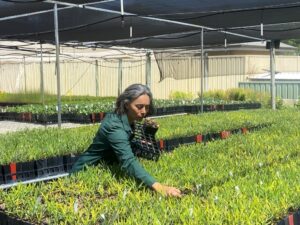
Zoe agreed. ‘I was ambitious when I was younger, but now it is about contributing and leaving a legacy, ensuring people want to work at APACE and stay.
‘We have twenty hort-trained staff and thirty-five volunteers of varying abilities. Some use wheelchairs, some wear headphones while they work. All of us growing native plants the planet needs, all of us building community. We play games like 20 questions over a cuppa. Someone will start with “Am I a dicot?” and the Latin names start pouring out. There is joy in watching people’s passion at play.’
Kaitlin said, ‘Picture ten women in a room, propagating plants for eight and a half hours a day. We do the same thing over and over again. Of course there are different personalities, but there is a lot of talking and laughing. For many women, the propagation department becomes their family.
‘PGA offers what we call “mum” hours to suit school pickups; nine to three thirty. They are happy for me to do mum hours when I return from mat leave. They were like, “What do you want to do? You tell us. We will try to make it happen. We want you to stay.” You do not find many jobs with that kind of flexibility.’
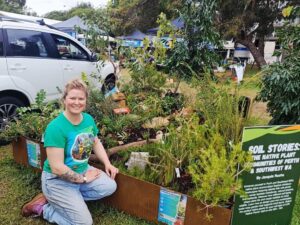
Jacquie laughs at the idea that nursery work is relaxing. ‘With fifty volunteers, a volunteer board and six paid staff, there is never a dull moment. I am checking that people are okay, juggling reports, audits and financials, and making sure the toilet gets cleaned. I took it personally when someone flew off the handle because I had not answered an email fast enough. I knew I was burning out. Negotiating to work remotely from my caravan to refresh our strategy, with delegation built in, feels like slowly rehydrating.’
All of the women spoke frankly about the realities of the work – the physical toll, the emotional load, and the fact that pay rarely reflects the skill involved.
‘Nursery work is hard,’ said Katie Harris, Manager of Ibrox Park Nursery in Burbank, Queensland. ‘You get hot and dirty and rained on. I tell new staff, especially younger ones, promise you will not give up until after week four. By then their bodies have adjusted, but it is not for everyone.’
Zoe agreed. ‘Horticulture is not paid well and does not have an esteemed status, even though it requires specialised knowledge. It is not seen as a career. People usually find it by accident. During Covid, nurses and teachers were suddenly recognised as essential workers. If we listen to what the Earth is telling us through fires and floods, now we are essential too.’
Several women also pointed to the quiet importance of sector connection. Not as a career ladder, but as reassurance and that the challenges they face are not personal or isolated.
Zoe said, ‘This season has been particularly humid. A competitor said, “It is like the acacias are germinating and then being steamed.” It reminded me that I was not alone and that what has been built is worth tending.’
Sharing notes with other nurseries, attending industry events, studying together or simply hearing that someone else is grappling with the same season, the same pressure, the same questions, helps steady the work. None of the women named mentorship, culture or networks as reasons they stay, yet these threads ran through every story. Their experiences were shaped by those who came before them – women who absorbed the friction of entering male-dominated spaces, and normalising women’s presence so the next generation could focus on the work itself rather than proving they belonged.
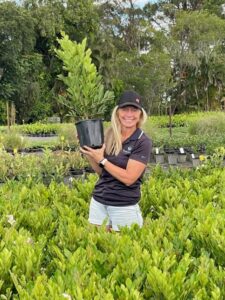
Kaitlin put it plainly. ‘Women in our generation are lucky we do not have to experience what older women did. I am really grateful for that. Women who came before us in nursery paved the way.’ She is careful not to overstate it. ‘It still feels new. And a bit fragile. We are not “done”. But in my experience, there are no fixed gender roles anymore. I have a forklift licence, I drive the tractor, I use the machinery. I am here because I can do the job.’
That does not mean the work is easy. Nursery work involves long hours, physical labour, emotional load and constant problem-solving. Pay is low, recognition is scarce, burnout is real and progression is often hard-won rather than guaranteed. And yet, again and again, the women described why they stay.
They spoke about sharing purpose and knowledge. They described workplaces where care is built into the structure: flexible hours, trust, noticing when someone is struggling, making business decisions together over a beer and making room for people to stay. For these women, greenlife offers something increasingly rare: meaningful work, shared wisdom and community, and that is reason enough to keep showing up.
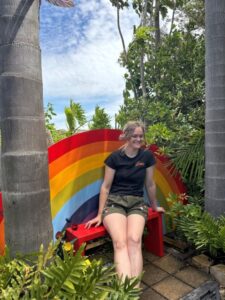
Ellie put it simply: ‘There is no downside to plants. We will always need them for food, wellness, shade, beauty. Even after five or six years, all the colours of a new hibiscus delivery still light me up. Horticulture gives me hope. It makes me happy. I am in it forever.’
All images supplied by the author.
Jennifer McQueen
Director of Communications
Greenlife Industry Australia