
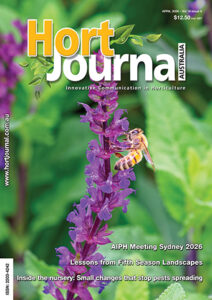
Biosecurity: Protecting our industry and our livelihoods
The International Day of Plant Health falls on 12 May, so in the lead up to this event next month, I thought it only fitting that we dedicate an issue to the theme of biosecurity.
Some of you may be attending the Plant Biosecurity Research Symposium at the State Library of Victoria, Melbourne in May. If so, I would be keen to hear your thoughts on what innovation and research presented there caught your attention. For those of you who will be unable to make this symposium, including me, never fear! We have put together a range of articles covering plant biosecurity research right through to emerging innovation in this issue.
We start with my wrap up of the International Association of Horticultural Producers (AIPH) Sydney meeting that was held in March, where biosecurity was a hot topic, especially in the face of anthropogenic climate change. Matt Dolan, CEO, New Zealand Plant Producers Incorporated (NZPPI) presented on that nation’s Plant Pass scheme, and Celeste Cook from Greenlife Industry Australia (GIA) presented on Biosecure HACCP, a high health plant production system. Celeste has also written a separate article for this issue, explaining what BioSecure HACCP looks like in practice for nurseries (‘Inside the nursery: Small changes that stop pests spreading’).
Elsewhere in these pages, new GIA Chief Executive Officer Sean Cole shares why systematic biosecurity practices must become part of core nursery business (‘Biosecurity: Why it is becoming core nursery business’). As biosecurity risks escalate, John Siemon tells us that the Botanic Gardens of Sydney are stepping up with innovative strategies, collaborative action and a renewed sense of custodianship for both endemic and exotic plant biodiversity (‘Safeguarding Australia’s botanic gardens: Biosecurity in a changing world’). Michael Casey explains how maintaining indoor green walls requires careful and knowledgeable horticultural management to help protect plant health, while safeguarding the people who share these interior spaces (‘Why Integrated Pest Management matters in indoor green infrastructure’).
Regular contributor Tania Harman from PwC Australia provides professional insight in her article ‘How to write a successful grant funding application’. This is the first article in a practical series for Australia’s horticulture innovators where Tania will break down what assessors look for, and how to shape a compelling grant funding application from choosing the right project and timing, to building clear, credible responses with practical examples.
In other news, Hort Innovation recently released the Australian Horticulture Statistics Handbook 2024/2025. In the ‘Other horticulture’ section of this report, a five-year comparison of nursery statistics shows a slight increase in production across the country in 2025, in both number of units produced (+3%) and supply wholesale value (+4%), when compared to 2024 figures. However, the 2025 figures are still lower than those produced during the COVID-19 peak in 2021.
What would it take for the industry to exceed the pandemic era highs of recent plant production? That is a question I know keeps many of you occupied. If you think you have the answer, I would be interested in sharing your thoughts in these pages.
Until next time,
Gabrielle Stannus and your Hort Journal team