
Horticulture at the heart of clean water
By Daniella Gerente
Kingston City Council is renewing 109 of its 197 raingardens in 2026–27, with 88 having been renewed in 2024-25, pairing evidence‑based plant selection with hands‑on horticultural training and a friendly ‘beautification’ competition across crews. The result: robust biofilters that look good, are easy to maintain, and keep tonnes of sediment, nutrients and pollutants out of local creeks and Port Phillip Bay.
What exactly is a raingarden and why should horticulturists care?
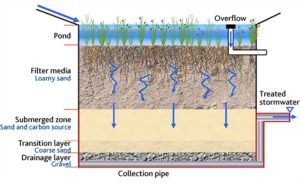
A raingarden (biofilter/bioretention system) is a vegetated basin or trench that temporarily ponds runoff (typically 200–500 mm), which is then filtered through a layered, low‑organic, sandy filter media profile where plant roots and microbial biofilms remove sediment, nutrients (N, P), hydrocarbons and metals before the water drains away or enters the stormwater network. In other words, it looks like a garden bed, but it is engineered to clean water and must drain within 24 hours after rainfall to remain healthy and safe1.
It is this intersection, plants as the treatment technology, that makes horticulture pivotal. The Facility for Advancing Water Biofiltration (FAWB) and the CRC for Water Sensitive Cities (CRCWSC) show that species choice and planting density strongly influence nitrogen removal, long‑term media permeability and overall system resilience1.
Building capability and culture: Kingston’s renewal + ‘beautification’ competition
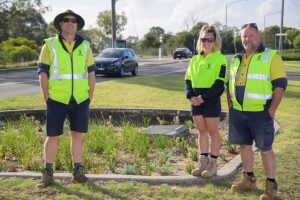
In 2024–25, Kingston commenced renewal on 88 raingardens (vegetation refresh, surface media reset, flushing of associated pipes, and replanting to FAWB‑aligned palettes), with the remainder to follow over the next few years. To scale quality, the Integrated Water Management (IWM) and Open Space teams ran toolbox sessions on how biofilters work, what species do functionally, and how to inspect and maintain assets. We then launched a Raingarden Beautification Competition; five horticulture crews rejuvenated showcase sites, which were judged on native diversity, visual appeal and water sensitive urban design (WSUD) outcomes, with on‑site conversations from curious residents turning maintenance into community education.
Evidence‑based species selection: What the studies say
The following design cues for horticulturists are taken from the FAWB and CRCWSC literature.
Use loamy sand for filter media in accordance with FAWB requirements – most larger nurseries would be able to provide FAWB tested filter media. Avoid mulch. Although mulch helps with weed management, they clog the filter media, wash off in big storms and enter the stormwater system. Instead, reduce weeds via high planting density.
FAWB Tested Filter media: The filter media should be well-graded i.e. it should have all particle size ranges present, from the 0.075 mm to the 4.75 mm sieve (as defined by AS1289.3.6.1 – 1995). There should be no gap in the particle size grading, and the composition should not be dominated by a small particle size range. This is important for preventing structural collapse due to particle migration2.
The plant community is part of the treatment train, not just a decorative layer. Roots maintain porosity, dense foliage shades and stabilises the surface, and species diversity hedges against seasonal stresses. Combine ‘FAWB-recommended’ species that have high surface area to volume ratio, and which consistently support nutrient removal and media health e.g. Carex appressa, Ficinia nodosa, Juncus spp., Goodenia ovata, Dianella spp., and Lomandra longifolia, so that amenity/structure species meet streetscape expectations. Use at least 50% of FAWB-recommended species, with the remainder to suit the area and including native and visually appealing plants.
Palettes in practice: Five Kingston sites, five workable mixes
Third St, Clayton South
Plants: Goodenia ovata (height/back), Lomandra spp. (accents, including L. longifolia), Carpobrotus spp. (groundcover).
Why it works: Goodenia and Lomandra support infiltration and resilience; Rapid-growing Carpobrotus cover suppresses weeds and protects the surface from crusting.
Fraser Ave, Edithvale
Plants: Lomandra longifolia, Ficinia nodosa, Carpobrotus ‘Aussie Rambler’, Acacia binata, Dianella caerulea.
Why it works: Ficinia/Dianella handles wet–dry cycles; Lomandra provides structural clumps; Carpobrotus gives living mulch for surface stability.
Brisbane Tc (shaded raingarden), Parkdale
Plants: Dianella spp., Disphyma crassifolium, Lomandra longifolia, Carex appressa, Juncus spp., Acaena novae‑zelandiae.
Why it works: Under shade, Carex and Juncus remain reliable for nutrient removal and moisture tolerance; Dianella/Lomandra adds structure and year‑round cover.
Wells Rd (Hort South – winning site), Chelsea Heights
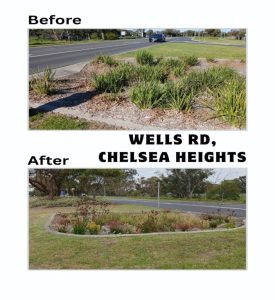
Plants: Mixed Anigozanthos cultivars (‘Bush Diamond’, ‘Bush Pearl’, ‘Bush Zest’, ‘Bush Dance’), Carex appressa, Eremophila glabra ‘Blue Horizon’.
Why it works: A clear FAWB backbone (Carex) underpins function; Colour/form from Anigozanthos and prostrate Eremophila delivers the ‘wow’ without sacrificing treatment.
Voltri St, Cheltenham
Plants: Callistemon viminalis ‘Dawson River Weeper’, Myoporum parvifolium, Ficinia nodosa.
Why it works: Canopy and living mulch (Myoporum) pairs with the dependable biofilter anchor (Ficinia).
Maintain systems to drain within 24 hours. Check inlets/outlets and surface condition after storms and at programmed inspections. If clogging persists seek an environmental engineer as it could be the drainage layer.
The first two years require more intense maintenance to ensure plant establishment. At this stage, monthly inspections and after rainfall events are recommended. After two years, maintenance is required once every three months and after rainfall events. This ensures that silt is removed at the inlet to minimise clogging and allow stormwater to enter the raingarden.
Maintenance should be simplified. Routine care should be light‑touch but regular, after significant rain and at scheduled inspections. Here are four steps our crews actually use:
- Inlet: Remove litter/leaves/sediment from inlets and surface, and repair minor scour so inflows spread across the bed. For any make‑up, use compatible biofilter media, not topsoil.
- Filter media: Confirm ponding empties within 24 hours. If not, scrape away any surface crust/moss, check outlets/underdrains and, if needed, do a simple percolation test to verify media conductivity or contact a drainage engineer.
- Plants: Hand‑weed early (before seed set), fill in bare patches quickly, and prune only for safety/visibility. Keep high planting density and avoid fertilisers/herbicides on the filter media. It is recommended to do hand weeding on filter media.
- Outlet: Inspect and flush outlets/underdrains when required, verify edges, paths and signage. Record issues for programmed follow‑up (e.g. forebay clean‑out, batch replacements).
These steps echo FAWB/CRCWSC guidance and have proven workable for Kingston’s field team. They are quick to do, easy to standardise, and directly linked to performance.
| Layer (Top → Bottom) | Recommended Depth | Material / Soil Type | Purpose |
| Ponding Zone (Above Surface) | 100–300 mm | Temporary surface water storage | Holds runoff during storms and increases treatment time |
| Filter Media (Bioretention Soil) | 400–600 mm | Sandy loam bioretention mix: • 70–85% washed sand • 5–10% silt/clay fines • 5–10% low-nutrient organic matter | Main treatment layer filters pollutants, removes nutrients, and supports plants |
| Transition Layer (Choking Layer) | 50–100 mm | Coarse sand or fine aggregate (2–5 mm) | Stops filter media migrating into drainage layer |
| Submerged Zone | 150–300 mm | Washed sand blended with carbon source (e.g. hardwood chips, biochar, or composted wood) | Creates low-oxygen zone to promote denitrification and improve nitrogen removal |
| Drainage Layer | 200–300 mm | Clean, washed aggregate (7–20 mm crushed rock) with slotted ag pipe | Collects treated water and conveys it to outlet |
| Geotextile (Optional, site dependent) | Thin layer | Non-woven geotextile | Prevents subgrade soil entering drainage layer (not always used) |
| Subgrade (Existing Soil) | N/A | In-situ natural soil | Structural support; may allow infiltration if permeable |
Outcomes and what is next
Across the network, Kingston’s raingardens intercept an estimated 100 tonnes of sediment per year, roughly 10 tip trucks, along with nutrients and roadway pollutants that would otherwise reach Port Phillip Bay. Renewal is boosting amenity and public appreciation. Residents approach crews on‑site to ask what is being planted and why. The competition format has also helped embed horticulture as a core water‑quality partner, not a downstream ‘taker’ of assets.
The next step is to package this into a repeatable playbook – species’ palettes by setting (full sun, partial shade, roadside), drain‑down diagnostics at a glance, and seasonal task lists that align with horticultural cycles.
Practical takeaways
In summary, the key practical takeaways for Hort Journal readers looking to design, construct and/or maintain new and/or existing raingardens are:
- Start with the media and hydraulics. If the raingarden does not drain, it will not perform, no matter how beautiful the plants. Use loamy sand within the FAWB/CRCWSC conductivity range.
- Plant for function first, then add flair. Anchor with Carex appressa, Ficinia nodosa, Juncus spp., Goodenia ovata, Dianella spp., Lomandra longifolia; then layer amenity species for colour, form and habitat.
- Think ‘living mulch’. High density planting plus spreading groundcovers protect the surface better than organic mulches which float away and/or clog the rain garden.
- Make maintenance easy to do right. A four‑step checklist after rain will catch 90% of problems before they escalate.
Author’s note: The author thanks Kingston’s Horticulture teams for their creativity and persistence, and the many residents who stopped to chat and cheer on the work.
References
Facility for Advancing Water Biofiltration (FAWB). (2008). Final Report, 2005-2008. https://www3.monash.edu.au/fawb/publications/fawb-final-report-2008-v1.pdf
FAWB. (2009, June). Stormwater Biofiltration Systems Adoption Guidelines. https://watersensitivecities.org.au/wp-content/uploads/2022/04/fawb-adoption-guidelines-full-document.pdf
Daniella Gerente
Integrated Water Management Coordinator
City of Kingston
E: Daniella.Gerente@kingston.vic.gov.au