
Public revelry when complex planting is primary
By Jac Semmler and Alice Ziebell
As cities respond to climate pressure, resource constraints, and rising expectations for high quality public space, planting should be central to how we shape the future of urban design. A plant driven approach, which embraces naturalistic, multi-layer principles offers adaptive, biodiverse, and experientially rich environments, spaces where living systems structure form, moderate climate, and deliver long term value.
For the design and horticulture industries, this presents both an opportunity and a responsibility: to rethink how planting is designed, delivered and managed. The question is no longer whether planting plays a role, but how it can form the foundation of the spaces we inhabit. This recalibration sits at the heart of future-focused design and is grounded in living systems, long-term performance and an experiential quality.
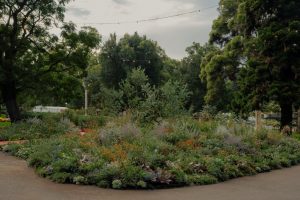
Projects such as ‘Plant Futures: The Future in Bloom’, presented at the Melbourne International Flower and Garden Show 2026, offer a compelling model. Delivered by Super Bloom in collaboration with Heliotope, Evergreen Infrastructure and Mood Construction, the project demonstrated the potential of plant led design at scale.
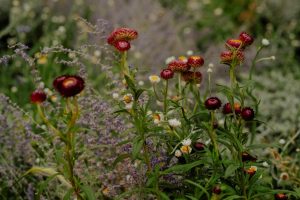
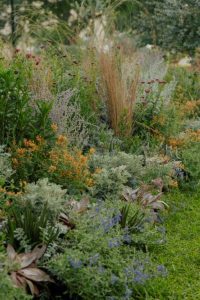
Within a compact footprint, the garden featured a dense, multi-layered system of more than fifty species. Traditional bedlines were replaced by an interwoven matrix of climate compatible species, dry-tolerant perennials composed of grasses and succulents, and shrubs and airy trees that brought loose, see-through structure. Both grown and designed as community rather than a collection in modules, the planting simultaneously created spatial structure, ecological function and visual richness.
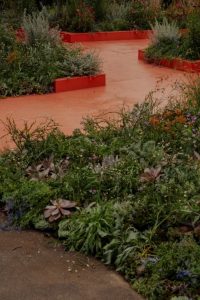
This signals an important shift for the discipline away from selecting individual species and toward composing adaptive plant communities. In Plant Futures, species were chosen not only for individual performance and luminous qualities, but for how they interact and how they occupy space, respond to seasonal change, and coexist under shared conditions, while contributing to an abundant and beautiful aesthetic.
Climate responsiveness is inseparable from this approach. Reduced water availability, rising temperatures, and increasingly variable conditions are already reshaping planting design across Australia. While resilience is often framed as a constraint on beauty, Plant Futures demonstrated the opposite. In it we saw a garden composed entirely of dry climate, low-input species that remained expressive, immersive and dynamic.
Through consistent selection which embraced the adaptations plants need to survive in dry climates, and the qualities which capture and reflect the unique quality of light in the Southern Hemisphere, the planting reinforced a critical point that climate-compatible design does not limit ambition. Performance and aesthetics are not competing priorities and are instead interdependent. Diversity of species and life forms is critical and hence many were grown from seed and propagated ahead of the show together with key partnerships with growers, the Native Plant Project, Plant Growers Australia, Botanix Plant Supply and Remarkable Trees.

A key strength of the project was its role as a demonstration garden. Such projects provide a shared reference point, allowing design partners and clients to observe the impact and potential of planting beyond traditional expectations of ‘urban green’. At industry events, this role is amplified, creating space for both technical exchange, advocacy and broader public engagement.
These built examples make abstract ideas tangible. Conversations around the nuances of species selection and care become more immediate and more persuasive when grounded in lived experience. For an industry advocating greater investment in planting, this visibility is essential. Demonstration builds confidence, and confidence drives adoption – it has never been truer that seeing is believing.
In Plant Futures, the impact was evident. Visitors lingered, returned, and immersed themselves in the densely layered planting. The project posed a simple but powerful question: what happens when planting leads? The response suggested a deeper truth that there is a human hunger for beauty, and future public spaces must deliver both beauty, resilience and dynamism.
Importantly, the project extended beyond its initial installation. Following the show, the garden was relocated to a permanent public site in Footscray, enabling ongoing observation of how the planting establishes and evolves. In doing so, it reinforces a fundamental principle that planting is not a fixed product, but a living system whose value unfolds over time.
The implications of a plant-driven future are far reaching. For design partners, it demands deeper integration of horticultural knowledge into the design process from conception to care. For nurseries, it underscores the importance of diversity and climate suitability. More broadly, it requires a shift in how planting is valued, not as an accessory, but as essential living infrastructure.
Projects like Plant Futures demonstrate that resilience, biodiversity and visual impact are not mutually exclusive. When approached systematically, and supported by the right knowledge, creative and collaborative processes, planting can deliver across all three.
The future of landscapes and gardens, urban spaces and places, will be shaped not only by what is built, but by what is grown and how those living systems perform over time. A plant-driven approach has the potential to fundamentally reshape how public space is experienced, valued and sustained.
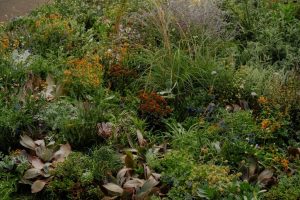
In this future, urban landscapes are defined by layered, climate responsive planting that evolves and shifts with the seasons, supporting habitat and creating immersive environments for people to inhabit and enjoy. Access to meaningful places becomes an expectation, not an exception. Planting operates simultaneously as infrastructure, ecology, creative and cultural expression.
At its best, when planting is primary, it creates spaces of public revelry, where beauty, performance, and experience are inseparable, and where people are invited not just to pass through, but to dwell.
Our thanks to the team behind the Melbourne International Flower and Garden Show for their support of feature gardens.
Plant Futures was made possible with the support of the Austem Foundation, Native Plant Project, Australian Institute of Horticulture, Plant Growers Australia, Remarkable Trees, Botanix Plant Supply and Boomaroo Nurseries.
For more on ‘Plant Futures: The Future in Bloom’ visit www.thesuperbloom.com.au.
Jac Semmler and Alice Ziebell
Super Bloom