
Melbourne International Flower and Garden Show 2026
By Gabrielle Stannus
Despite some wet and windy weather, the 2026 Melbourne International Flower and Garden Show drew an impressive 108,672 attendees over five days at the Royal Exhibition Building and Carlton Gardens. Your intrepid editor braved the rain to bring you this roundup of this annual industry event, focussing on the gardens on display, and the plants found within them, including some old favourites and new discoveries.
SHOW GARDENS
‘We the Wild’
Matt York claimed the esteemed City of Melbourne Award of Excellence for Best in Show for ‘We the Wild’, a garden inspired by Victoria’s southern coastline. Constructed by Ratio, the design captivated judges by demonstrating how even compact spaces can nurture biodiversity and evoke a sense of wildness. Matt also received the Horticultural Media Association Award for Best Use of Plant Life.
‘The idea of the garden is to celebrate the restorative power of time in nature,’ Matt said, ‘How could we bring the kind of magnificence and restorative power of the landscapes along the Victorian coastline, be it the Otway’s with the Dicksonia (antarctica) ferns or Wilson’s Prom with the granite boulders… and apply them in small garden design? The benefit there being that you can develop a garden of scale for individual respite and rejuvenation, but then as part of the city mosaic for the city of 8 million (Melbourne’s projected population by 2050), your garden can also become part of the broader pollination, urban cooling and biodiversity strategy.’
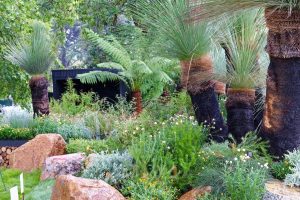
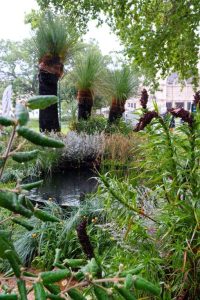
Showgoers were captivated by the 200-year-old grass trees (Xanthorrhoea glauca) salvaged by Surf Coast Palms from the south coast of New South Wales. ‘The hope is that through gardens, these incredible ancient trees get to keep living for hundreds of years longer,’ Matt explained. He added that whilst showgoers were completely absorbed by the grass trees, tree ferns and proteas, they were also interested in smaller plants such as the Chrysocephalum he planted en masse, and the variegated plectranthus (Plectranthus ‘Blue Spires’) he used to lighten a dark corner. Other lesser-known plants attracting attention included mountain pepper (Tasmannia lanceolata), dragon tree richea (Richea dracophylla), endemic to wet forest in Tasmania’s southeast, and the Dinner Plain candle heath (Dracophyllum continentis Syn. Richea continentis), common in montane to alpine wet heathland near watercourses or bogs in Victoria and New South Wales.
Listening to showgoers as they viewed not only Matt’s but other Show gardens, I heard many words of praise for the Sir Grange® Zoysia grass installed around many of the gardens. Matt also spoke highly of this no-mow grass, ‘It is a gorgeous grass. I think people will start to use this more where, say in the past, they might have used a Mondo or a Tanika Lomandra en masse. It is certainly not as robust as a kikuyu or a couch, and I would not use it in a high traffic area. However, it is an amazing feature.’
‘Je ne sais quoi’
Joel Barnett from InStyle Gardens also received a Gold Medal for his garden ‘Je ne sais quoi’, as well as the Mark Bence Construction Award. ‘It is a representation of my time at the Geelong Cement Cricket Club, where I played when I was a teenager… it was next door to a cement works. So, that is where the silos’ representation comes from,’ said Joel. This site has since been converted to housing. ‘We did a design and build job on one of the houses that was built there, and some of the plants we put in were asparagus ferns. We went back there a few months ago and the ferns were looking awesome, so we dug some out and potted them up, and have used them in this garden,’ Joel explained.
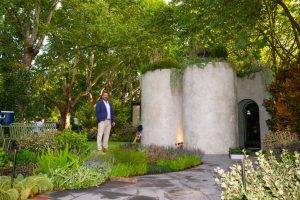
Joel mostly used foliage rather than flowers to bring colour into his garden, sourcing plants primarily from Chartwell Nurseries in Geelong, and Warners Nursery. Ginkgo ‘Piedmont Pillar’, Acer palmatum dissectum ‘Seiryu’, Magnolia ‘Sweet Carolina’ and Laurus nobilis ‘Baby Bay’ balls added a formal element to this garden, whilst Joel allowed other plants, including Casuarina glauca ‘Greenwave’ and Westringia fruticosa, a little more freedom. ‘I wanted them to be more wild, and I did not want them to be clipped. If you’ve got too many clipped balls around the places, I don’t think it looks any good.’
Joel used a series of grasses to add structure to this garden, including Schizachyrium scoparium ‘Blue Heaven’ (American prairie grass). This densely-tufted, deciduous, perennial grass fits in well with the ‘prairie meadow’ look. It produces an upright mound of fine-textured, glaucous leaves tinted deep pink and burgundy in late summer, before turning shades of red, orange and copper in autumn and winter. Upright, silvery blue flowers appear during late summer and autumn.
‘Urban Luxe’
First-time Show Garden entrant Andrew Stark received the coveted People’s Choice Award for his garden, ‘Urban Luxe’. ‘It’s my take on a modern Italian garden inspired by the Boboli Gardens in Florence and Villa d’Este just outside in Tivoli near Rome,’ said Andrew of the garden, and was constructed by Andrew Stark Gardens and MPF Garden Company using plants supplied by Warners Nurseries. With limestone paving from Turkey and beautiful green pots from France, this garden certainly was ‘luxe’!
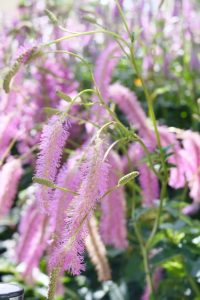
I kept hearing Andrew say ‘squirrel’ as he interacted with showgoers observing his garden. ‘I saw this plant at the Chelsea Flower Show many years ago and I brought it into Australia,’ Andrew explained to me, ‘It’s called Sanguisorba hakusanensis ‘Lilac Squirrel’. Everyone wants to know what that is.’ It’s an herbaceous perennial growing to a height of about one metre, with a mat-forming, running rootstock. ‘Lilac Squirrel’ has rounded, blue-green leaflets and its flowers, produced from midsummer to early autumn, are pinkish-purple, fluffy, hanging, squirrel tails – hence its cultivar name. Another plant that attracted attention was a bright pink coneflower (Echinacea ‘Primadonna Pink’). ‘It has absolutely huge 15-centimetre size flowers, but on a compact plant and an absolute myriad of flowers per plant,’ Andrew enthused.
BOUTIQUE GARDENS
‘Reverie’
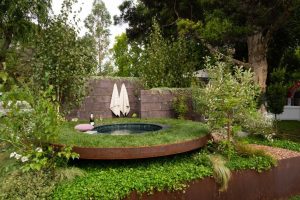
Timeless Outdoors was awarded First Place in Landscaping Victoria’s Boutique Gardens competition for ‘Reverie’ which they constructed with Coastal Elements Landscaping. ‘Reverie’ invited visitors into a space of calm and quiet escape, functioning as a modern watering hole that encourages stillness and restoration. A central spa acted as the focal point, with a surrounding band of lush grass designed to create rhythm and depth. Recycled slate roof tiles were used as a walling element to introduce unexpected texture, and to demonstrate Timeless Outdoors’ commitment to sustainable and considered design. Lead nursery Spring Hill Nursery and Garden supplied the plants that added to the garden’s cool, lush, textured look. Plants ranged from trees such as Betula utilis ‘Jacquemontii’ (Himalayan Birch) to grasses, e.g. Miscanthus ‘Yakushima Dwarf’ (dwarf silver grass).
CHALLENGER ACHIEVABLE GARDENS
‘A Women’s Garden’
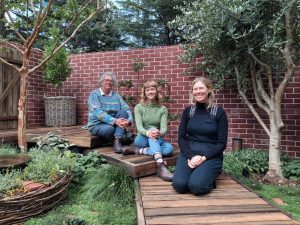
Megan Blair, Georgina Honner and Sarah Jones received the Excellence Award, Gold Medal and Best Construction prize in this student-focussed category for their joint design, ‘A Women’s Garden’. ‘A huge part of the design was collaborating as women. We work as gardeners and we work mostly for women, so they are definitely our cohort,’ Sarah explained. ‘We thought a lot about the vulnerability of older women. They are the cohort that is most at risk of homelessness, so the garden was a practical response to the potential of downsizing or sharing accommodation. How can we share gardens and still have something that feels meaningful and personal, and a space for connection for more vulnerable women.’ The team received many questions about their coastal tussock grass (Poa poiformis), whilst the espaliered apple (Malus domestica ‘Gala’) and crepe myrtle (Lagerstroemia indica x fauriei ‘Biloxi’) also received a great deal of attention.
Like many other displays this year, ‘A Women’s Garden’ combined both native and exotic plants, including edibles. Most plants in this garden were supplied by Bellarine Landcare Nursery, genU Community Nurseries, a social enterprise supporting people working with disabilities, and Queenscliff Indigenous Nursery, with exotics sourced from Batesford Plant Nursery, Established Tree Transplanters, Merrywood (espaliered plants) and Wombat Gully Plant Farm. This team encouraged other designers to support their local indigenous plant nursery and to learn what plants are native to their areas. Price wise, they say buying stock in tubes means you do not have to spend big bucks to make a beautiful garden for your client.
‘Sunset Over Salt Lake’
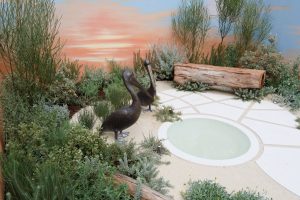
London College of Garden Design student Ebony Lea Cetinich also received a Gold Medal for her garden ‘Sunset Over Salt Lake’, inspired by the salt lake opposite her home in Mildura, where she says water is scarce and beauty is often quiet and overlooked. Ebony also received the Best Use of Plantlife award for her garden. ‘I wanted to stick with salt and drought tolerant plants to show people that natives can be beautiful. I find that there’s a lot of a negative perception around natives. I want to celebrate them, bring awareness to them and potentially get more of them into cultivation,’ Ebony said. Saltbush underpinned Ebony’s planting palette, including Maireana sedifolia (pearl saltbush), which occurs through northern Victoria across into the Flinders Ranges. This saltbush proved popular with showgoers, who also loved the wild rose (Diplolaena grandiflora) and the Acacia binerva ‘Sterling Silver’.
‘I had to do a lot of shopping around because these native plants are not traditionally something that’s in your Bunnings,’ she says, adding that Kuranga Native Nursery, proved a boon to her garden. ‘They have larger stock and you can see what the plant’s going to look like. It is hard when the reforestation or indigenous nurseries only keep the tube stock. People don’t really know what they look like (in advance).’ Emily also sourced plants from the Advanced Tree Company, GrowAbility Knoxbrooke Nursery and Riverland Native Plants.
‘Beneath the Canopy’
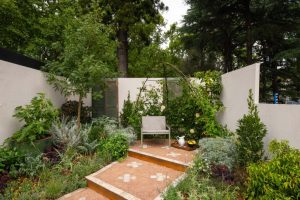
Holmesglen student Megan Griffey also received a Gold Medal for her garden, ‘Beneath the Canopy’. Inspired by the shaded squares Megan sought sanctuary in during a visit to Portugal, this garden included a semi-dome arbour over which climbing roses grew; ‘Cécile Brünner’ to cover the structure, intertwined with ‘Gold Pierre de Ronsard’ for its flowers. No need to wait for a tree to grow to provide shade!
Megan’s plant palette was non-purist, incorporating a mix of natives and exotics, and both ornamental and edible, reflecting her hospitality background. Edible plants included the more familiar fig, artichoke, bay, feijoa and quince, as well as lesser-known natives, aniseed myrtle (Syzygium anisatum) and spiked mint bush (Prostanthera phylicifolia). Native to New South Wales and Victoria, the latter is a rounded shrub growing to about 1.5-2 metres high that has a resemblance to rosemary. Megan sourced this plant from Knoxbrooke Nursery, a social enterprise based in Mount Evelyn on Melbourne’s outskirts. In addition to the roses, crowd-pleasers included sedum (Sedum hybrida ‘Blue Pearl’), digger’s speedwell (Veronica perfoliata), wormwood (Artemisia absinthimum) and silver plectranthus (Plectranthus argentatus). Other nurseries supplying plants for this garden included Alameda Homestead Nursery, Antique Perennials, Botanix Plant Supply, Merrywood, Proven Winners, Specialty Trees and Warners Nurseries.
BALCONY GARDENS
‘Immerse’
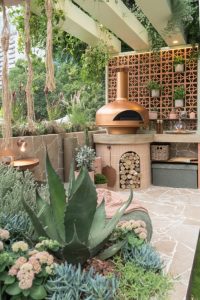
First Place in the Balcony Gardens competition went to La Muxlow for ‘Immerse’. Constructed by Liven it Up, ‘Immerse’ reclaims the exposed balcony as a functional garden room, using screening, adaptable elements and layered planting to restore privacy, flexibility and connection. ‘I wanted you to be able to go out there and still live your life outside because a lot of apartment living is quite trapped indoors. I imagined that we could bring some of those things that we do inside, outside,’ explained designer La Muxlow, whose balcony garden encourages multiple use including cooking (with a pizza oven installed), yoga, entertaining, working from home and even watching TV. La’s plant selection focussed on super-tough plants that can survive exposure, including trailers such as lotus, sedum, hardenbergia, geranium and rosemary sourced from nurseries including Aumann’s Templestowe and Ausflora Pacific. She also included a range of edible plants such as almonds, chillies, strawberries and rosemary, locating the herbs close to the outdoor kitchen, where they can be added directly to a pizza.
BORDER GARDENS
‘Tsuchikabe’
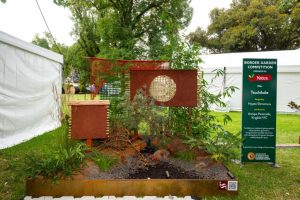
There were some very interesting interpretations of a ‘border garden’ in this category! In one response, a produce enclosure took up the whole footprint (2.4 m x 2.4 m). However, First Place in this category went to ‘Tsuchikabe’, designed by Hayato Shimomura. ‘Tsuchikabe’ is a traditional Japanese earthen wall passed down generations. Using Australia’s red soil and wall-making plants[JH1] , Hayato reimagined a traditional Japanese garden space. Antique Perennials were the lead nursery.
This display garden was beautifully composed. Our photos of this garden do not do it justice, so I have not included them here. A reminder of the reasons why you need to visit the Show in person and not just rely on our report!
EXHIBITION GARDENS
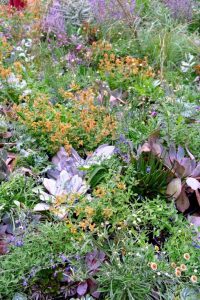
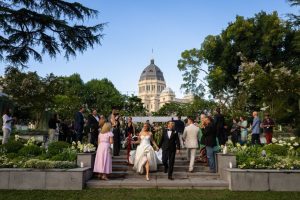
Elsewhere around the Show, visitors could immerse themselves in a series of exhibition gardens, and in one case, even get married within it. Yes, you read that right! 2026 saw the debut of the ‘Wedding Garden’, designed by Jason Hodges in partnership with the legendary team at Semken Landscaping. ‘Get Married at #MelbFlowerShow’ is now a ‘thing’. Billed as ‘a once-in-a-lifetime wedding in the most beautiful garden in Australia’, I understand that the Wedding Garden will return in 2027.
The ‘Plant Futures: The Future in Bloom’ garden challenged a long-held misconception in garden design that climate-friendly, low-water, dry-climate plants come at the expense of colour, form or delight. I must agree with the event organisers that this spectacular floral garden proved the opposite. The design celebrated the luminosity, diversity and adaptability of dry-climate species, demonstrating that landscapes built for resilience can also be lush, enchanting and full of wonder. You can read more about this garden in two other articles in this issue: Michael Casey’s ‘The structure behind greening’ and Patrick Regnault’s ‘Beauty, purpose and the modern garden’.
Created by Urban Discovery for the Victorian Schools Garden Program, ‘The Wildplace Children’s Garden’ allowed the young and young at heart to immerse themselves in play. This garden was designed to entice children, spark curiosity, invite collaboration, evoke wonder, regulate nervous systems and build community. A big ask! Key features included sensory elements, edible planting (including native bush foods) and loose parts, all of which combined to create a child-centric garden with playful and adaptable spaces.
IN SUMMARY
In many of the display gardens, the native versus exotic plant debate seemed to be turned on its head this year. Designers are starting to add their own touch to the prairie meadow look, incorporating a range of plants from Australia and abroad suitable to the local climate. Mixing local and introduced plants also proved popular in more formal gardens. Gardens incorporating edible plants remained popular, with designers using both native and non-native plants to grow food. With the Middle East conflict continuing, and associated increases in fuel and fertiliser prices, I do not see this trend changing any time soon. With so many beautiful gardens on display at the Melbourne International Flower and Garden Show, there was much to take in. I highly encourage you to visit next year so you can see for yourself how thoughtfully designers are reimagining beauty, productivity and climate resilience in the modern garden.