
The biochar revolution
Engineering carbon-rich growing media for resilience
By Erik van Zuilekom
What if the most transformative amendment available to nursery production was not new at all, but ancient, misunderstood, and hiding in plain sight? Biochar is gaining traction across Australian horticulture, yet much of what is sold under its name barely qualifies as true biochar. Understanding why that distinction matters could change how you think about growing media.
What is biochar?
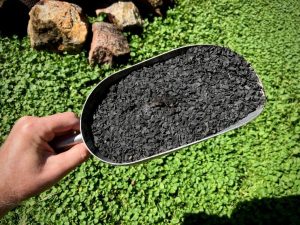
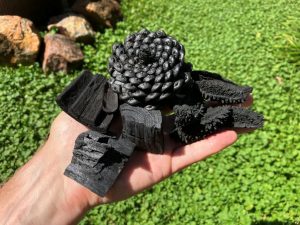
The term tells the story if you listen carefully. ‘Bio’ refers to biological inoculation. ‘Char’ refers to charcoal. Biochar is organic material that has been pyrolysed (heated in the absence of oxygen at temperatures typically between 450°C and 600°C), which converts its carbon into a remarkably stable form that persists for centuries rather than decades¹. Without that pyrolysis step, the carbon remains labile, i.e., easily altered, and is functionally no different from compost breaking down in a heap.
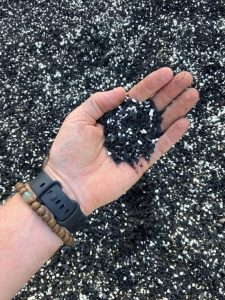
But pyrolysis alone produces only charcoal. The biological activation, inoculating that charcoal with beneficial soil microorganisms, is what earns the ‘bio’ prefix. This is not a pedantic distinction. A great deal of product marketed as biochar is incompletely pyrolysed charcoal that has never been biologically activated. The performance difference is substantial, and growers deserve to know which they are buying. Ask your supplier about pyrolysis temperatures and inoculation processes, and if they cannot answer clearly, that tells you something.
A storage mechanism, not a nutrient source
Here is where the biggest misunderstanding persists. Biochar does not feed plants; it is a structural and biological storage mechanism that has significant value in what it holds and what it can host.
Well-produced biochar is riddled with microscopic pores that dramatically increase surface area within a substrate. This porosity creates an extraordinary lattice of protected habitat for beneficial bacteria, fungi and other soil organisms, whilst simultaneously improving air-filled porosity, drainage and moisture retention². In conventional substrate engineering, those properties tend to work against each other. In biochar-amended media, they coexist.
When paired with nutrients, through fertigation, compost incorporation or microbial inoculant application, biochar becomes what is described as ‘charged’. It functions rather like perlite, zeolite and activated charcoal combined, holding moisture without waterlogging, retaining nutrients against leaching, providing stable structure, and supporting the microbial communities upon which healthy root systems depend.
The concept is far from novel. The terra preta soils of the Amazon basin, some dating back several thousand years, were created by indigenous communities who incorporated charcoal, organic waste and biological materials into otherwise poor tropical soils³. Those enriched patches remain dramatically more fertile than surrounding soils today, after millennia of tropical rainfall. What those communities understood intuitively, we are only now beginning to quantify.
Evidence from my own trials
I approach most horticultural innovations with the healthy scepticism that comes from decades of observing the gap between marketing promises and field reality. When I began trialling biochar in food production, I designed the work to be deliberately unforgiving.
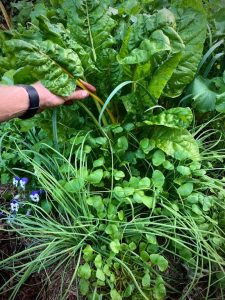
I established three adjacent beds in January 2024, installed directly into the existing Krasnozem clay soils at my property in the Redlands region of southeast Queensland. One served as an untreated control. The second received micronised, inoculated, biochar applications only. The third received a combination of inoculated biochar granules, compost and the same biological inoculant. All beds shared a single drip irrigation system. No pest management, exclusion netting, pesticides or foliar feeding were applied throughout the entire twelve months. I wanted to see what the soil could deliver under minimal human interference.
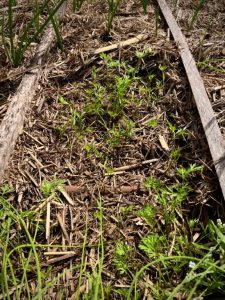
The results were unambiguous. Over twelve months, the biologically inoculated bed produced roughly double the weight of produce compared with the control. The bed receiving biochar, compost and biological inoculant produced a 193% increase over the control.
The qualitative observations were equally telling. The control bed suffered multiple plant deaths during summer establishment. Growth was frequently weak and chlorotic. The biochar-amended bed experienced zero plant deaths during that same brutal summer. Sweetcorn cobs in the control reached roughly 10 centimetres. In the biochar bed, they developed to 25 to 30 centimetres. Seed germination was noticeably stronger, and while pest pressure affected all beds, it caused visibly less damage where soil biology was thriving.
I present these as practitioner observations rather than controlled science. But the consistency across multiple crop types and seasons is difficult to dismiss.
Practical considerations for nurseries
For production managers weighing biochar adoption, a few principles stand out.
Start with quality. Feedstock material, pyrolysis temperature and biological inoculation all dramatically influence performance⁴ If a supplier cannot provide specification sheets or explain their inoculation process, that product may not deliver what you are expecting.
Application rates require precision. Published research generally identifies optimal incorporation between 5 and 20 per cent by volume, depending on species and existing substrate composition². Beyond approximately 30 per cent, benefits can plateau or reverse. Start conservatively, observe carefully, and adjust.
Pair biochar with biology and nutrients from the outset. Uncharged biochar can initially adsorb nutrients from the surrounding substrate, temporarily reducing availability to roots. Combining it with compost, or applying it pre-charged, avoids this lag.
Expect to recalibrate your fertigation as biochar holds nutrients more effectively than most amendments, which reduces leaching losses but may require adjustment to existing programmes during the first season.
Biochar will not solve every challenge in nursery production. Nothing will. But for growers willing to source quality product, trial methodically and measure honestly, it offers something increasingly rare: a substrate component that improves with biological age rather than degrading, sequesters carbon for centuries, and builds the microbial foundations upon which healthy plants depend.
The revolution is quiet, but it is carbon-rich, and it is real.
Erik van Zuilekom
UnitedNatures Design / UnitedNatures Edible Garden
E: unitednatures@yahoo.com.au
References
- Lehmann, J. & Joseph, S. (2015). Biochar for Environmental Management: Science, Technology and Implementation (2nd ed.). Routledge.
- Chen, L., Ao, J., Gao, Z., Xu, Z., Yu, H., Zhang, H., Yu, C., Wei, L. & Li, S. (2025, September 11). Dose-dependent effects of biochar amendment on early rice seedling growth and nursery substrate properties in Southern China. Frontiers in Agronomy, 1679276.
- Glaser, B. & Birk, J.J. (2012). State of the scientific knowledge on properties and genesis of Anthropogenic Dark Earths in Central Amazonia (terra preta de Índio). Geochimica et Cosmochimica Acta, 82, 39–51.
- Enders, A., Hanley, K., Whitman, T., Joseph, S. & Lehmann, J. (2012). Characterization of biochars to evaluate recalcitrance and agronomic performance. Bioresource Technology, 114, 644–653.