
The structure behind greening
By Michael Casey
When we speak about successful greening projects, the conversation often leans quite naturally towards planting design, species selection, colour, texture and seasonal interest. Yet, in many of what I call ‘structurally installed landscapes’, the real foundation of success sits elsewhere, and that is in the integrity of the system supporting it all. This is not a discussion about improving soil structure in the traditional horticultural sense, nor is it centred on the familiar ground-based practices we apply in gardens, streetscapes or open landscapes where planting occurs directly into the earth. Rather, this article discusses what happens when landscape is asked to perform on built form, on framed platforms, within engineered installations, or as part of a constructed setting where the planting, growing media, hardscape and supporting structure must all work together as a coordinated whole.
As more greening projects are introduced into dense urban environments, this distinction becomes increasingly important. Many of today’s most exciting landscape outcomes are no longer occurring on natural ground where weight, drainage and root movement can be managed in more familiar ways. Instead, they are being integrated into buildings, temporary installations, rooftops, suspended elements, decks and other constructed environments where the living landscape becomes part of a structural proposition. Once that shift occurs, the way we think about design must also shift, because the project can no longer be approached solely through a planting lens. It must be understood through the combined disciplines of horticulture, construction and structural performance, each one informing the other from the outset.
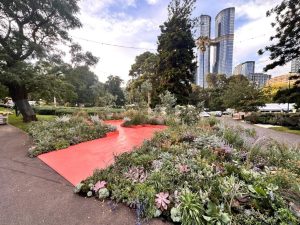
The recent Plant Futures – The Future in Bloom garden display at the 2026 Melbourne International Flower and Garden Show is a very timely example of this point. Described by the event organisers as an immersive living laboratory and one of its most ambitious horticultural showcases, this installation was developed through a collaboration between Super Bloom, Heliotope Studio, Evergreen Infrastructure and Mood Construction, with sustainability embedded through modular planting, multi-use materials and a commitment to relocate the garden to a public space after the event. The project has been positioned not simply as a showpiece, but as a benchmark for future planting design in our cities, and that makes it an ideal working example of why structural integrity matters so deeply in greening projects designed for structural installations.
What makes this discussion particularly relevant is that structurally installed greening projects are often judged first by what the public sees, while the technical discipline that makes the outcome possible remains largely invisible. A visitor may walk through a garden such as Plant Futures and experience movement, colour, atmosphere and a sense of immersion, but beneath that visual delight sits an enormous amount of practical decision-making. The weight of planting systems, the load of saturated media, the way water is captured and drained, the containment of materials, the sequencing of installation and the stability of every built element all influence whether the landscape can function safely and successfully. In this kind of work, plants are not simply placed into a setting after the construction is complete. They are part of a living system that must be anticipated within the structural and construction framework from the very beginning.
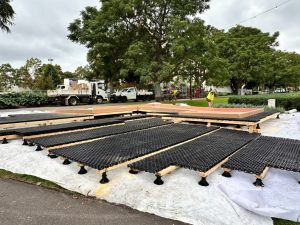
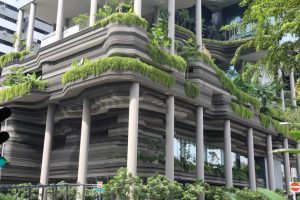
That is why structural integrity should never be treated as a secondary technical check undertaken late in the design process. It is one of the primary enablers of good greening outcomes, because it determines whether the design can be realised as intended, and whether it will continue to perform after the initial visual impact has passed. In traditional in-ground horticulture, we may focus heavily on soil improvement, site preparation and plant establishment in ways that are guided by the conditions of natural ground. In structural installations, however, the questions are different. We must understand what the supporting structure can carry, how loads are distributed, how water changes those loads, how planting zones are contained, how interfaces with built surfaces are protected, and how the whole system can be maintained without undermining safety or performance. The horticulture remains critically important, but it is now inseparable from the engineering logic of the installation itself. Take the example of the five-star, luxury Parkroyal Collection Pickering hotel in Singapore where greenery has been introduced to every level, vertical structure and void to hide grey elements of the building and integrate the built form into the natural form.
Plant Futures highlights this relationship particularly well because, as the Melbourne International Flower and Garden Show noted, the garden has been grown using a modular cultivation system. Plants were allowed to develop together in communities, while also framing the project as a blueprint for the future of urban planting, and confirming that the entire garden will be replanted into a public space after the show. Those details speak strongly to the value of coordinated thinking. Modularity is often discussed in terms of sustainability and reduced waste, and rightly so, but it also has a structural and logistical value that should not be overlooked. A modular approach can make complex greening installations more manageable by assisting with handling, staging, transportation, placement and eventual relocation, while also introducing a level of precision that is essential when landscape is being installed within a built framework rather than spread across open ground.
There is also a broader lesson here for the horticulture and green infrastructure sectors. Too often, greening is still perceived as something that can be layered onto a project once the main structural and construction decisions have already been resolved, when in fact the opposite is true. The most successful projects are those where the green layer is treated as integral from the beginning, not as decoration to be added later. If that integration does not occur early, the consequences can be significant. Drainage may be inadequate, loads may be underestimated, access for installation or maintenance may be poorly resolved, and the long-term life of the project may be placed under unnecessary pressure. These are not small oversights as they directly impact the viability of the landscape, and the confidence clients, asset owners and the broader public place in structurally installed greening systems.
This is especially worth noting in relation to temporary or event-based installations, because there can be a tendency to assume that if a project is not permanent, the structural considerations are somehow less important. In reality, temporary landscapes often demand even greater discipline, as they must be installed efficiently, perform immediately, remain safe in a public environment and, in some cases, transition into a second life beyond the event itself. Plant Futures demonstrates exactly this kind of thinking, with the Melbourne International Flower and Garden Show, emphasising its low-water planting palette, modular approach, integration of multi-use materials, reliance on local growers and suppliers, and post-show relocation. These are not just sustainability gestures, but signs of a project that has been conceived with care, practicality and long-term purpose.
For our industry, this should serve as a reminder that the future of urban greening will not be defined by planting alone, impressive though that planting may be. It will be defined by our ability to bring living systems into built environments with intelligence, rigour and respect for the structural conditions that support them. Structural integrity is not the opposite of creativity, nor does it diminish the horticultural richness of a project. In fact, it is what allows ambitious ideas to be realised with confidence, and what gives those ideas the strength to endure.
In the end, the most successful greening projects are those where the visible beauty above is matched by hidden strength below and within. That is the lesson structurally installed landscapes continue to teach us, and it is one that becomes more important with every new project that asks planting to do more within the built environment. Plant Futures, along with every other structural landscape, offers more than inspiration. It offers a practical example of how thoughtful collaboration, sustainable intent and structural discipline can come together to shape the future of greening in our cities.
Michael Casey
Director, Evergreen Infrastructure
National Urban Green Infrastructure Round Table (Co-founder)
World Ambassador for World Green Roofs Day
E: michael@evergreeninfrastructure.com.au