
Garden tech in action: Robotic mowers and drones
By David Khoury and Ian Turner
Maintaining expansive and diverse landscapes such as those at the Australian Botanic Garden Mount Annan (ABGMA) is no small feat. Covering 416 hectares on Dharawal Country in south-west Sydney, the Garden balances the needs of natural woodland conservation, open lawns, curated plant displays and visitor infrastructure. Traditional methods of maintenance can be time-consuming, labour-intensive and often dependent on fuel-powered machinery. This article reports on recent trials at ABGMA, where autonomous mowers and drones have been tested in real landscape conditions. These trials provide a glimpse of how automation and smart technology can be integrated into horticultural operations to improve outcomes and reshape daily practice.
As the horticulture industry seeks more sustainable and efficient approaches, new technologies are beginning to offer practical alternatives. Robotic lawn mowers and aerial drones, once seen as futuristic or niche, are now finding real-world applications in public gardens, parks and large landscapes.
Robotic lawn mowers: Efficiency on the ground
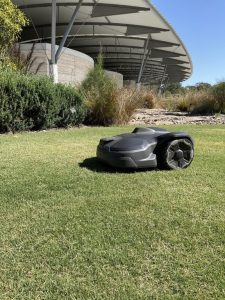
Robotic mowers are no longer just a novelty for suburban backyards. Advances in battery technology, navigation systems, and durability mean they are increasingly suited to commercial-scale use. In late 2024, the Natural Areas and Open Spaces team at ABGMA conducted a trial of the GPS-tracked and automated remote mowers. The trial site was our large Zoysia macrantha and Sunken Couch lawns adjacent to the Australian PlantBank and National Herbarium of NSW, areas previously maintained using a traditional diesel reel mower.
Trial setup and operation
With support from a local contractor, boundary wires were installed to define the mowing zones, and the robotic mower was programmed via a smartphone app. Once set, the mower required minimal human input, navigating the lawns autonomously and returning to its charging station when required.
Performance and features
The performance attributes and other features of this robotic mower are described below:
- Coverage: Designed for medium to large lawns, the mower can manage areas up to 2,200 m², including slopes of up to 35°.
- Battery life: A single charge allows 2.5 hours of continuous mowing, consuming the equivalent of a 60-watt light bulb.
- Noise and safety: Operating below 60 dB, the mower is significantly quieter than the typical reel mower, reducing noise pollution and occupational hearing risks.
- Lawn quality: The fine cutting action mulches clippings, returning nutrients to the soil and reducing waste.
- Sustainability: Battery operation eliminates diesel use, lowering both costs and emissions.
Staff feedback and outcomes
Staff reported immediate benefits in reduced manual mowing hours, improved turf appearance, and a quieter, less intrusive operation. The mower’s consistency meant lawns were kept in optimal condition with less intervention, freeing staff to focus on more specialised horticultural tasks. While robotic mowers cannot yet replace all traditional equipment, especially for complex or irregular areas, the trial showed clear benefits in efficiency, sustainability and visitor experience.
Aerial drones: Precision from above
If robotic mowers represent the next step in turf care, drones are revolutionising large-scale monitoring and pest management. At ABGMA, drones are increasingly used to supplement manual fieldwork in weed control, ecosystem monitoring and pest management.
Applications in weed management
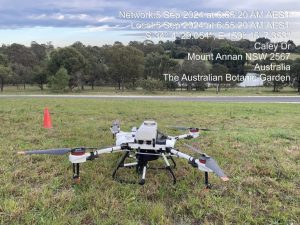
In partnerships, the Garden trialled drones equipped with both high-resolution mapping cameras and herbicide dispersal units. One major trial focused on the invasive Chilean needle grass (Nassella neesiana), a highly persistent weed across Australian landscapes.
Working with specific drone contractors, the process involved:
- Site mapping: Drones captured detailed imagery and weed distribution data, identifying the extent of infestations.
- Targeted application: Drones fitted with granular dispensers applied an appropriate specific herbicide directly onto affected areas.
The results were striking. Manual application methods had previously limited coverage. Staff could only carry and distribute 1 kg of herbicide at a time across challenging terrain. In contrast, drones applied up to 50 kg in a single day, treating over 28,000 m2 (2.3 hectares) with precision and efficiency.
Broader uses of drone technology
Beyond weed control, drones are proving valuable in:
- Biodiversity monitoring: Tracking vegetation health and canopy changes using NDVI or thermal imaging.
- Feral animal management: Mapping activity patterns and supporting targeted control efforts.
- Landscape planning: Producing aerial maps that assist with restoration, planting design and irrigation planning.
For staff, drones offer both a time-saving tool and a new way to collect data that was previously difficult or costly to obtain.
Cost, investment and value
Like all emerging technology, robotics and drones require upfront investment. The robotic mower retails in the commercial market for several thousand dollars, with additional costs for installation and occasional servicing. Drones vary widely, from a few thousand dollars for camera-equipped models to tens of thousands for advanced agricultural units with spraying or seeding capacity.
However, the long-term savings are compelling:
- Reduced labour costs: Freeing skilled staff for higher-value horticultural work.
- Fuel and emissions savings: Cutting diesel consumption aligns with sustainability goals.
- Improved coverage: Enabling more effective management of large or difficult areas.
- Visitor experience: Quieter, less intrusive maintenance improves the ambience of public gardens.
When viewed against the ongoing costs of traditional equipment and labour, the value proposition of robotics and drones becomes clear.
Looking ahead: Where next for garden tech?
The ABGMA trials highlight the potential for smart technology to reshape horticulture, but they also underscore the need for careful integration.
- Robotic mowers are best suited to well-defined lawns and regularly maintained turf. Future models may overcome current limitations in terrain and coverage.
- Drones are highly versatile and likely to expand into new roles from weed detection to aerial seeding for habitat restoration. As regulations around pilot licensing and chemical application evolve, their adoption will likely grow across public gardens and natural reserves.
- Staff training and engagement will be critical. New technologies do not replace skilled horticulturists but rather enhance their capacity, allowing them to focus on conservation, plant curation and visitor engagement.
The future of horticulture will likely be a hybrid model: skilled people supported by autonomous systems, delivering care for plants and landscapes at scales previously unimaginable.
Conclusion
The trials of robotic mowers and drones at ABGMA have provided valuable insights into the practical benefits and challenges of adopting emerging technology. From quieter, emission-free lawn care to precision weed management across hectares of difficult terrain, these tools are already making a measurable impact. As costs fall and capabilities expand, it is reasonable to expect that robotics and drones will move from trial novelty to everyday necessity in the management of public gardens, parks and large green spaces. For the horticulture industry, the challenge will not be whether to adopt these technologies, but how best to integrate them into long-term strategies for sustainable, efficient and high-quality garden care.
All images supplied by the authors.
David Khoury and Ian Turner
Australian Botanic Garden Mount Annan