
Saltbushes of the world
By Clive Larkman
Plants are divided into a series of logical groups based on their botanical characteristics, a result of the work commenced by noted Swedish botanist and physician Carl Linnaeus in the early 18th century. Since that time, the science of classifying plants has developed greatly, and the decisions to move plants into or out of taxonomic categories are made based on increasingly smaller differences, thus becoming more technical. As a result, plant taxonomists have moved many individual species between genera and occasionally families. Sometimes it is hard for the novice to follow these changes, but they are often the work and debate of many academics.
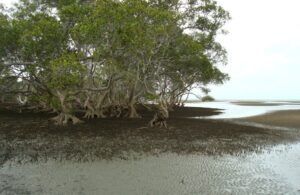
There are groups of plants that span families, genera, countries and even continents. They are plants that have evolved to deal with specific environmental conditions and have done so in remarkably similar ways. The most extensive of these would have to be what are called the ‘true mangroves’, which occur from latitudes 40º S to 30º N across all continents. For example, the grey mangrove (Avicennia marina) occurs in Westernport Bay and Corner Inlet in southern Victoria while the red mangrove (Rhizophora mangle) occurs in central/southern Florida and the Caribbean. This is what is referred to as convergent evolution where unrelated species independently develop similar traits or features because they adapt to similar environments or ecological niches, not because they inherited them from a common ancestor. Currently, there are over seventy species of true mangroves across more than 20 genera in around 15 families.
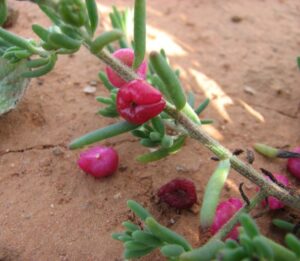
Samphires are another plant group demonstrating convergent evolution. Samphires are known to occur across at least six families and ten genera across Europe, Asia, USA and Australia. Like mangroves, samphires have adapted to harsh conditions where very high levels of salt are present. Both groups are referred to as halophytes, a term which literally means a plant that has adapted to high saline conditions.
Another interesting group that also consists of halophytes is the range of plants commonly called saltbushes. Saltbushes are found all over the world and the term covers plants from five genera across two families with the largest genus being Atriplex The other four are Chenopodium, Enchylaena, Rhagodia and Sarcobatus.
Chenopodium is a small genus which has had multiple taxonomic revisions over the years. Berry saltbush, Chenopodium robertianum (Syn. Einadia hastata) is native to eastern Australia. It is a small plant with green flowers in summer. It is closely related to Atriplex and is also in the family Chenopodiaceae. Not as widely found as most of the other Australian saltbushes, C. robertianum still produces edible berries and salty foliage. Whilst edible, the berries do have a bitter taste so are used relatively minimally. The foliage can be boiled to produce a salty water as a flavouring. I am sure there would have been localised usage, however, this is not well documented.
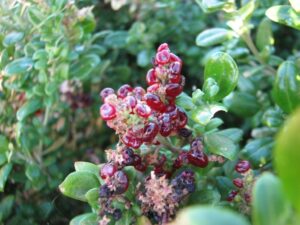
Enchylaena is an Australian genus in the Chenopodiaceae containing only two species, Enchylaena tomentosa (ruby saltbush) and E. lanata (barrier saltbush). Ruby saltbush is found over most of the arid parts of Australia. Its ripened fruit is picked and eaten raw and has a sweet and salty flavour. Indigenous groups across the country have used the fruits and, in some places, the foliage as a regular part of their diet. This saltbush is also useful as a foraging source in drier times of the year, such as late summer and drought periods when other nutritious forage plants are unavailable. It is also popular in many modern restaurants for the salty flavours of its fruit and foliage. Barrier saltbush looks very similar to ruby saltbush but has yellow berries and only occurs in south-western Australia. It prefers similar conditions and was/is used in similar ways.
Rhagodia is another Australian saltbush genus in the Chenopodiaceae that thrives in a variety of soil types, particularly in the arid areas of this country. There are eleven accepted species in this genus, although there are many that are grouped under Chenopodium or even Atriplex. The three most common species are Rhagodia baccata (berry saltbush), R. candolleana (seaberry saltbush) and R. spinescens (creeping saltbush). The plants are evergreen shrubs or groundcovers. Most have silver foliage and red or white berries that are popular as bush food and alternative stock fodder. They add contrasting colours and textures to the garden and the dense growth makes them a quality alternative for hedging or groundcover mats. Their drought-tolerant nature makes them useful in the hot dry gardens of inland Australia.
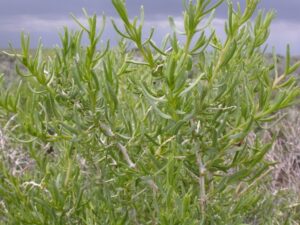
The fourth genus, Sarcobatus is a North American genus consisting of two species, S. vermiculatus (greasewood or saltbush) and S. baileyi (Nevada saltbush). Formerly listed in the family Chenopodiaceae, this genus is now classed in the monotypic Sarcobataceae. S. vermiculatus occurs from southwest Canada down the west coast of USA into northern Mexico. S. baileyi only occurs in and around the state of Nevada. Sarcobatus plants are deciduous shrubs growing to 1-2.5 metres tall with spiny branches and succulent foliage. The leaves are green in contrast to the grey-green of most of the saltbushes. The two species reproduce from seed and sprouts. Unlike other saltbushes, Sarcobatus plants are not widely grown as a food source for stock or human consumption as they contain high levels of oxalates which can cause kidney failure. However, they are used for their timber which is yellow, very hard and tough, its hardness useful for making arrow shafts.
Finally, we get to the fifth and final genus of the saltbushes identified in this article, Atriplex, another member of the Chenopodiaceae. Atriplex is a very large genus which includes over 200 species from around the world. So, I will profile it in my next article and include cooking tips for all the saltbushes described here.