
Merchandising for maximum impact, minimum spend
By John Fitzsimmons
Garden centre operators have many opportunities to improve merchandising and increase sales volumes. As practical demonstrations at the Garden Inspiration Group’s 2026 gathering in Melbourne showed, these improvements need not necessarily be costly.
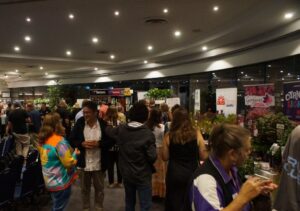
The Garden Inspiration Group (GIG) invited key staff from independent garden centres to its annual function at The Manningham in Bulleen on 2 March 2026. Guest presenters, Carolyn and Joby Blackman from Vivid Design demonstrated creative ways to display and engage customers with product placement and cross merchandising. Horticulturist Carolyn and her landscape designer husband Joby have worked locally and internationally.
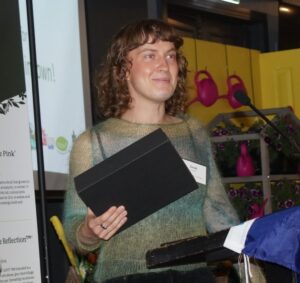
Carolyn combined her horticultural and design experience with energy and enthusiasm to inspire the audience to make things ‘shoppable’. ‘The idea tonight is to create design inspiration within garden centre spaces that is both affordable and doable, using materials that may already be in the garden centre or even in hard rubbish, that we can use to inspire the creation of small achievable pockets of interest in the garden centre’, Carolyn said.
Carolyn has drawn inspiration from successful specialist retailers including Mecca and Sephora. She explained that Sephora understands the power of contrast in visual merchandising and succeeds by selling systems and solutions, rather than simply arranging products into categories. In many garden centres, by contrast, products are still grouped in traditional categories such as potting mixes or fertilisers. At Mecca, she noted, the entire retail experience is designed around interconnected product systems. Customer experience is prioritised over pure transaction, with education and inspiration forming part of the offer.
‘People value it and love it,’ Carolyn said. ‘They feel like they are being educated and given insight and knowledge while having an amazing experience. The education and inspiration are the favour, the expertise, the reason you went there.’
Drawing on these examples, Carolyn challenged the audience to consider how garden centres could apply the same thinking to their own businesses by presenting products as integrated gardening solutions rather than isolated items.
‘What is that in your nursery?’ she asked. ‘Is it the shrub and groundcover that grow together? Is it the potting mix, planting mix or compost? The clay breaker, fertiliser or plant starter, the liquid fertiliser and then the pelletised fertiliser? What is your nursery’s equivalent of Mecca’s moisturiser system? Which of your products give customers the best experience and the feeling they have been educated?’
Carolyn then demonstrated how even well-designed garden centres can become visually dominated by green. Introducing strong points of difference, particularly through colour contrast, can break this monotony and draw attention to specific areas of the store. High-impact contrasts such as black and white, or bold colour combinations, can help distinguish key displays and guide customers through the space.
Understanding colour relationships can have a significant effect. Carolyn pointed to the use of green’s opposite on the colour wheel, red, as one example, as well as striking combinations such as magenta or bright pink against yellow and green. ‘Colour contrast is amazingly memorable and eye-catching,’ she said. ‘Colour is emotive. It is memorable and people connect with it, and it does not necessarily take much to achieve.’
Repetition is another powerful retail design principle. Creating repeated ‘runs’ of products can establish rhythm and visual impact, while variation in height and layering can add further interest. Simple tools such as wheeled platforms, old trolleys or pallets can be used effectively to elevate products and create layered displays, particularly when combined with contrasting colours.
At the same time, Carolyn emphasised that displays must remain practical for customers. ‘One important thing when you create something in your nursery is that it still needs to be shoppable,’ she said, ‘Sometimes you walk into beautiful stores where everything looks so perfect you feel like you should not touch anything. Create the display that everybody notices but still make it clear that the products are for sale. Break the display apart slightly so it does not look too perfect and include identifiable retail benches so it clearly signals that customers can buy from it. It needs to be visually interesting and captivating. It should stop people in their tracks and create a picture or a theme, but customers must still be able to buy the products.’
Carolyn also noted how strongly cosmetic retailers value botanical ingredients. ‘Botanicals are seen as the premium product and are highly regarded,’ she said. ‘If we cannot take something from that, then I do not know.’ She pointed out that Mecca has recently expanded this concept further, with its Melbourne store now selling flowers and herbal botanical products through an in-store apothecary supported by an on-site naturopath.
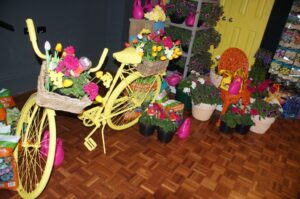
Working under the brief of ‘fast, furious, cheap and doable’, GIG members demonstrated how simple props and recycled materials could be used to create impactful retail displays integrating the marketing principles Carolyn outlined. Using items such as old ladders, crates and bicycles, the group constructed four display vignettes designed to be easily reproduced in garden centres anywhere.
To help attendees replicate these ideas, ‘recipe cards’ outlining each display concept were included in the GIG showbags to spark design inspiration and encourage experimentation. Each vignette began with a simple framework of two or three pallets, with divider back walls created from old doors or slatted panels, and were themed as follows:
Black Tie: A sophisticated display built around black backgrounds and elegant black-and-white pots arranged at varying heights. The vignette showcased striking foliage plants including Astilbe ‘Dark Side of the Moon’, Hebe ‘Chocolate Box’, Heuchera ‘Black Taffeta’ and Euphorbia ‘Miner’s Merlot’.
Coastal Cottage: This vignette centred on a beach umbrella and an old deck chair, with IKEA decking placed over pallets to create a platform. A wall-mounted ‘post-swim’ shower set, and towels formed part of the backdrop, with hardy coastal plants displayed in an old trug and on repurposed timber cabinets.
Spring’s Up: A bright display dominated by strong orange and yellow tones. An old bicycle, café table and chairs, and character doors formed the backdrop, while seasonal bulb packs, potted greenlife, potting mix, colourful watering cans and decorative pots completed the display.
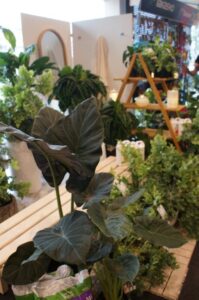
Wellness: Designed to evoke calm and relaxation, this display featured cool white backgrounds, mirrors and natural timber furniture. These elements contrasted with the diverse textures and forms of lush green indoor plants.
A year of ups, downs and opportunity
GIG MC Mike Donsen reflected on what he described as an ‘up-and-down’ year for the garden centre industry. Melbourne’s iconic Acorn Nursery site was saved from development, while the equally well-known Poynton’s Nursery site was not, and Diacos’ Keilor nursery closed. Trading conditions played a role in some closures, but for many garden centres, rising government land taxes remain a critical factor affecting long-term viability. The industry was also saddened by the fire that destroyed Colchester Nursery and by the loss of Kieron Hart of Greengold Nursery in the ACT.
There were also positive developments. The Greenery Heidelberg was upgraded following its acquisition by the Humphris family, joining a rebranded Greenery store at Mount Evelyn. Kuranga Nursery acquired the well-known Beasley’s garden centre.
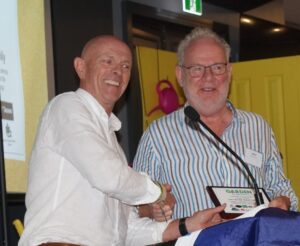
Mike Donsen acknowledged the long-standing contributions of the Beasley family to the industry, presenting an award to second-generation members Bill and Neil. Additional awards were presented to the van der Horst family of Acorn Nursery and to Sarah Poynton, who received the 2026 GIG Champion Award.
Reflecting on the future of the sector, Donsen also highlighted the need for new garden centres in growing urban areas: ‘One thing that has become really apparent to me is that there are now large geographic areas that need garden centres. Take the Clyde–Berwick–Narre Warren corridor in Melbourne’s outer south-east, for example. There are very few centres serving that region. With Poyntons leaving its site, there will be even less on the eastern side of the city. We need to keep independent nurseries vibrant, strong and proactive. I am encouraged to see so many younger people in the industry, because they will play a key role in making that happen.’